Iranian high-ranking officials suffer successive attacks, oil prices hit rock bottom, institutions warn of impending new storm.
2026-03-18 18:12:25
During the Asian and European trading sessions on March 18, international oil prices experienced a significant rebound after hitting a low.
WTI crude oil futures fell by more than 4.5% at one point during the session, and are currently trading at $94.12 per barrel, with the daily decline narrowing to 1.48%. The market is experiencing an exceptionally fierce battle between bulls and bears, influenced by both geopolitical conflicts and improved supply.
Following the death of Iranian Supreme National Security Council Secretary Larijani, Israel has delivered another major piece of news.
Israeli media, citing officials, reported that the Israeli military carried out an attack on Iranian Intelligence Minister Esmail Khatib on the night of March 17 and is currently awaiting the outcome. These unexpected military developments have significantly curbed the rapid rise in oil prices.
Despite the ongoing conflict, approximately 90 ships continue to pass through the Strait of Hormuz, and Iranian oil exports remain at the level of millions of barrels. Shipping data shows that some ships are circumventing Western sanctions through clandestine transportation, while vessels from countries such as India and Pakistan have also successfully transited the strait with diplomatic coordination.
From March 1st to 15th, a total of 89 ships passed through the strait, including 16 oil tankers. More than one-fifth of these were related to Iran, while the rest were mainly Chinese-owned or Greek-flagged vessels. Some ships claimed Chinese ownership and crew to reduce the risk of attack.
A key easing signal has emerged on the supply side as Iraq and Kurdish authorities have reached an agreement to resume crude oil exports via Türkiye's Ceyhan port starting March 18.
This news directly caused oil prices to fall by more than $2 per barrel, temporarily easing market panic over supply disruptions.
To stabilize oil prices, the United States has tacitly allowed Iranian oil tankers to pass through its territory. The US Treasury Secretary stated that allowing Iranian vessels to transport oil is crucial for ensuring global supply. Although the US military bombed Iranian military facilities on Kharg Island, Trump clearly indicated that Iran's oil infrastructure would be preserved for the time being, demonstrating significant policy flexibility.
The situation quickly became tense again, with the Iranian Foreign Minister making it clear that Iran was ruling out a ceasefire.
Majid Mousavi, commander of the Aerospace Force of the Islamic Revolutionary Guard Corps of Iran, issued a strong statement announcing plans to launch the “strongest retaliatory strike to date” against the enemy, and emphasized that hostile forces have no chance of defeating Iran. The strong statement quickly boosted risk aversion in the market.
Hirofumi Suzuki, chief foreign exchange strategist at Sumitomo Mitsui Banking Corporation, said that although the upward momentum of crude oil prices has temporarily stalled, this does not mean that the market situation has improved significantly; currently, various markets are only showing a certain degree of recovery.
Salman Ahmed, Global Head of Macro and Strategic Asset Allocation at Fidelity International, said at a webinar on Wednesday that oil is very inelastic in the short term and prices are likely to remain high in the near future.
Goldman Sachs data shows that crude oil flows through the Strait of Hormuz have stabilized at a fraction of previous levels, averaging about 500,000 barrels per day over four days, a 98% decrease from pre-war levels, or a reduction of about 19.5 million barrels per day. Meanwhile, other oil-producing countries are seeking alternative routes. Iraq has reached an agreement with the Kurdish region to resume exports via Turkey; Saudi Arabia is diverting some of its crude oil to the Red Sea port of Yanbu; and the UAE is utilizing the port of Fujairah in the Gulf of Oman. These alternatives have helped reduce regional crude oil outflows from an average of 17 million barrels per day earlier this week to 14.9 million barrels per day on Tuesday.
ING Group has warned that if Iran intends to exert pressure by pushing up energy prices, the number of oil tankers it allows to pass through the Strait of Hormuz could be significantly limited. This would further exacerbate oil price volatility and have a sustained impact on the US dollar index and global commodity markets. Analysts point out that the Strait of Hormuz is not completely closed, but rather "selectively blocked," prioritizing Iranian exports.
International oil prices remain highly volatile, and key statements from various parties can quickly influence price movements. Investors may choose to wait and see rather than take action, or buy on dips when news causes market panic.
From a technical perspective, oil prices have fallen below the 5-day moving average and the 0.618 Fibonacci retracement level. If they cannot quickly return to above 96, there is a possibility of weakness, indicating that the market is betting on a de-escalation of the conflict and the emergence of various alternative solutions that would alleviate concerns about crude oil supply.
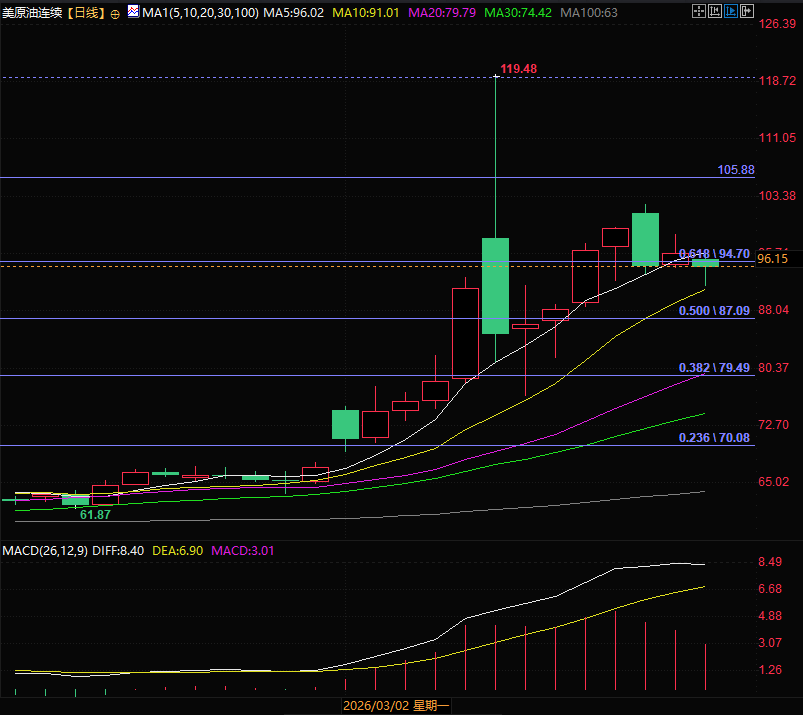
(WTI crude oil futures daily chart, source: EasyForex)
At 18:09 Beijing time, WTI crude oil futures were trading at $94.09 per barrel.
WTI crude oil futures fell by more than 4.5% at one point during the session, and are currently trading at $94.12 per barrel, with the daily decline narrowing to 1.48%. The market is experiencing an exceptionally fierce battle between bulls and bears, influenced by both geopolitical conflicts and improved supply.
Geopolitical strife: A series of attacks on Iranian high-ranking officials put short-term pressure on oil prices.
Following the death of Iranian Supreme National Security Council Secretary Larijani, Israel has delivered another major piece of news.
Israeli media, citing officials, reported that the Israeli military carried out an attack on Iranian Intelligence Minister Esmail Khatib on the night of March 17 and is currently awaiting the outcome. These unexpected military developments have significantly curbed the rapid rise in oil prices.
Supply-side positive news: Iraq resumes exports, causing a sharp short-term drop in oil prices.
Despite the ongoing conflict, approximately 90 ships continue to pass through the Strait of Hormuz, and Iranian oil exports remain at the level of millions of barrels. Shipping data shows that some ships are circumventing Western sanctions through clandestine transportation, while vessels from countries such as India and Pakistan have also successfully transited the strait with diplomatic coordination.
From March 1st to 15th, a total of 89 ships passed through the strait, including 16 oil tankers. More than one-fifth of these were related to Iran, while the rest were mainly Chinese-owned or Greek-flagged vessels. Some ships claimed Chinese ownership and crew to reduce the risk of attack.
A key easing signal has emerged on the supply side as Iraq and Kurdish authorities have reached an agreement to resume crude oil exports via Türkiye's Ceyhan port starting March 18.
This news directly caused oil prices to fall by more than $2 per barrel, temporarily easing market panic over supply disruptions.
To stabilize oil prices, the United States has tacitly allowed Iranian oil tankers to pass through its territory. The US Treasury Secretary stated that allowing Iranian vessels to transport oil is crucial for ensuring global supply. Although the US military bombed Iranian military facilities on Kharg Island, Trump clearly indicated that Iran's oil infrastructure would be preserved for the time being, demonstrating significant policy flexibility.
Iran takes a hard line: no ceasefire ruled out, vows strongest retaliation.
The situation quickly became tense again, with the Iranian Foreign Minister making it clear that Iran was ruling out a ceasefire.
Majid Mousavi, commander of the Aerospace Force of the Islamic Revolutionary Guard Corps of Iran, issued a strong statement announcing plans to launch the “strongest retaliatory strike to date” against the enemy, and emphasized that hostile forces have no chance of defeating Iran. The strong statement quickly boosted risk aversion in the market.
Institutional View: Oil Price Rise Pauses, Market Has Not Truly Improved
Hirofumi Suzuki, chief foreign exchange strategist at Sumitomo Mitsui Banking Corporation, said that although the upward momentum of crude oil prices has temporarily stalled, this does not mean that the market situation has improved significantly; currently, various markets are only showing a certain degree of recovery.
Salman Ahmed, Global Head of Macro and Strategic Asset Allocation at Fidelity International, said at a webinar on Wednesday that oil is very inelastic in the short term and prices are likely to remain high in the near future.
Goldman Sachs data shows that crude oil flows through the Strait of Hormuz have stabilized at a fraction of previous levels, averaging about 500,000 barrels per day over four days, a 98% decrease from pre-war levels, or a reduction of about 19.5 million barrels per day. Meanwhile, other oil-producing countries are seeking alternative routes. Iraq has reached an agreement with the Kurdish region to resume exports via Turkey; Saudi Arabia is diverting some of its crude oil to the Red Sea port of Yanbu; and the UAE is utilizing the port of Fujairah in the Gulf of Oman. These alternatives have helped reduce regional crude oil outflows from an average of 17 million barrels per day earlier this week to 14.9 million barrels per day on Tuesday.
ING Group has warned that if Iran intends to exert pressure by pushing up energy prices, the number of oil tankers it allows to pass through the Strait of Hormuz could be significantly limited. This would further exacerbate oil price volatility and have a sustained impact on the US dollar index and global commodity markets. Analysts point out that the Strait of Hormuz is not completely closed, but rather "selectively blocked," prioritizing Iranian exports.
Summary and Technical Analysis:
International oil prices remain highly volatile, and key statements from various parties can quickly influence price movements. Investors may choose to wait and see rather than take action, or buy on dips when news causes market panic.
From a technical perspective, oil prices have fallen below the 5-day moving average and the 0.618 Fibonacci retracement level. If they cannot quickly return to above 96, there is a possibility of weakness, indicating that the market is betting on a de-escalation of the conflict and the emergence of various alternative solutions that would alleviate concerns about crude oil supply.
(WTI crude oil futures daily chart, source: EasyForex)
At 18:09 Beijing time, WTI crude oil futures were trading at $94.09 per barrel.
- Risk Warning and Disclaimer
- The market involves risk, and trading may not be suitable for all investors. This article is for reference only and does not constitute personal investment advice, nor does it take into account certain users’ specific investment objectives, financial situation, or other needs. Any investment decisions made based on this information are at your own risk.