On the eve of the Fed's dot plot release, the dollar's pullback from its highs did not diminish its resilience.
2026-03-18 18:26:44
On Wednesday (March 18), during the European session, the US dollar index fluctuated narrowly between 99.50 and 99.60, weakening slightly by about 0.01% to 0.07%, failing to continue the high of around 100.54 reached last week. It has seen a slight pullback this week, but still recorded consecutive gains over the past two weeks, with a monthly increase of about 1.9%.
The main reason for this situation with the US dollar is that the ongoing conflict with Iran has pushed up oil prices and inflation expectations, while traders are waiting for today's FOMC meeting and profit-taking has led to a short-term profit giveback.
Fundamental analysis
The Federal Reserve's FOMC meeting : The market widely expects the Fed to keep the federal funds rate unchanged at 3.50%-3.75%, but the focus is on the dot plot (the path of rate cuts in 2026) and Powell's press conference. High oil prices have led the market to reduce its expectation of rate cuts in 2026 to about 25 basis points. If the dot plot is hawkish (reducing the number of rate cuts) or Powell's remarks are cautious, it will directly boost the dollar's interest rate advantage; conversely, if it is unexpectedly dovish, it may trigger a short-term correction, but geopolitical risks will quickly provide support.
Middle East geopolitical conflicts and oil prices : The war involving Iran has driven up crude oil prices, exacerbating Europe's reliance on energy imports and raising inflation concerns. The United States, as a net energy exporter, benefits, strengthening the safe-haven status of the dollar and its relative economic resilience. If the conflicts show no signs of a rapid de-escalation, the dollar's safe-haven status will continue.
Today's PPI data : February's PPI year-on-year rate is expected to be 2.9%, and the month-on-month rate is 0.5%. If the actual data exceeds or meets expectations, it will further confirm inflationary pressures, support the Fed's cautious stance, and benefit the US dollar; if it is weaker, it will alleviate some pressure but have a smaller impact.
Factory orders and EIA crude oil inventories : January factory orders are expected to decline by 0.7% month-on-month. Crude oil inventory data will affect energy prices and provide indirect support for the US dollar.
mainstream view
Viewpoint 1: The US dollar index is flat around 99.60, with traders awaiting the FOMC decision; tensions in the Middle East may support the dollar, and any hawkish comments are favorable for the dollar given the expectation of unchanged interest rates.
Viewpoint 2: The US dollar weakened due to falling US Treasury yields; attention should be paid to profit-taking ahead of the Fed meeting. The US dollar index has significant support around 99.50, and a rebound is possible near the 200-day moving average. The US dollar has retreated from its 2026 high of around 100.54, but its strong upward trend remains unchanged. If the FOMC dot plot is hawkish or oil prices remain high, it will strengthen the upward momentum.
Technical Analysis
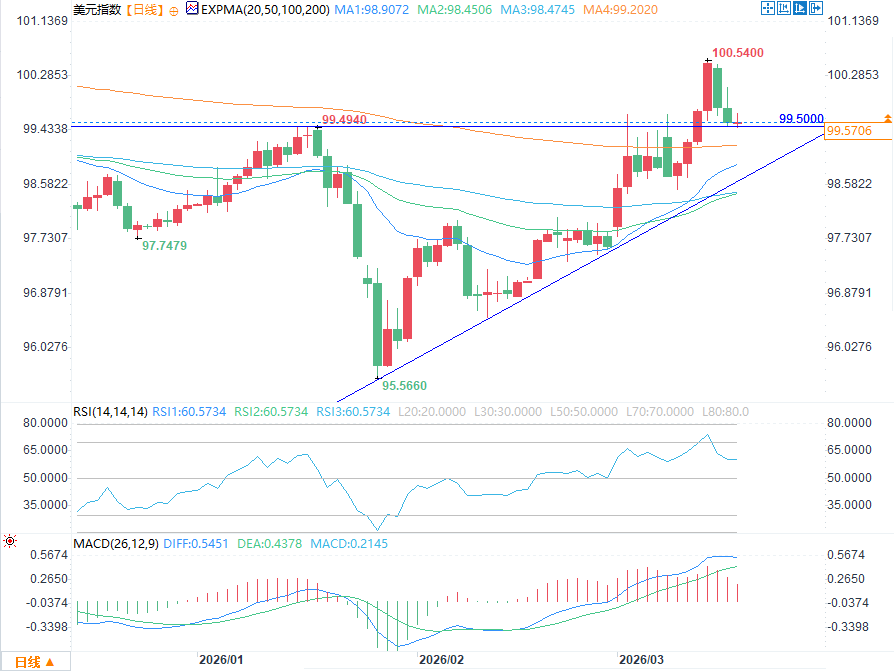
(US Dollar Index Daily Chart Source: FX678)
The US dollar index is in an upward channel on the daily chart and is currently testing the key support level of 99.50 (the nine-day moving average and a psychological level). If it holds, it may rebound to 100.54 (a high in nearly 10 months) or even the upper channel line of 101.00.
The 4-hour chart shows a slight weakening trend, but the MACD golden cross remains valid. Short-term resistance is at 99.80-100.00. A break below 99.50 would target the 99.00 level.
The RSI (14) fell from above 70 to 59, easing overbought pressure but still showing bullish momentum. It is appropriate to pay attention to support rebound signals.
Financial History
20:30: US February PPI (Year-on-Year/Month-on-Month) – Key Inflation Data
22:00: US January Factory Orders (MoM) - Manufacturing Reference
22:30: EIA Crude Oil Inventories – Impact on Oil Prices
02:00: Federal Reserve interest rate decision + FOMC meeting statement + Powell press conference (Important, pay attention to the dot plot and expectations of a rate cut in 2026)
Frequently Asked Questions
The main reason for this situation with the US dollar is that the ongoing conflict with Iran has pushed up oil prices and inflation expectations, while traders are waiting for today's FOMC meeting and profit-taking has led to a short-term profit giveback.
Fundamental analysis
The Federal Reserve's FOMC meeting : The market widely expects the Fed to keep the federal funds rate unchanged at 3.50%-3.75%, but the focus is on the dot plot (the path of rate cuts in 2026) and Powell's press conference. High oil prices have led the market to reduce its expectation of rate cuts in 2026 to about 25 basis points. If the dot plot is hawkish (reducing the number of rate cuts) or Powell's remarks are cautious, it will directly boost the dollar's interest rate advantage; conversely, if it is unexpectedly dovish, it may trigger a short-term correction, but geopolitical risks will quickly provide support.
Middle East geopolitical conflicts and oil prices : The war involving Iran has driven up crude oil prices, exacerbating Europe's reliance on energy imports and raising inflation concerns. The United States, as a net energy exporter, benefits, strengthening the safe-haven status of the dollar and its relative economic resilience. If the conflicts show no signs of a rapid de-escalation, the dollar's safe-haven status will continue.
Today's PPI data : February's PPI year-on-year rate is expected to be 2.9%, and the month-on-month rate is 0.5%. If the actual data exceeds or meets expectations, it will further confirm inflationary pressures, support the Fed's cautious stance, and benefit the US dollar; if it is weaker, it will alleviate some pressure but have a smaller impact.
Factory orders and EIA crude oil inventories : January factory orders are expected to decline by 0.7% month-on-month. Crude oil inventory data will affect energy prices and provide indirect support for the US dollar.
mainstream view
Viewpoint 1: The US dollar index is flat around 99.60, with traders awaiting the FOMC decision; tensions in the Middle East may support the dollar, and any hawkish comments are favorable for the dollar given the expectation of unchanged interest rates.
Viewpoint 2: The US dollar weakened due to falling US Treasury yields; attention should be paid to profit-taking ahead of the Fed meeting. The US dollar index has significant support around 99.50, and a rebound is possible near the 200-day moving average. The US dollar has retreated from its 2026 high of around 100.54, but its strong upward trend remains unchanged. If the FOMC dot plot is hawkish or oil prices remain high, it will strengthen the upward momentum.
Technical Analysis
(US Dollar Index Daily Chart Source: FX678)
The US dollar index is in an upward channel on the daily chart and is currently testing the key support level of 99.50 (the nine-day moving average and a psychological level). If it holds, it may rebound to 100.54 (a high in nearly 10 months) or even the upper channel line of 101.00.
The 4-hour chart shows a slight weakening trend, but the MACD golden cross remains valid. Short-term resistance is at 99.80-100.00. A break below 99.50 would target the 99.00 level.
The RSI (14) fell from above 70 to 59, easing overbought pressure but still showing bullish momentum. It is appropriate to pay attention to support rebound signals.
Financial History
20:30: US February PPI (Year-on-Year/Month-on-Month) – Key Inflation Data
22:00: US January Factory Orders (MoM) - Manufacturing Reference
22:30: EIA Crude Oil Inventories – Impact on Oil Prices
02:00: Federal Reserve interest rate decision + FOMC meeting statement + Powell press conference (Important, pay attention to the dot plot and expectations of a rate cut in 2026)
Frequently Asked Questions
Q1: Why has the US dollar index maintained a strong overall trend recently?
A1: This is mainly due to the escalating conflict between Iran and the Middle East, which has driven up global energy prices and inflation expectations. As a net energy exporter, the United States has benefited relatively. At the same time, the Federal Reserve has reduced its expectations for interest rate cuts in 2026 due to inflationary pressures, strengthening the dollar's interest rate advantage and safe-haven appeal. Even if short-term data is weak, geopolitical risks have quickly offset the downside potential.
Q2: What is the core impact of today's FOMC meeting on the US dollar?
A2: Interest rates are likely to remain unchanged, but the dot plot and Powell's speech will determine the policy path in 2026. If the number of rate cuts is reduced due to oil price inflation (more hawkish), the dollar will be significantly boosted; if the expectation of rate cuts is maintained or increased (dovish), there may be a short-term pullback, but tensions in the Middle East will quickly provide support, making the overall outlook positive for the dollar.
Q3: How exactly does the Middle East conflict support the demand for the US dollar as a safe haven?
A3: The conflict caused oil prices to surge, increasing European energy import costs and exacerbating economic pressures, while the US's energy independence benefited it. Investors turned to dollar assets for safety, coupled with support from US Treasury yields, boosting demand for the dollar index. Even if the conflict eases, high oil prices in the short term will maintain inflation concerns, thus indirectly benefiting the dollar.
Q4: What chain reaction will occur on the US dollar if the PPI data exceeds expectations?
A4: If the February PPI data is higher than expected, it will further confirm inflationary pressures, strengthen market expectations of a cautious stance from the Federal Reserve, reduce pricing in interest rate cuts, and directly boost the dollar exchange rate. Conversely, if it is weaker, although it will alleviate pressure in the short term, its impact will be limited under the prevailing geopolitical risks and will not change the overall strong tone.
Q5: What risk factors should investors pay close attention to in the current environment?
A5: First, the FOMC's unexpectedly dovish stance led to profit-taking; second, a sudden easing of tensions in the Middle East or the release of peace signals weakened safe-haven demand as oil prices fell; and third, persistently weak US economic data exposed concerns about growth. It is recommended to dynamically adjust positions based on oil prices and the dot plot, and to be wary of sudden news events causing sharp fluctuations in exchange rates.
- Risk Warning and Disclaimer
- The market involves risk, and trading may not be suitable for all investors. This article is for reference only and does not constitute personal investment advice, nor does it take into account certain users’ specific investment objectives, financial situation, or other needs. Any investment decisions made based on this information are at your own risk.