The Fed's decision in the early hours! The dot plot may see slight changes; the real drama is yet to come.
2026-03-18 19:53:17
The Federal Reserve's interest rate decision early Thursday morning (March 19, 2:00 AM) is highly anticipated. Amidst current geopolitical tensions, particularly the severe disruption to shipping in the Strait of Hormuz caused by the US-Iran conflict, crude oil prices have fluctuated significantly. WTI crude oil futures prices recently approached $97 per barrel before falling back to the $94-95 per barrel range, while Brent crude oil prices are trading above $100 per barrel, reflecting continued escalating market concerns about energy supply disruptions.
The US dollar index is currently hovering around 99.5-100, and financial conditions have tightened somewhat. The Federal Reserve is expected to maintain the target range for the federal funds rate at 3.50%-3.75%, with market pricing indicating a near 99% probability of this. The Fed is also signaling a "wait-and-see" approach through its latest Summary of Economic Projections (SEP) and dot plot, in response to potential upward pressure on inflation and uncertainty in economic activity.
The policy statement from this meeting is expected to see only limited adjustments. The first paragraph may shift its description of economic activity from "solid" to "moderate," reflecting a slowdown in growth momentum in recent data. The second paragraph may add a mention of increased uncertainty stemming from geopolitical conflicts, which could push up inflation and exert downward pressure on economic activity in the short term, but would not alter the overall risk balance assessment. The forward guidance section is likely to remain unchanged, continuing to emphasize that the "degree and timing of additional adjustments" will depend on data. Two governors (Milan and Waller) are likely to continue voting against rate cuts, but the number of dissenters is not expected to increase significantly, indicating that internal resistance to immediate easing remains strong.
The SEP update is the focus of this meeting. The Federal Reserve is likely to raise its forecasts for inflation and unemployment while lowering its economic growth expectations to reflect the potential transmission of rising energy prices to prices and their impact on demand. The dot plot is expected to remain relatively restrained, showing only one rate cut (25 basis points) in 2026 and another in 2027, with the long-term median interest rate remaining at 3.0%. This is largely in line with the market's previous pricing of a cumulative rate cut of approximately 26 basis points this year, and approximately 35 basis points by June 2027.
The following is a comparison of key economic forecast medians (typical adjustment directions based on recent trend inferences):
Powell is expected to maintain a neutral stance, emphasizing that decision-making is data-dependent. He may point out that tighter financial conditions have already offset some of the inflationary pressures from rising energy prices, and there is no need to rush into disrupting market expectations with policy changes. Regarding the disruption to shipping in the Strait of Hormuz, he may downplay the persistence of the short-term impact while reiterating the balance between the Fed's dual mandate (price stability and full employment). The overall tone will avoid creating panic, focusing on observing the evolution of subsequent inflation and growth data.
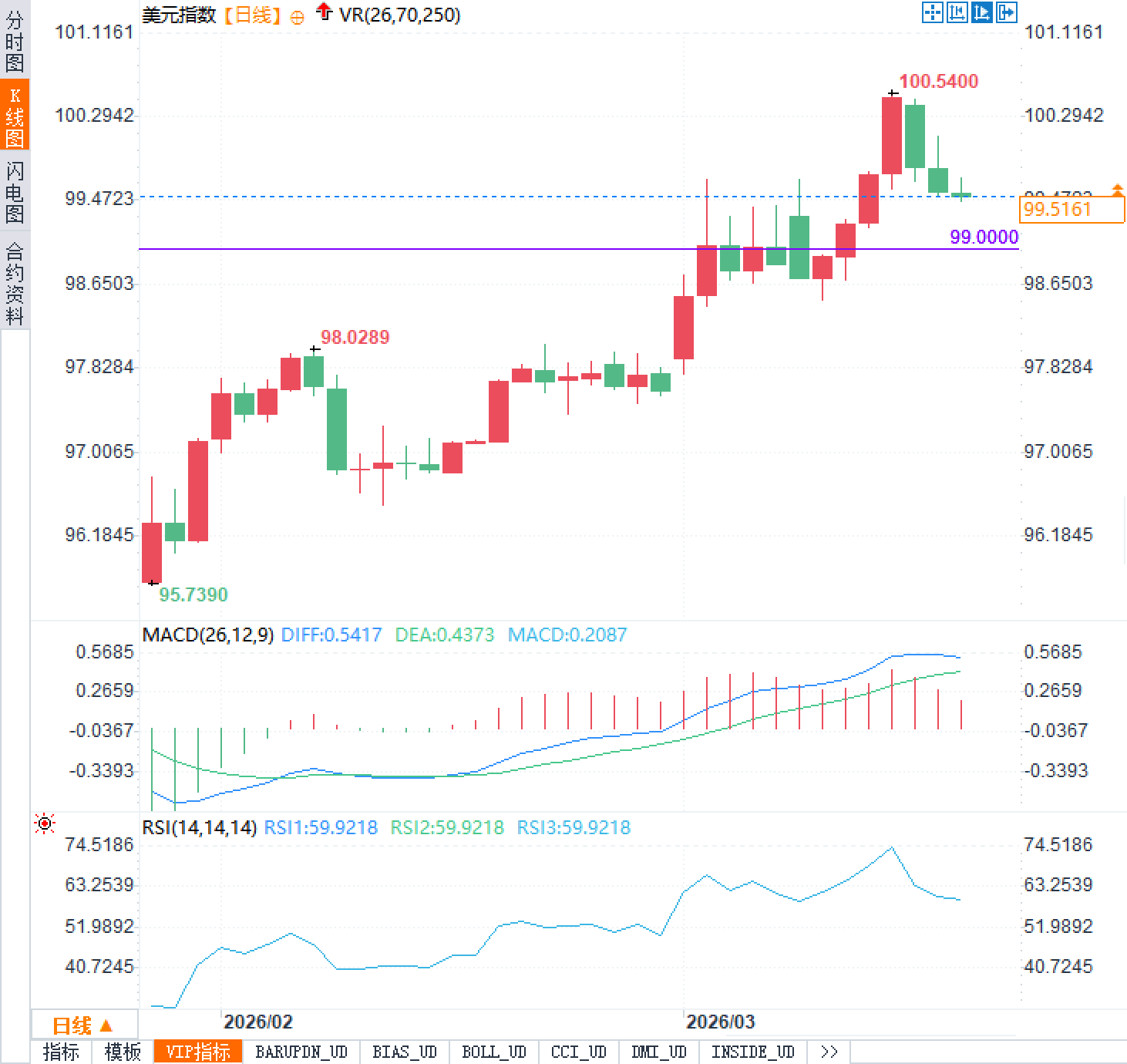
The US dollar index is currently hovering around 99.5-100, and financial conditions have tightened somewhat. The Federal Reserve is expected to maintain the target range for the federal funds rate at 3.50%-3.75%, with market pricing indicating a near 99% probability of this. The Fed is also signaling a "wait-and-see" approach through its latest Summary of Economic Projections (SEP) and dot plot, in response to potential upward pressure on inflation and uncertainty in economic activity.
Policy statement fine-tuning and forward guidance continuation
The policy statement from this meeting is expected to see only limited adjustments. The first paragraph may shift its description of economic activity from "solid" to "moderate," reflecting a slowdown in growth momentum in recent data. The second paragraph may add a mention of increased uncertainty stemming from geopolitical conflicts, which could push up inflation and exert downward pressure on economic activity in the short term, but would not alter the overall risk balance assessment. The forward guidance section is likely to remain unchanged, continuing to emphasize that the "degree and timing of additional adjustments" will depend on data. Two governors (Milan and Waller) are likely to continue voting against rate cuts, but the number of dissenters is not expected to increase significantly, indicating that internal resistance to immediate easing remains strong.
Summary of Economic Forecasts and Key Changes in the Dot Plot
The SEP update is the focus of this meeting. The Federal Reserve is likely to raise its forecasts for inflation and unemployment while lowering its economic growth expectations to reflect the potential transmission of rising energy prices to prices and their impact on demand. The dot plot is expected to remain relatively restrained, showing only one rate cut (25 basis points) in 2026 and another in 2027, with the long-term median interest rate remaining at 3.0%. This is largely in line with the market's previous pricing of a cumulative rate cut of approximately 26 basis points this year, and approximately 35 basis points by June 2027.
The following is a comparison of key economic forecast medians (typical adjustment directions based on recent trend inferences):
| index | Last prediction (end of 2025) | Expected adjustment direction |
|---|---|---|
| Real GDP growth rate in 2026 | Approximately 2.3% | Lower |
| Unemployment rate in 2026 | Approximately 4.4% | Upward |
| 2026 PCE inflation rate | Approximately 2.4% | Upward |
| Median federal funds rate at the end of 2026 | Approximately 3.375% | Basically stable or slightly adjusted |
Powell's potential statement at the press conference
Powell is expected to maintain a neutral stance, emphasizing that decision-making is data-dependent. He may point out that tighter financial conditions have already offset some of the inflationary pressures from rising energy prices, and there is no need to rush into disrupting market expectations with policy changes. Regarding the disruption to shipping in the Strait of Hormuz, he may downplay the persistence of the short-term impact while reiterating the balance between the Fed's dual mandate (price stability and full employment). The overall tone will avoid creating panic, focusing on observing the evolution of subsequent inflation and growth data.
Frequently Asked Questions
Question 1: Why is it highly likely that the Federal Reserve will not cut interest rates at this meeting, but will instead choose to maintain the status quo?
A: Current geopolitical conflicts have triggered energy price volatility, pushing up inflation expectations. Meanwhile, tightening financial market conditions (a stronger dollar and volatile US Treasury yields) have themselves had a contractionary effect, helping to curb demand-side pressures. The Federal Reserve prefers a wait-and-see approach rather than rash action to avoid policy missteps during periods of peak uncertainty. The dot plot maintains a path of only one rate cut until 2026, indicating that most policymakers believe the return of inflation to the 2% target may be delayed due to external shocks.
Question 2: What impact would it have on the market if the dot plot showed fewer interest rate cuts in 2026 than expected?
A: If the midpoint of the dot plot confirms only one rate cut or fewer, it will strengthen the market's pricing in "higher and longer" interest rates, which may push up US Treasury yields, support the dollar, and put pressure on risk assets in the short term. However, given that the energy shock has already been partially priced in, the upside potential is limited. Conversely, if there is an unexpected indication of further easing, it will temporarily alleviate market tensions, but subsequent data is needed to verify its sustainability.
Question 3: What is the core impact of the situation in the Strait of Hormuz on the Federal Reserve's decision-making?
A: Shipping disruptions in the region directly raise global energy costs, constituting a typical supply-side inflationary shock rather than a demand-driven one. The Federal Reserve is unlikely to directly address supply issues through interest rates, and therefore prefers to maintain a neutral policy stance, waiting to see if the shock transmits to core inflation and the anchoring of expectations. Meanwhile, the uncertainty brought about by the conflict increases the downside risk weight, but current employment and growth data have not yet shown a significant deterioration, limiting the necessity for an immediate shift to a dovish stance. Overall, this may reinforce the "wait-and-see + data-dependent" framework.
- Risk Warning and Disclaimer
- The market involves risk, and trading may not be suitable for all investors. This article is for reference only and does not constitute personal investment advice, nor does it take into account certain users’ specific investment objectives, financial situation, or other needs. Any investment decisions made based on this information are at your own risk.