Attacks on Qatar's Ras Raffan industrial city caused extensive damage to the world's largest LNG facility, leading to a surge in LNG contract prices.
2026-03-19 10:47:43
According to APP, Qatari officials confirmed that its Ras Raffaele industrial city, home to the world's largest liquefied natural gas (LNG) facility, was attacked by Iranian ballistic missiles on the evening of March 18th, local time. Air defense systems intercepted four missiles, but the fifth struck its target, causing a large-scale fire and extensive structural damage. While the fire is under control, the facility's core production units suffered severe damage; no casualties have been reported so far. Gas exports from the industrial city had already been completely suspended earlier this month due to escalating regional conflict, and this latest attack further delays the resumption of operations, with repairs expected to take weeks to months.

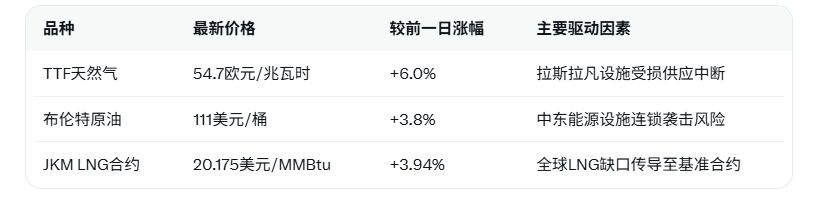
Ras Raffarin Industrial City , a core hub for Qatar Energy, normally accounts for about one-fifth of global liquefied natural gas (LNG) supply annually, with exports primarily flowing to European and Asian markets. This strike not only exacerbated the supply shortage but also directly pushed up international energy prices. Latest data from multiple energy consulting firms shows that European benchmark TTF natural gas futures have climbed to approximately €54.7 per megawatt-hour, a single-day increase of over 6%; Brent crude oil simultaneously broke through $111 per barrel, rising nearly 3.8% from the previous day. Asian spot LNG prices followed suit, showing a clear trend of remaining high in the short term.
Tom Mazek, Head of European Gas and LNG Research at Wood Mackenzie , recently stated regarding the Middle East conflict: "A retaliatory attack on Ras Lafan is exactly the scenario the global gas market fears most." He emphasized that even with the facility already shut down, natural gas futures will still receive a significant bullish boost at Thursday's opening, with the impact evenly distributed across multiple forward contracts, rather than being concentrated solely in near-month contracts. This aligns with traders' observations: given the facility's shutdown, the futures curve has shifted upwards overall, and the forward premium has widened.
The impact of this event on global supply chains is particularly profound. Cash-strapped emerging economies face pressure from a sharp rise in liquefied natural gas (LNG) import costs, while industrial companies from the UK to Japan may slow production due to rising energy prices. Major Asian countries, as major importers, will also face pressure on industrial activity and residential energy costs. Latest data shows that the international LNG benchmark contract (JKM) has surged to $20.175/MMBtu, a single-day increase of 3.94%. This chain reaction stems from the combined effect of a global LNG market supply disruption and shipping risks in the Strait of Hormuz, with both factors tightening the price spread between spot and futures markets.
To visually illustrate price changes, the following is a comparison table of the latest major energy benchmarks:
Analysts reasonably speculate that if the repair work requires large-scale reconstruction, the demand gap for liquefied natural gas in Europe and Asia could reach millions of tons in the short term, keeping prices high until at least the end of the second quarter. New supply sources are unlikely to fully fill the vacuum in the short term.
Editor's Summary : This attack highlights the vulnerability of Persian Gulf energy infrastructure to geopolitical conflicts, and the global liquefied natural gas (LNG) market supply and demand balance has been disrupted. Increased price volatility in the short term is inevitable, but the duration of the turmoil will be determined by the pace of repairs and diplomatic easing. Investors and businesses need to closely monitor satellite imagery, official repair announcements, and changes in futures curves.
Frequently Asked Questions
1. Why is the Laslavan Industrial City so crucial?
This industrial city houses almost all of Qatar's liquefied natural gas (LNG) production, liquefaction, and export facilities, accounting for one-fifth of global capacity annually and serving as a major source of imports for Europe and Asia. Any disruption would directly lead to a global supply shortage, driving prices up across the board.
2. What was the immediate background to Iran's attack?
Iran's Revolutionary Guard had previously warned that energy facilities in several countries around the Persian Gulf had become "legitimate targets" in response to attacks on their own facilities. Qatar intercepted most of the missiles, but one still hit, causing a fire and structural damage, escalating regional tensions.
3. What will be the long-term impact on natural gas prices in Europe and Asia?
European TTF gas prices have risen by over 6%, with Asian spot prices rising in tandem. If the recovery takes several months, the pressure on European winter stockpiling will increase, and rising import costs in Asia may be passed on to industrial electricity and residential gas prices, significantly increasing the overall risk of energy inflation.
4. Why have international LNG contract prices risen sharply?
The LNG benchmark contract (JKM), serving as a reference for international spot pricing, has seen a surge in demand amid a supply shortage. The international JKM contract rose 3.94% to $20.175/MMBtu, a direct consequence of global LNG disruptions, with traders anticipating continued support for longer-term contracts. The international market rapidly reflects risk through spot and swap prices, making the JKM a core benchmark for LNG trading in Asia and globally; its rise directly impacts importers' cost accounting and hedging strategies.
5. What is the future market outlook, and what signals should investors pay attention to?
Short-term prices are likely to remain high, while medium-term prices depend on the speed of recovery and the safety of shipping across the Taiwan Strait. It is recommended to continuously monitor Qatar's official assessment, changes in international futures curves, and the dynamics of alternative supplies, and to make advance inventory management and hedging arrangements to cope with potential continued volatility. Overall, the event has pushed the global LNG market into a new phase of supply shortage, and the real-time fluctuations of the JKM contract will be an important indicator for judging the progress of recovery and geopolitical risks.
Ras Raffarin Industrial City , a core hub for Qatar Energy, normally accounts for about one-fifth of global liquefied natural gas (LNG) supply annually, with exports primarily flowing to European and Asian markets. This strike not only exacerbated the supply shortage but also directly pushed up international energy prices. Latest data from multiple energy consulting firms shows that European benchmark TTF natural gas futures have climbed to approximately €54.7 per megawatt-hour, a single-day increase of over 6%; Brent crude oil simultaneously broke through $111 per barrel, rising nearly 3.8% from the previous day. Asian spot LNG prices followed suit, showing a clear trend of remaining high in the short term.
Tom Mazek, Head of European Gas and LNG Research at Wood Mackenzie , recently stated regarding the Middle East conflict: "A retaliatory attack on Ras Lafan is exactly the scenario the global gas market fears most." He emphasized that even with the facility already shut down, natural gas futures will still receive a significant bullish boost at Thursday's opening, with the impact evenly distributed across multiple forward contracts, rather than being concentrated solely in near-month contracts. This aligns with traders' observations: given the facility's shutdown, the futures curve has shifted upwards overall, and the forward premium has widened.
The impact of this event on global supply chains is particularly profound. Cash-strapped emerging economies face pressure from a sharp rise in liquefied natural gas (LNG) import costs, while industrial companies from the UK to Japan may slow production due to rising energy prices. Major Asian countries, as major importers, will also face pressure on industrial activity and residential energy costs. Latest data shows that the international LNG benchmark contract (JKM) has surged to $20.175/MMBtu, a single-day increase of 3.94%. This chain reaction stems from the combined effect of a global LNG market supply disruption and shipping risks in the Strait of Hormuz, with both factors tightening the price spread between spot and futures markets.
To visually illustrate price changes, the following is a comparison table of the latest major energy benchmarks:
Analysts reasonably speculate that if the repair work requires large-scale reconstruction, the demand gap for liquefied natural gas in Europe and Asia could reach millions of tons in the short term, keeping prices high until at least the end of the second quarter. New supply sources are unlikely to fully fill the vacuum in the short term.
Editor's Summary : This attack highlights the vulnerability of Persian Gulf energy infrastructure to geopolitical conflicts, and the global liquefied natural gas (LNG) market supply and demand balance has been disrupted. Increased price volatility in the short term is inevitable, but the duration of the turmoil will be determined by the pace of repairs and diplomatic easing. Investors and businesses need to closely monitor satellite imagery, official repair announcements, and changes in futures curves.
Frequently Asked Questions
1. Why is the Laslavan Industrial City so crucial?
This industrial city houses almost all of Qatar's liquefied natural gas (LNG) production, liquefaction, and export facilities, accounting for one-fifth of global capacity annually and serving as a major source of imports for Europe and Asia. Any disruption would directly lead to a global supply shortage, driving prices up across the board.
2. What was the immediate background to Iran's attack?
Iran's Revolutionary Guard had previously warned that energy facilities in several countries around the Persian Gulf had become "legitimate targets" in response to attacks on their own facilities. Qatar intercepted most of the missiles, but one still hit, causing a fire and structural damage, escalating regional tensions.
3. What will be the long-term impact on natural gas prices in Europe and Asia?
European TTF gas prices have risen by over 6%, with Asian spot prices rising in tandem. If the recovery takes several months, the pressure on European winter stockpiling will increase, and rising import costs in Asia may be passed on to industrial electricity and residential gas prices, significantly increasing the overall risk of energy inflation.
4. Why have international LNG contract prices risen sharply?
The LNG benchmark contract (JKM), serving as a reference for international spot pricing, has seen a surge in demand amid a supply shortage. The international JKM contract rose 3.94% to $20.175/MMBtu, a direct consequence of global LNG disruptions, with traders anticipating continued support for longer-term contracts. The international market rapidly reflects risk through spot and swap prices, making the JKM a core benchmark for LNG trading in Asia and globally; its rise directly impacts importers' cost accounting and hedging strategies.
5. What is the future market outlook, and what signals should investors pay attention to?
Short-term prices are likely to remain high, while medium-term prices depend on the speed of recovery and the safety of shipping across the Taiwan Strait. It is recommended to continuously monitor Qatar's official assessment, changes in international futures curves, and the dynamics of alternative supplies, and to make advance inventory management and hedging arrangements to cope with potential continued volatility. Overall, the event has pushed the global LNG market into a new phase of supply shortage, and the real-time fluctuations of the JKM contract will be an important indicator for judging the progress of recovery and geopolitical risks.
- Risk Warning and Disclaimer
- The market involves risk, and trading may not be suitable for all investors. This article is for reference only and does not constitute personal investment advice, nor does it take into account certain users’ specific investment objectives, financial situation, or other needs. Any investment decisions made based on this information are at your own risk.