The Bank of Japan maintained its interest rate at 8:1, but warned that the situation in the Middle East has become the biggest black swan event.
2026-03-19 11:27:18
On Thursday (March 19), the Bank of Japan (BOJ) decided to maintain its policy rate at 0.75% by a vote of 8 to 1. This marks the BOJ's continued wait-and-see approach since last year's rate hike, reflecting its cautious stance in the current highly uncertain environment. The policy statement contained significantly stronger warnings regarding the situation in the Middle East. Market attention is focused on BOJ Governor Kazuo Ueda's monetary policy press conference scheduled for 2:30 PM.

The Bank of Japan's assessment of the current economy: While some sectors are showing weakness, the Japanese economy is generally recovering moderately. Exports and industrial production are generally trending steadily, and corporate profits remain high overall, despite the impact of tariff reductions on the manufacturing sector. The virtuous cycle of income and expenditure is gradually strengthening with the support of government economic measures and a loose monetary environment.
Inflation expectations have risen moderately, and as the economy continues to improve, the perception of labor shortages is expected to intensify, leading to a further rise in medium- to long-term inflation expectations.
The Bank of Japan believes that real interest rates are at a significantly low level, and if the economic activity and price outlook presented in its January outlook report are realized, it will provide room for further increases in policy interest rates.
The Bank of Japan issued a clear risk warning in its outlook section: against the backdrop of escalating tensions in the Middle East, global financial and capital markets are experiencing increased volatility, and oil prices have risen significantly; future developments warrant close attention.
The Middle East conflict has become the biggest source of external uncertainty, and rising energy prices directly threaten Japan's energy security and inflation stability, which are heavily reliant on imports.
The Bank of Japan reiterated its future policy direction: with the economy continuing to improve and inflation expectations rising, and given the significantly low real interest rates, the central bank will continue to raise policy rates if economic activity and price prospects meet the expectations of its January outlook report.
The statement did not provide a specific timetable or magnitude, but it made it clear that the path of interest rate hikes remains unchanged, and may be delayed only due to external shocks.
In the short term, the Bank of Japan's decision to remain on hold and hold interest rates steady is in line with market expectations. The medium- to long-term path of interest rate hikes remains unchanged, but the situation in the Middle East has become the biggest uncertainty. If the Strait of Hormuz continues to be disrupted and oil prices remain volatile at high levels for an extended period, inflationary pressures will further intensify, and the pace of interest rate hikes may be delayed.
Investors should be wary of energy price dynamics and geopolitical developments, as short-term volatility is high, while medium- to long-term attention should be paid to central banks' assessments and adjustments regarding the impact on the Middle East.
The Bank of Japan maintained its interest rate at 0.75%, in line with market expectations. The USD/JPY pair remained range-bound during Thursday's early Asian trading session, currently trading narrowly around 159.65. This reflects the market's anticipation of the Bank of Japan Governor Kazuo Ueda's press conference at 14:30 for further clues.
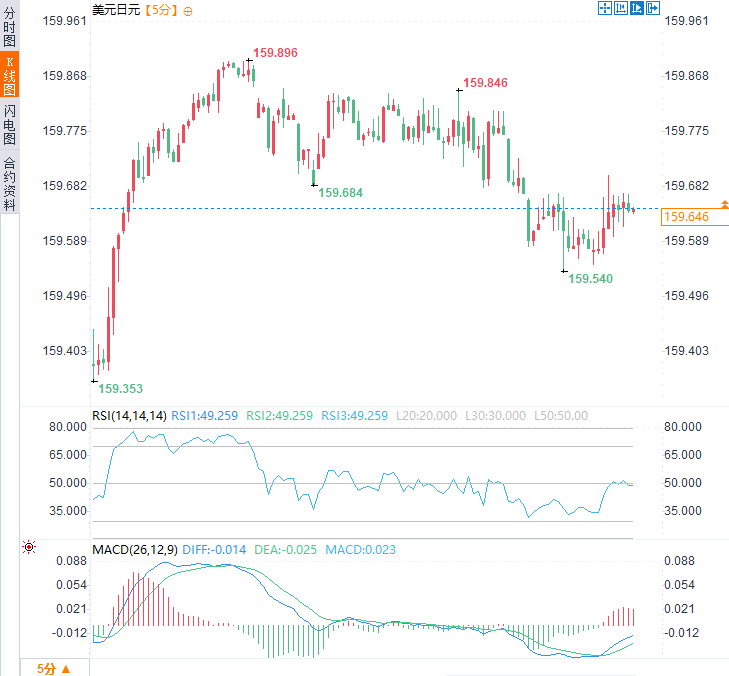
(USD/JPY 5-minute chart, source: FX678)
The Bank of Japan (BOJ) voted 8-1 to maintain its policy rate at 0.75%, assessing a moderate economic recovery and a modest rise in inflation expectations, but noting a worsening labor shortage. The BOJ warned of escalating tensions in the Middle East, rising oil prices, and global market volatility, emphasizing the need for close monitoring of future developments. With real interest rates significantly low, the BOJ anticipates further policy rate increases should the economic and price outlook materialize. The short-term outlook remains cautious, while the medium- to long-term path of interest rate hikes remains unchanged, but the Middle East conflict has become the biggest external uncertainty.
Investors should pay close attention to the Bank of Japan Governor Kazuo Ueda's monetary policy press conference at 14:30 on Thursday, focusing on energy price dynamics and geopolitical developments. Short-term volatility is high, and the pace of interest rate hikes in the medium to long term may be delayed due to the impact of oil prices.
At 11:26 Beijing time, the US dollar was trading at 159.67/68 against the Japanese yen.
The economy is recovering moderately, exports and industry are stable, and corporate profits remain high.
The Bank of Japan's assessment of the current economy: While some sectors are showing weakness, the Japanese economy is generally recovering moderately. Exports and industrial production are generally trending steadily, and corporate profits remain high overall, despite the impact of tariff reductions on the manufacturing sector. The virtuous cycle of income and expenditure is gradually strengthening with the support of government economic measures and a loose monetary environment.
Inflation expectations are rising moderately, and the feeling of labor shortage is intensifying.
Inflation expectations have risen moderately, and as the economy continues to improve, the perception of labor shortages is expected to intensify, leading to a further rise in medium- to long-term inflation expectations.
The Bank of Japan believes that real interest rates are at a significantly low level, and if the economic activity and price outlook presented in its January outlook report are realized, it will provide room for further increases in policy interest rates.
Tensions in the Middle East have led to a significant rise in oil prices and increased volatility in global markets.
The Bank of Japan issued a clear risk warning in its outlook section: against the backdrop of escalating tensions in the Middle East, global financial and capital markets are experiencing increased volatility, and oil prices have risen significantly; future developments warrant close attention.
The Middle East conflict has become the biggest source of external uncertainty, and rising energy prices directly threaten Japan's energy security and inflation stability, which are heavily reliant on imports.
With real interest rates significantly low and the economic and price outlook favorable, interest rate hikes will continue.
The Bank of Japan reiterated its future policy direction: with the economy continuing to improve and inflation expectations rising, and given the significantly low real interest rates, the central bank will continue to raise policy rates if economic activity and price prospects meet the expectations of its January outlook report.
The statement did not provide a specific timetable or magnitude, but it made it clear that the path of interest rate hikes remains unchanged, and may be delayed only due to external shocks.
Short-term outlook remains cautious, but the medium- to long-term interest rate hike path remains unchanged; Middle East risks are the biggest uncertainty.
In the short term, the Bank of Japan's decision to remain on hold and hold interest rates steady is in line with market expectations. The medium- to long-term path of interest rate hikes remains unchanged, but the situation in the Middle East has become the biggest uncertainty. If the Strait of Hormuz continues to be disrupted and oil prices remain volatile at high levels for an extended period, inflationary pressures will further intensify, and the pace of interest rate hikes may be delayed.
Investors should be wary of energy price dynamics and geopolitical developments, as short-term volatility is high, while medium- to long-term attention should be paid to central banks' assessments and adjustments regarding the impact on the Middle East.
Market reaction – taking USD/JPY as an example
The Bank of Japan maintained its interest rate at 0.75%, in line with market expectations. The USD/JPY pair remained range-bound during Thursday's early Asian trading session, currently trading narrowly around 159.65. This reflects the market's anticipation of the Bank of Japan Governor Kazuo Ueda's press conference at 14:30 for further clues.
(USD/JPY 5-minute chart, source: FX678)
Editor's Summary
The Bank of Japan (BOJ) voted 8-1 to maintain its policy rate at 0.75%, assessing a moderate economic recovery and a modest rise in inflation expectations, but noting a worsening labor shortage. The BOJ warned of escalating tensions in the Middle East, rising oil prices, and global market volatility, emphasizing the need for close monitoring of future developments. With real interest rates significantly low, the BOJ anticipates further policy rate increases should the economic and price outlook materialize. The short-term outlook remains cautious, while the medium- to long-term path of interest rate hikes remains unchanged, but the Middle East conflict has become the biggest external uncertainty.
Investors should pay close attention to the Bank of Japan Governor Kazuo Ueda's monetary policy press conference at 14:30 on Thursday, focusing on energy price dynamics and geopolitical developments. Short-term volatility is high, and the pace of interest rate hikes in the medium to long term may be delayed due to the impact of oil prices.
At 11:26 Beijing time, the US dollar was trading at 159.67/68 against the Japanese yen.
- Risk Warning and Disclaimer
- The market involves risk, and trading may not be suitable for all investors. This article is for reference only and does not constitute personal investment advice, nor does it take into account certain users’ specific investment objectives, financial situation, or other needs. Any investment decisions made based on this information are at your own risk.