The Bank of Japan kept interest rates unchanged, and the yen fluctuated as it awaited the governor's speech.
2026-03-19 12:09:41
The yen faced some selling pressure against the dollar during Asian trading hours on Thursday (March 19), with the USD/JPY pair currently trading around 159.65. Despite the Bank of Japan's decision to maintain its policy rate at 0.75%, as expected by the market, the dollar underperformed other major currencies.
The Bank of Japan held rates steady for the second consecutive meeting, primarily due to the continued surge in oil prices caused by the conflict between the US and Israel in the Middle East and Iran, which seriously threatens Japan's economic prospects. As one of the world's most energy-dependent countries, Japan is directly affected by rising oil prices, which increase import costs and exacerbate imported inflationary pressures. This could also dampen consumption and business investment, creating a risk of stagflation.
This situation has put the Bank of Japan in a dilemma between raising interest rates and maintaining an accommodative stance: raising rates could curb inflation and support the yen, but could further damage the fragile recovery; maintaining the status quo could exacerbate the yen's depreciation and runaway inflation expectations.
Market expectations for an interest rate hike at this meeting have been reduced to almost zero, and investors are now turning their attention to the upcoming press conference by Bank of Japan Governor Kazuo Ueda, hoping for the latest guidance on the outlook for monetary policy.
Kazuo Ueda stated on Tuesday that he is confident prices and wages will continue to rise at an accelerating pace. He noted, "Underlying inflation is expected to gradually converge toward our 2% target between the second half of fiscal year 2026 and fiscal year 2027." He added that the Bank of Japan will guide monetary policy appropriately to achieve stable and sustainable inflation.
Meanwhile, the dollar fell slightly after the Fed's interest rate meeting on Wednesday.
The Federal Reserve, as expected, kept the federal funds rate unchanged at 3.50%-3.75%, stating that it would only consider adjusting monetary policy if there were clear signs of easing inflation. This statement further cooled market expectations for a short-term rate cut, causing the dollar index to weaken after a brief surge, which in turn contributed to the relative appreciation of the yen.
Overall, the current slight decline in USD/JPY mainly reflects a temporary cooling of demand for the safe-haven dollar and the short-term impact of the Bank of Japan maintaining the status quo. However, the stagflation risk stemming from Japan's energy dependence, and expectations that the Federal Reserve will postpone easing due to war-related inflation concerns, still provide medium- to long-term bullish support for USD/JPY.
Investors should pay close attention to Kazuo Ueda's press conference, the latest developments in the Middle East, and the remaining US economic data this week, as these factors will directly determine the short-term direction of the exchange rate.
If both the Federal Reserve and the Bank of Japan maintain a cautious stance, the relative strength of the US dollar is likely to continue, and the USD/JPY pair may resume its upward momentum after a pullback. In the short term, the 159.00-160.00 range will remain a key area of intense competition between bulls and bears.
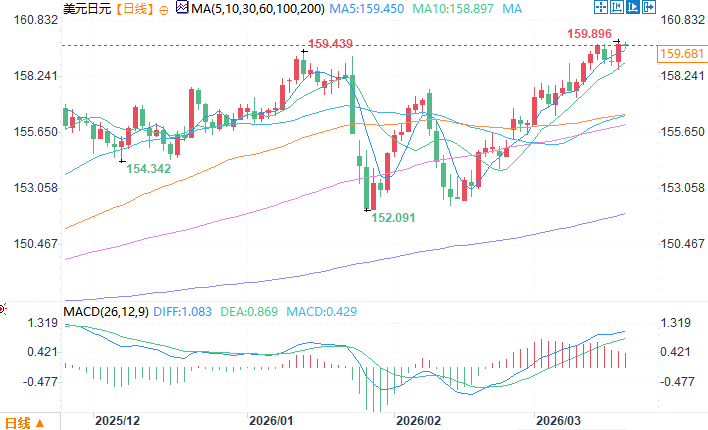
USD/JPY Daily Chart Source: EasyForex
At 12:09 Beijing time on March 19, the USD/JPY exchange rate was 159.65/66.
The Bank of Japan held rates steady for the second consecutive meeting, primarily due to the continued surge in oil prices caused by the conflict between the US and Israel in the Middle East and Iran, which seriously threatens Japan's economic prospects. As one of the world's most energy-dependent countries, Japan is directly affected by rising oil prices, which increase import costs and exacerbate imported inflationary pressures. This could also dampen consumption and business investment, creating a risk of stagflation.
This situation has put the Bank of Japan in a dilemma between raising interest rates and maintaining an accommodative stance: raising rates could curb inflation and support the yen, but could further damage the fragile recovery; maintaining the status quo could exacerbate the yen's depreciation and runaway inflation expectations.
Market expectations for an interest rate hike at this meeting have been reduced to almost zero, and investors are now turning their attention to the upcoming press conference by Bank of Japan Governor Kazuo Ueda, hoping for the latest guidance on the outlook for monetary policy.
Kazuo Ueda stated on Tuesday that he is confident prices and wages will continue to rise at an accelerating pace. He noted, "Underlying inflation is expected to gradually converge toward our 2% target between the second half of fiscal year 2026 and fiscal year 2027." He added that the Bank of Japan will guide monetary policy appropriately to achieve stable and sustainable inflation.
Meanwhile, the dollar fell slightly after the Fed's interest rate meeting on Wednesday.
The Federal Reserve, as expected, kept the federal funds rate unchanged at 3.50%-3.75%, stating that it would only consider adjusting monetary policy if there were clear signs of easing inflation. This statement further cooled market expectations for a short-term rate cut, causing the dollar index to weaken after a brief surge, which in turn contributed to the relative appreciation of the yen.
Overall, the current slight decline in USD/JPY mainly reflects a temporary cooling of demand for the safe-haven dollar and the short-term impact of the Bank of Japan maintaining the status quo. However, the stagflation risk stemming from Japan's energy dependence, and expectations that the Federal Reserve will postpone easing due to war-related inflation concerns, still provide medium- to long-term bullish support for USD/JPY.
Investors should pay close attention to Kazuo Ueda's press conference, the latest developments in the Middle East, and the remaining US economic data this week, as these factors will directly determine the short-term direction of the exchange rate.
If both the Federal Reserve and the Bank of Japan maintain a cautious stance, the relative strength of the US dollar is likely to continue, and the USD/JPY pair may resume its upward momentum after a pullback. In the short term, the 159.00-160.00 range will remain a key area of intense competition between bulls and bears.
USD/JPY Daily Chart Source: EasyForex
At 12:09 Beijing time on March 19, the USD/JPY exchange rate was 159.65/66.
- Risk Warning and Disclaimer
- The market involves risk, and trading may not be suitable for all investors. This article is for reference only and does not constitute personal investment advice, nor does it take into account certain users’ specific investment objectives, financial situation, or other needs. Any investment decisions made based on this information are at your own risk.