US Troop Increase in the Middle East, Iran Launches Bombing Campaign in the Gulf: The Heart of Global Energy is Burning
2026-03-19 11:14:27
The US-Israel war against Iran has entered its third week, escalating from attacks on military facilities to strikes on energy infrastructure and key strategic targets. Trump is considering sending thousands more troops to the Middle East, with plans including securing the Strait of Hormuz, controlling Kharg Island (Iran's oil hub), and seizing its highly enriched uranium stockpile.
Iran launched the 63rd round of Operation True Commitment-4, unleashing a massive missile attack on US-related oil and energy facilities in the region. The statement emphasized reciprocal retaliation and warned that if the attacks continued, the scope of the strikes would be expanded to all energy infrastructure of US and Israeli allies, until "complete destruction".
Amid the ongoing energy crisis, oil prices fluctuated at high levels. On Thursday (March 19) during the Asian session, US crude oil prices fluctuated and are currently trading around $96.30 per barrel, with a daily increase of about 0.9%.

The United States is considering sending thousands more troops to the Middle East in preparation for an expanded military operation against Iran. Ground forces face significant risks: 13 U.S. troops have already been killed and approximately 200 wounded, public approval ratings are low, and Trump campaigned on promises to avoid a new war in the Middle East.
The troop increase plan faces domestic political backlash and parliamentary resistance, especially with the midterm elections approaching, as any large-scale ground operation could trigger an anti-war wave and voter discontent.
The troop increase plan includes three core objectives: to deploy troops to ensure the security of the Strait of Hormuz and restore 20% of global oil transportation; to control Kharg Island, Iran's oil hub (which handles 90% of crude oil exports), cutting off Iran's war funding; and to seize Iran's stockpile of highly enriched uranium, completely eliminating the nuclear threat.
These targets all require the involvement of ground troops, which carries extremely high risks and could trigger extreme Iranian retaliation and a larger-scale regional war.
Early on the morning of the 19th local time, the Iranian Islamic Revolutionary Guard Corps announced the launch of the 63rd round of Operation True Commitment-4, which will involve large-scale missile attacks on oil and energy facilities in the region that are linked to the United States.
The statement indicated that this action was a direct and reciprocal retaliation for the attacks on Iranian energy infrastructure on the 18th. Iran emphasized that it originally did not want the war to escalate to the energy sector, nor did it wish to affect the economies of neighboring countries, but the enemy's provocations have led the war into a "new phase."
Iranian armed forces have carried out multiple rounds of strikes to ensure that the damage suffered by the enemy is on par with the damage to Iranian infrastructure.
The statement issued a stern warning: if the attacks continue, Iran will expand its strikes to all energy infrastructure of US and Israeli allies until it is "completely destroyed".
This action signifies that Iran has designated energy facilities as legitimate targets for retaliation, posing an unprecedented threat to global energy security.
Iran's massive missile attacks on Gulf energy facilities have dramatically increased the risk of global energy supply disruptions. The Strait of Hormuz is essentially blocked, oil exports from eight countries have plummeted by 61%, and increased floating storage has further reduced the actual amount reaching the market.
Oil prices continue to fluctuate at high levels, while inflationary pressures and economic slowdown are intensifying. The US troop buildup and escalating Iranian retaliation have created a vicious cycle. Investors should be wary of unforeseen events triggering a reversal in oil prices and pay close attention to the resumption of navigation in the Taiwan Strait and the actual implementation of the G7/IEA reserve releases.
As the war with Iran enters its third week, Trump is considering sending thousands more troops to the Middle East, with plans including securing the Strait of Hormuz, controlling Kharg Island, and seizing highly enriched uranium stockpiles. However, the risks to ground troops are enormous, American troops have already suffered casualties, and public approval ratings are low, despite Trump's campaign promise to avoid a new war in the Middle East.
Iran launched the 63rd round of Operation True Commitment-4, unleashing a massive missile attack on US-related oil and energy facilities in the region as retaliation, and warned that if the attack continued, it would be expanded to all energy infrastructure of its allies, until it was completely destroyed.
The conflict has escalated to core energy infrastructure, disrupting one-fifth of global oil transportation and amplifying oil price and inflationary pressures. Investors need to be highly vigilant against a new round of supply shocks triggered by Iran's extreme retaliation, and pay close attention to the decision to increase troop presence, the resumption of navigation in the Taiwan Strait, and progress in international coordination.
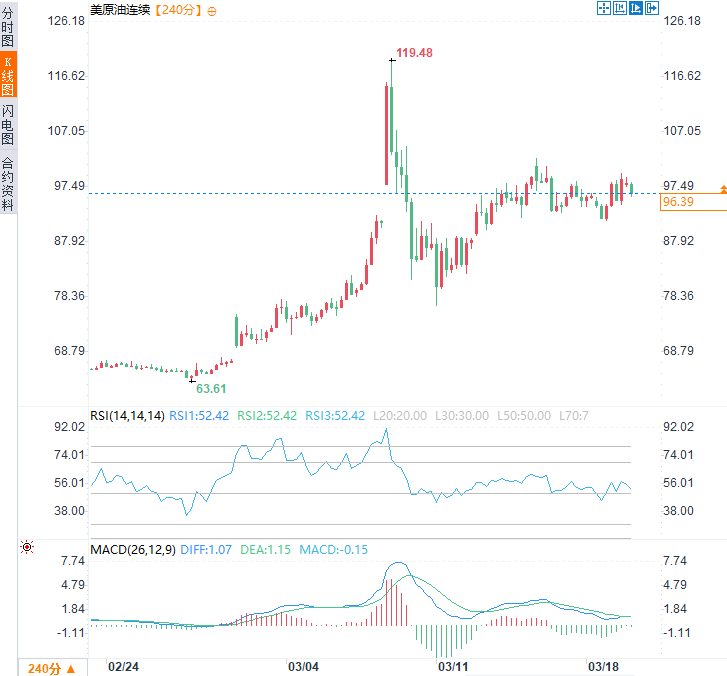
(US crude oil 4-hour chart, source: FX678)
At 11:13 Beijing time, US crude oil futures were trading at $95.87 per barrel.
Iran launched the 63rd round of Operation True Commitment-4, unleashing a massive missile attack on US-related oil and energy facilities in the region. The statement emphasized reciprocal retaliation and warned that if the attacks continued, the scope of the strikes would be expanded to all energy infrastructure of US and Israeli allies, until "complete destruction".
Amid the ongoing energy crisis, oil prices fluctuated at high levels. On Thursday (March 19) during the Asian session, US crude oil prices fluctuated and are currently trading around $96.30 per barrel, with a daily increase of about 0.9%.
Trump is considering sending thousands more troops to the Middle East, facing both risks and domestic political pressure.
The United States is considering sending thousands more troops to the Middle East in preparation for an expanded military operation against Iran. Ground forces face significant risks: 13 U.S. troops have already been killed and approximately 200 wounded, public approval ratings are low, and Trump campaigned on promises to avoid a new war in the Middle East.
The troop increase plan faces domestic political backlash and parliamentary resistance, especially with the midterm elections approaching, as any large-scale ground operation could trigger an anti-war wave and voter discontent.
Ensure the security of Hormuz, control Kharg Island, and seize the stockpile of highly enriched uranium.
The troop increase plan includes three core objectives: to deploy troops to ensure the security of the Strait of Hormuz and restore 20% of global oil transportation; to control Kharg Island, Iran's oil hub (which handles 90% of crude oil exports), cutting off Iran's war funding; and to seize Iran's stockpile of highly enriched uranium, completely eliminating the nuclear threat.
These targets all require the involvement of ground troops, which carries extremely high risks and could trigger extreme Iranian retaliation and a larger-scale regional war.
Real Commitment-4, Operation 63: Massive Missile Attacks on Regional Energy Facilities
Early on the morning of the 19th local time, the Iranian Islamic Revolutionary Guard Corps announced the launch of the 63rd round of Operation True Commitment-4, which will involve large-scale missile attacks on oil and energy facilities in the region that are linked to the United States.
The statement indicated that this action was a direct and reciprocal retaliation for the attacks on Iranian energy infrastructure on the 18th. Iran emphasized that it originally did not want the war to escalate to the energy sector, nor did it wish to affect the economies of neighboring countries, but the enemy's provocations have led the war into a "new phase."
Reciprocal retaliation, warning that if continued, it would be expanded to all energy infrastructure of allies.
Iranian armed forces have carried out multiple rounds of strikes to ensure that the damage suffered by the enemy is on par with the damage to Iranian infrastructure.
The statement issued a stern warning: if the attacks continue, Iran will expand its strikes to all energy infrastructure of US and Israeli allies until it is "completely destroyed".
This action signifies that Iran has designated energy facilities as legitimate targets for retaliation, posing an unprecedented threat to global energy security.
Oil prices and inflationary pressures continue to rise, and the risk of a global energy crisis is increasing sharply.
Iran's massive missile attacks on Gulf energy facilities have dramatically increased the risk of global energy supply disruptions. The Strait of Hormuz is essentially blocked, oil exports from eight countries have plummeted by 61%, and increased floating storage has further reduced the actual amount reaching the market.
Oil prices continue to fluctuate at high levels, while inflationary pressures and economic slowdown are intensifying. The US troop buildup and escalating Iranian retaliation have created a vicious cycle. Investors should be wary of unforeseen events triggering a reversal in oil prices and pay close attention to the resumption of navigation in the Taiwan Strait and the actual implementation of the G7/IEA reserve releases.
Editor's Summary
As the war with Iran enters its third week, Trump is considering sending thousands more troops to the Middle East, with plans including securing the Strait of Hormuz, controlling Kharg Island, and seizing highly enriched uranium stockpiles. However, the risks to ground troops are enormous, American troops have already suffered casualties, and public approval ratings are low, despite Trump's campaign promise to avoid a new war in the Middle East.
Iran launched the 63rd round of Operation True Commitment-4, unleashing a massive missile attack on US-related oil and energy facilities in the region as retaliation, and warned that if the attack continued, it would be expanded to all energy infrastructure of its allies, until it was completely destroyed.
The conflict has escalated to core energy infrastructure, disrupting one-fifth of global oil transportation and amplifying oil price and inflationary pressures. Investors need to be highly vigilant against a new round of supply shocks triggered by Iran's extreme retaliation, and pay close attention to the decision to increase troop presence, the resumption of navigation in the Taiwan Strait, and progress in international coordination.
(US crude oil 4-hour chart, source: FX678)
At 11:13 Beijing time, US crude oil futures were trading at $95.87 per barrel.
- Risk Warning and Disclaimer
- The market involves risk, and trading may not be suitable for all investors. This article is for reference only and does not constitute personal investment advice, nor does it take into account certain users’ specific investment objectives, financial situation, or other needs. Any investment decisions made based on this information are at your own risk.