The UK unemployment rate remains near a five-year high at 5.2%, with wage growth slowing to 3.8%. Geopolitical tensions may exacerbate the economic slowdown and push up unemployment.
2026-03-19 15:24:29
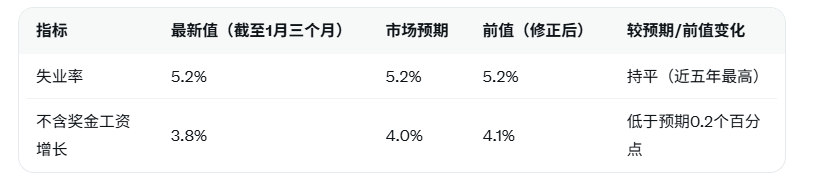
According to APP, data released by the UK Office for National Statistics on Thursday showed that the unemployment rate remained at its highest level in nearly five years in the three months to January. Geopolitical tensions could dampen economic growth and push the unemployment rate higher in the coming months. The data showed that the unemployment rate was 5.2% in the three months to January, unchanged from the three months to December. The average annual wage growth rate, excluding bonuses, was 3.8%, lower than the revised previous figure of 4.1%. Economists had previously expected an unemployment rate of 5.2% and an adjusted wage growth rate of 4.0%.

The latest data from the UK Office for National Statistics confirms that the number of unemployed is approximately 1.88 million, an increase of 330,000 from a year ago, with youth unemployment also climbing to a five-year high. Slowing wage growth reflects a widening imbalance between labor supply and demand: companies are less willing to hire, while the influx of job seekers is increasing. The conflict in Iran, coupled with high global energy prices, has directly increased business operating costs through higher oil and gas imports, suppressing investment and expansion, leading to a further contraction in employment demand.
The profound impact of the events on the UK economy is multi-dimensional. High oil prices amplify imported inflationary pressures, forcing businesses to cut costs and reduce hiring; meanwhile, weaker-than-expected wage growth weakens household consumption, creating a cycle of weak demand. Analysts reasonably speculate that if the Middle East conflict continues into the second quarter, UK GDP growth could be revised down by 0.3-0.5 percentage points, and the unemployment rate could exceed 5.5% within the year. The Bank of England needs to balance controlling inflation with stabilizing growth; interest rate cuts may be brought forward due to the easing of the labor market, but the continued energy shock will limit policy space. At the business level, rising labor costs in manufacturing and services, coupled with financing pressures, are squeezing profit margins; at the household level, slower real income growth will suppress retail and housing demand, becoming a new bottleneck for economic growth.
To visually illustrate the differences in the data, the following is a comparison table of the latest key labor market indicators:
Editor's Summary : The Middle East conflict has translated energy price volatility into systemic pressure on the UK labor market. High unemployment and signs of slowing wages highlight the fragility of economic growth. The employment outlook remains under pressure in the short term, but the medium-term trend depends on the speed of conflict de-escalation, a decline in oil prices, and adjustments to monetary policy. Investors and businesses need to closely monitor subsequent unemployment data, CPI trends, and the Bank of England's meeting minutes.
Frequently Asked Questions
1. Why has the UK unemployment rate remained at 5.2%, the highest in nearly five years?
The data for the three months ending in January remained unchanged from the previous month, but rose sharply by 0.8 percentage points compared to a year ago, with the number of unemployed increasing by 330,000. The core driver was the Middle East war pushing up energy costs, coupled with a freeze in corporate hiring and an increase in job seekers, leading to a looser labor market. The youth unemployment rate also hit a five-year high, further confirming that the economic slowdown has spread from the demand side to the employment sector.
2. How will the geopolitical situation specifically affect the UK's economic growth and unemployment prospects?
As a net energy importer, the high price of Brent crude oil in the UK directly increases costs for logistics, manufacturing, and utilities, suppressing investment expansion and reducing job openings. Conflict uncertainty amplifies risk aversion, and capital outflows and pound volatility exacerbate recruitment difficulties. Analysts predict that if the conflict continues, the unemployment rate may rise above 5.5% this year, putting significant downward pressure on GDP growth. While the Bank of England has more room to cut interest rates, inflation risks remain.
3. Why does the discrepancy between economists' expectations and actual data attract market attention?
Unemployment was in line with expectations, but wage growth was significantly below 4.0%, highlighting that the weakness in the labor market was beyond market pricing. Investors subsequently raised their probability of a Bank of England rate cut, causing volatility in the pound and bond markets. This also confirms the persistent transmission effects of the Middle East conflict: the energy shock has evolved from short-term price increases to a drag on medium- to long-term growth and employment, requiring policymakers to address the dual challenges of imported inflation and weak demand in advance.
The latest data from the UK Office for National Statistics confirms that the number of unemployed is approximately 1.88 million, an increase of 330,000 from a year ago, with youth unemployment also climbing to a five-year high. Slowing wage growth reflects a widening imbalance between labor supply and demand: companies are less willing to hire, while the influx of job seekers is increasing. The conflict in Iran, coupled with high global energy prices, has directly increased business operating costs through higher oil and gas imports, suppressing investment and expansion, leading to a further contraction in employment demand.
The profound impact of the events on the UK economy is multi-dimensional. High oil prices amplify imported inflationary pressures, forcing businesses to cut costs and reduce hiring; meanwhile, weaker-than-expected wage growth weakens household consumption, creating a cycle of weak demand. Analysts reasonably speculate that if the Middle East conflict continues into the second quarter, UK GDP growth could be revised down by 0.3-0.5 percentage points, and the unemployment rate could exceed 5.5% within the year. The Bank of England needs to balance controlling inflation with stabilizing growth; interest rate cuts may be brought forward due to the easing of the labor market, but the continued energy shock will limit policy space. At the business level, rising labor costs in manufacturing and services, coupled with financing pressures, are squeezing profit margins; at the household level, slower real income growth will suppress retail and housing demand, becoming a new bottleneck for economic growth.
To visually illustrate the differences in the data, the following is a comparison table of the latest key labor market indicators:
Editor's Summary : The Middle East conflict has translated energy price volatility into systemic pressure on the UK labor market. High unemployment and signs of slowing wages highlight the fragility of economic growth. The employment outlook remains under pressure in the short term, but the medium-term trend depends on the speed of conflict de-escalation, a decline in oil prices, and adjustments to monetary policy. Investors and businesses need to closely monitor subsequent unemployment data, CPI trends, and the Bank of England's meeting minutes.
Frequently Asked Questions
1. Why has the UK unemployment rate remained at 5.2%, the highest in nearly five years?
The data for the three months ending in January remained unchanged from the previous month, but rose sharply by 0.8 percentage points compared to a year ago, with the number of unemployed increasing by 330,000. The core driver was the Middle East war pushing up energy costs, coupled with a freeze in corporate hiring and an increase in job seekers, leading to a looser labor market. The youth unemployment rate also hit a five-year high, further confirming that the economic slowdown has spread from the demand side to the employment sector.
2. How will the geopolitical situation specifically affect the UK's economic growth and unemployment prospects?
As a net energy importer, the high price of Brent crude oil in the UK directly increases costs for logistics, manufacturing, and utilities, suppressing investment expansion and reducing job openings. Conflict uncertainty amplifies risk aversion, and capital outflows and pound volatility exacerbate recruitment difficulties. Analysts predict that if the conflict continues, the unemployment rate may rise above 5.5% this year, putting significant downward pressure on GDP growth. While the Bank of England has more room to cut interest rates, inflation risks remain.
3. Why does the discrepancy between economists' expectations and actual data attract market attention?
Unemployment was in line with expectations, but wage growth was significantly below 4.0%, highlighting that the weakness in the labor market was beyond market pricing. Investors subsequently raised their probability of a Bank of England rate cut, causing volatility in the pound and bond markets. This also confirms the persistent transmission effects of the Middle East conflict: the energy shock has evolved from short-term price increases to a drag on medium- to long-term growth and employment, requiring policymakers to address the dual challenges of imported inflation and weak demand in advance.
- Risk Warning and Disclaimer
- The market involves risk, and trading may not be suitable for all investors. This article is for reference only and does not constitute personal investment advice, nor does it take into account certain users’ specific investment objectives, financial situation, or other needs. Any investment decisions made based on this information are at your own risk.