Natural Gas Market Analysis: How are LNG Risks Reshaping Futures Logic?
2026-03-19 22:27:06
Over the past few weeks, amidst ongoing tensions in the Middle East and potential disruptions to the LNG supply chain, the natural gas market has exhibited a rather unusual pattern: significantly increased macroeconomic risks have been accompanied by relatively restrained price performance. The futures market has not seen a one-sided upward trend like crude oil, instead remaining largely within a trading range. This "failure to rise when it should" itself conveys a key signal—the market has not yet truly priced in geopolitical conflicts as actual supply shocks, but rather remains at the level of expectation.

Traders do not deny the existence of risk, but are still awaiting more decisive triggers, such as damage to key LNG facilities, disruptions to the transportation chain, or large-scale loading delays. Once these variables change from "possible" to "already happened," the price reaction is likely to shift from mild to rapid and violent. In other words, the current calm is more like a temporary equilibrium under uncertainty than a sign of risk abating.
LNG supply chain under pressure: a subtle tightening is underway.
From a fundamental perspective, risks are quietly accumulating. The global LNG system heavily relies on a relatively fragile chain: upstream gas sources, liquefaction facilities, maritime transport, and terminal regasification. Problems in any of these links could have a magnified effect on the overall supply. In the current environment, this chain has already experienced multiple disruptions—liquefaction facilities in the Middle East face safety concerns, key shipping routes are facing increased risks, shipping insurance costs have risen significantly, and some shipowners are beginning to actively avoid high-risk routes.
These changes won't immediately manifest as a gas shortage, but will gradually tighten the market through transportation delays, rising costs, and reduced available resources. The energy market often completes its pricing shift during this "implicit tightening": by the time a real shortage occurs, prices have often already moved significantly in advance. Therefore, rather than whether a supply has been "cut off," the continued decline in supply chain efficiency is more concerning.
US Market "Failure": Export Capacity Locks in Prices
In stark contrast to rising global risks, the US natural gas market has exhibited unusual sluggishness. The core reason for this lies not in weak demand, but in a structural constraint—the upper limit of LNG export capacity. While the US possesses substantial natural gas production, its ability to influence the global market depends on its liquefaction and export infrastructure, rather than the resources themselves.
At the current stage, LNG terminal capacity is limited, and export capacity is unlikely to expand rapidly in the short term. This means that even if demand surges in Europe and Asia, the United States cannot release additional supply in a timely manner. This constraint directly leads to market fragmentation: global LNG prices are tightening due to risk, while US domestic natural gas prices are reacting slowly due to relatively abundant supply, creating a clear "decoupling." In a sense, the US market is not without risk, but its price elasticity is "locked in" by infrastructure.
Europe becomes the pricing core: Global gas prices are being reshaped.
In contrast, Europe is at the heart of this energy repricing process. Due to its heavy reliance on imported LNG, Europe's dependence on the global spot market has increased significantly following constraints on traditional pipeline gas supplies. If the Middle East or other key supply sources are disrupted, Europe will have to compete for resources by raising purchase prices, thereby driving up global gas prices.
At the same time, Asian buyers will be passively drawn into the competition, leading to increased volatility in the spot market and even triggering a reassessment of long-term contract prices. In other words, natural gas prices are gradually shifting from "expectations of easing" to "marginal tight pricing," and Europe is amplifying this change. The pricing power in the global natural gas market is moving from a single region to a more complex multi-regional game.
Futures signals and future variables: The real market trend has not yet begun.
From the perspective of the futures market, the current price movement is more like a "wait-and-see equilibrium." On the one hand, actual supply has not yet been completely disrupted, and inventory levels still provide a certain buffer; on the other hand, seasonal factors are also suppressing demand, making the market lack the motivation to immediately factor in extreme scenarios. However, this equilibrium is inherently fragile because it is based on the premise that "the risks have not yet materialized."
Future trends will heavily depend on two key variables: first, whether geopolitical conflicts continue to impact the LNG supply chain; if critical facilities or transportation routes are damaged, supply shortages will quickly become apparent; second, whether there is a marginal release of US LNG export capacity; once export bottlenecks are broken, the price linkage between the US and global markets will significantly strengthen. Before this happens, the market may maintain a state of "superficial calm, underlying tension," but once the triggering conditions are met, price adjustments will be more rapid and non-linear.
In conclusion: The real risk is the risk that is suppressed.
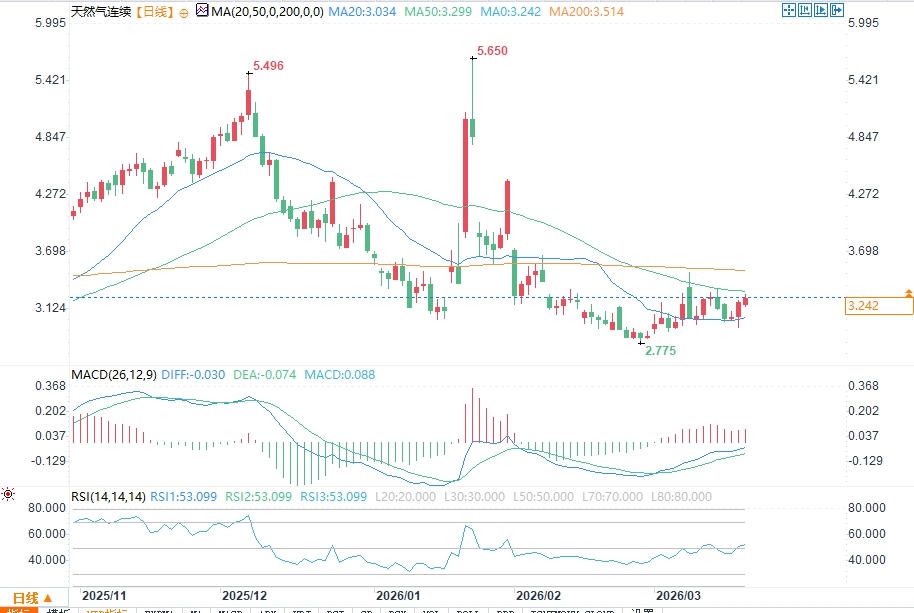
(COMEX natural gas daily chart source: EasyForex)
The biggest difference between the natural gas market and the crude oil market lies in the fact that the regional segmentation of the natural gas market means that risks are not reflected synchronously, but rather transmitted gradually in a staggered manner. This is also the core contradiction in the current market: risks already exist, but prices have not yet fully reflected them. In this environment, price calm does not mean safety, but rather that volatility is accumulating.
When export capacity, transportation security, and infrastructure become constraints, the market may maintain a semblance of stability for a long time, but once these constraints are broken, adjustments tend to be more drastic. For investors, what they really need to focus on is not just the price itself, but the underlying variables that determine the price—LNG flows, shipping costs, inventory changes, and the persistence of geopolitical situations.
In the energy market, the most dangerous thing is never the crisis that has already happened, but the risks that have not yet been fully priced in.
At 22:25 Beijing time, COEMX natural gas futures were trading at $3.246 per million British thermal units, up 5.91%.
Traders do not deny the existence of risk, but are still awaiting more decisive triggers, such as damage to key LNG facilities, disruptions to the transportation chain, or large-scale loading delays. Once these variables change from "possible" to "already happened," the price reaction is likely to shift from mild to rapid and violent. In other words, the current calm is more like a temporary equilibrium under uncertainty than a sign of risk abating.
LNG supply chain under pressure: a subtle tightening is underway.
From a fundamental perspective, risks are quietly accumulating. The global LNG system heavily relies on a relatively fragile chain: upstream gas sources, liquefaction facilities, maritime transport, and terminal regasification. Problems in any of these links could have a magnified effect on the overall supply. In the current environment, this chain has already experienced multiple disruptions—liquefaction facilities in the Middle East face safety concerns, key shipping routes are facing increased risks, shipping insurance costs have risen significantly, and some shipowners are beginning to actively avoid high-risk routes.
These changes won't immediately manifest as a gas shortage, but will gradually tighten the market through transportation delays, rising costs, and reduced available resources. The energy market often completes its pricing shift during this "implicit tightening": by the time a real shortage occurs, prices have often already moved significantly in advance. Therefore, rather than whether a supply has been "cut off," the continued decline in supply chain efficiency is more concerning.
US Market "Failure": Export Capacity Locks in Prices
In stark contrast to rising global risks, the US natural gas market has exhibited unusual sluggishness. The core reason for this lies not in weak demand, but in a structural constraint—the upper limit of LNG export capacity. While the US possesses substantial natural gas production, its ability to influence the global market depends on its liquefaction and export infrastructure, rather than the resources themselves.
At the current stage, LNG terminal capacity is limited, and export capacity is unlikely to expand rapidly in the short term. This means that even if demand surges in Europe and Asia, the United States cannot release additional supply in a timely manner. This constraint directly leads to market fragmentation: global LNG prices are tightening due to risk, while US domestic natural gas prices are reacting slowly due to relatively abundant supply, creating a clear "decoupling." In a sense, the US market is not without risk, but its price elasticity is "locked in" by infrastructure.
Europe becomes the pricing core: Global gas prices are being reshaped.
In contrast, Europe is at the heart of this energy repricing process. Due to its heavy reliance on imported LNG, Europe's dependence on the global spot market has increased significantly following constraints on traditional pipeline gas supplies. If the Middle East or other key supply sources are disrupted, Europe will have to compete for resources by raising purchase prices, thereby driving up global gas prices.
At the same time, Asian buyers will be passively drawn into the competition, leading to increased volatility in the spot market and even triggering a reassessment of long-term contract prices. In other words, natural gas prices are gradually shifting from "expectations of easing" to "marginal tight pricing," and Europe is amplifying this change. The pricing power in the global natural gas market is moving from a single region to a more complex multi-regional game.
Futures signals and future variables: The real market trend has not yet begun.
From the perspective of the futures market, the current price movement is more like a "wait-and-see equilibrium." On the one hand, actual supply has not yet been completely disrupted, and inventory levels still provide a certain buffer; on the other hand, seasonal factors are also suppressing demand, making the market lack the motivation to immediately factor in extreme scenarios. However, this equilibrium is inherently fragile because it is based on the premise that "the risks have not yet materialized."
Future trends will heavily depend on two key variables: first, whether geopolitical conflicts continue to impact the LNG supply chain; if critical facilities or transportation routes are damaged, supply shortages will quickly become apparent; second, whether there is a marginal release of US LNG export capacity; once export bottlenecks are broken, the price linkage between the US and global markets will significantly strengthen. Before this happens, the market may maintain a state of "superficial calm, underlying tension," but once the triggering conditions are met, price adjustments will be more rapid and non-linear.
In conclusion: The real risk is the risk that is suppressed.
(COMEX natural gas daily chart source: EasyForex)
The biggest difference between the natural gas market and the crude oil market lies in the fact that the regional segmentation of the natural gas market means that risks are not reflected synchronously, but rather transmitted gradually in a staggered manner. This is also the core contradiction in the current market: risks already exist, but prices have not yet fully reflected them. In this environment, price calm does not mean safety, but rather that volatility is accumulating.
When export capacity, transportation security, and infrastructure become constraints, the market may maintain a semblance of stability for a long time, but once these constraints are broken, adjustments tend to be more drastic. For investors, what they really need to focus on is not just the price itself, but the underlying variables that determine the price—LNG flows, shipping costs, inventory changes, and the persistence of geopolitical situations.
In the energy market, the most dangerous thing is never the crisis that has already happened, but the risks that have not yet been fully priced in.
At 22:25 Beijing time, COEMX natural gas futures were trading at $3.246 per million British thermal units, up 5.91%.
- Risk Warning and Disclaimer
- The market involves risk, and trading may not be suitable for all investors. This article is for reference only and does not constitute personal investment advice, nor does it take into account certain users’ specific investment objectives, financial situation, or other needs. Any investment decisions made based on this information are at your own risk.