The World Gold Council promotes the "Gold as a Service" model, ushering in the digital gold era.
2026-03-20 10:50:18
The World Gold Council announced a decisive step to reshape how gold functions in an increasingly digital financial system, unveiling a plan to build shared infrastructure to drive the next phase of digital gold adoption.
Despite recent market volatility, gold remains one of the best-performing assets, with particularly noteworthy growth in market sentiment surrounding tokenized gold. Industry data shows that the market capitalization of tokenized gold grew by 177% in 2025, from approximately $1.6 billion to $4.4 billion last year.
However, despite the industry's rapid growth, it continues to face some structural challenges, especially as decentralized platforms attempt to integrate digital innovation with physical assets. It is this complex and fragmented landscape that has prompted the World Gold Council (WGC) to address it through its latest initiatives.

On Thursday (March 19), the World Gold Council (WGC) and the Boston Consulting Group (BCG) jointly released a white paper titled "Digital Gold: The Necessity of Building the Infrastructure Together," which outlines a "Gold as a Service" model, an open platform designed to connect physical gold custody with digital systems used for issuing and managing gold products.
The core of the proposal is to standardize key processes such as custody coordination, reconciliation, compliance, and redemption, areas where scalability and interoperability in digital gold products have been very limited in recent years.
In an interview, Mike Oswin, Global Head of Market Structure and Innovation at the World Gold Council, said: “Digital gold is developing rapidly, but the infrastructure supporting it has failed to keep up. What we are seeing today is a fragmented ecosystem, with each supplier duplicating the same complex processes. This creates inefficiencies and ultimately limits growth.”
Oswin explained that while many developers are rapidly building platforms to support digital products, many ultimately fail because physical environments are often difficult to understand and manage.
He said: "The challenge of this complexity is to reach all agreements, whether it is liquidity, making sure you have the right suppliers to provide you with the right type of liquidity; or custody, storing it in a vault; insurance; or legal ownership, making sure you have the right legal structure to build around physical gold, thereby assuring your investors that they have full legal ownership of the physical asset."
Oswin points out that while tokenization helps expand access to gold, the lack of standardization limits its ability to seamlessly integrate into the modern financial system.
He explained, “Gold is essentially a physical asset, which presents unique challenges when you try to digitize it. You need absolute confidence in its custody, ownership, and redemption. Without a shared infrastructure, these guarantees are even more difficult to provide consistently across platforms.”
The proposed "Gold as a Service" model aims to address these issues by bringing together stakeholders in the market to create a common foundation for the issuance of digital gold. By embedding continuous reconciliation, auditability, and a standardized legal framework into the system, the platform aims to enhance trust while improving interchangeability between different products.
For Oswin, one of the most important achievements was the potential to transform gold from a static store of value into a more dynamic financial asset.
He stated, "If the issuance and circulation of digital gold can be standardized, then a wider range of application scenarios can be opened up. Gold can become a readily available form of capital, serving as collateral, integrating into the lending market, or achieving seamless circulation between different financial platforms."
This initiative also reflects a broader effort by the gold industry to ensure the metal remains relevant as financial markets undergo a rapid and ongoing digital transformation.
Oswin added, " The financial system is evolving rapidly, and gold needs to evolve accordingly. This is not about changing the nature of gold, but about ensuring that its core attributes such as trust, liquidity, and stability can exist in the digital environment. "
The World Gold Council (WGC) is currently calling on market participants, technology companies, and financial institutions to collaborate on developing shared infrastructure, suggesting that the next phase of growth for digital gold may depend heavily on collaboration rather than innovation alone.
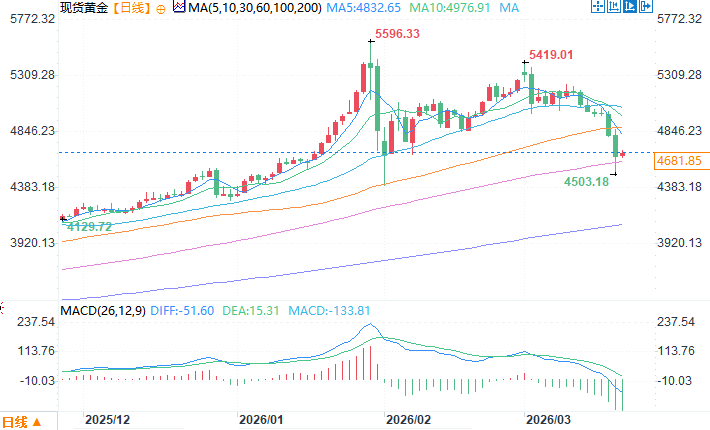
Spot gold daily chart source: EasyForex
At 10:50 AM Beijing time on March 20, spot gold was trading at $4700.15 per ounce.
Despite recent market volatility, gold remains one of the best-performing assets, with particularly noteworthy growth in market sentiment surrounding tokenized gold. Industry data shows that the market capitalization of tokenized gold grew by 177% in 2025, from approximately $1.6 billion to $4.4 billion last year.
However, despite the industry's rapid growth, it continues to face some structural challenges, especially as decentralized platforms attempt to integrate digital innovation with physical assets. It is this complex and fragmented landscape that has prompted the World Gold Council (WGC) to address it through its latest initiatives.
On Thursday (March 19), the World Gold Council (WGC) and the Boston Consulting Group (BCG) jointly released a white paper titled "Digital Gold: The Necessity of Building the Infrastructure Together," which outlines a "Gold as a Service" model, an open platform designed to connect physical gold custody with digital systems used for issuing and managing gold products.
The core of the proposal is to standardize key processes such as custody coordination, reconciliation, compliance, and redemption, areas where scalability and interoperability in digital gold products have been very limited in recent years.
In an interview, Mike Oswin, Global Head of Market Structure and Innovation at the World Gold Council, said: “Digital gold is developing rapidly, but the infrastructure supporting it has failed to keep up. What we are seeing today is a fragmented ecosystem, with each supplier duplicating the same complex processes. This creates inefficiencies and ultimately limits growth.”
Oswin explained that while many developers are rapidly building platforms to support digital products, many ultimately fail because physical environments are often difficult to understand and manage.
He said: "The challenge of this complexity is to reach all agreements, whether it is liquidity, making sure you have the right suppliers to provide you with the right type of liquidity; or custody, storing it in a vault; insurance; or legal ownership, making sure you have the right legal structure to build around physical gold, thereby assuring your investors that they have full legal ownership of the physical asset."
Oswin points out that while tokenization helps expand access to gold, the lack of standardization limits its ability to seamlessly integrate into the modern financial system.
He explained, “Gold is essentially a physical asset, which presents unique challenges when you try to digitize it. You need absolute confidence in its custody, ownership, and redemption. Without a shared infrastructure, these guarantees are even more difficult to provide consistently across platforms.”
The proposed "Gold as a Service" model aims to address these issues by bringing together stakeholders in the market to create a common foundation for the issuance of digital gold. By embedding continuous reconciliation, auditability, and a standardized legal framework into the system, the platform aims to enhance trust while improving interchangeability between different products.
For Oswin, one of the most important achievements was the potential to transform gold from a static store of value into a more dynamic financial asset.
He stated, "If the issuance and circulation of digital gold can be standardized, then a wider range of application scenarios can be opened up. Gold can become a readily available form of capital, serving as collateral, integrating into the lending market, or achieving seamless circulation between different financial platforms."
This initiative also reflects a broader effort by the gold industry to ensure the metal remains relevant as financial markets undergo a rapid and ongoing digital transformation.
Oswin added, " The financial system is evolving rapidly, and gold needs to evolve accordingly. This is not about changing the nature of gold, but about ensuring that its core attributes such as trust, liquidity, and stability can exist in the digital environment. "
The World Gold Council (WGC) is currently calling on market participants, technology companies, and financial institutions to collaborate on developing shared infrastructure, suggesting that the next phase of growth for digital gold may depend heavily on collaboration rather than innovation alone.
Spot gold daily chart source: EasyForex
At 10:50 AM Beijing time on March 20, spot gold was trading at $4700.15 per ounce.
- Risk Warning and Disclaimer
- The market involves risk, and trading may not be suitable for all investors. This article is for reference only and does not constitute personal investment advice, nor does it take into account certain users’ specific investment objectives, financial situation, or other needs. Any investment decisions made based on this information are at your own risk.