Nomura Securities issued a warning about the South Korean shipbuilding industry, downgrading Hyundai Heavy Industries' rating and cutting its target price by 33% to 350,000 won.
2026-03-20 13:21:37
According to APP, Nomura Securities analyst Eon Hwang pointed out that the current high valuations of the South Korean shipbuilding sector may face a significant correction in the second half of 2026. He emphasized that, influenced by geopolitical risks related to the Suez Canal and the Strait of Hormuz, the market's optimistic expectations for more defense contracts and rising freight rates in the first half of the year will continue to provide valuation support. However, the continued decline in new ship prices and the subsequent easing of tensions in the Middle East will prompt Nomura to become more cautious in the second half of the year.

In his latest report, Eon Hwang clearly stated: "The surge in orders driven by geopolitical factors in the first half of the year masked capacity expansion and price pressures. However, once the situation in the Middle East stabilizes, the decline in new shipbuilding prices will directly compress shipyard profit margins, making the current high valuations unsustainable." This judgment is based on the latest developments in the global shipping market: although the current conflict in the Middle East continues to drive demand for LNG carriers and tankers, Nomura expects order growth to slow in the second half of the year, and low-price competition from Chinese shipyards will further suppress the pricing power of South Korean shipbuilders.
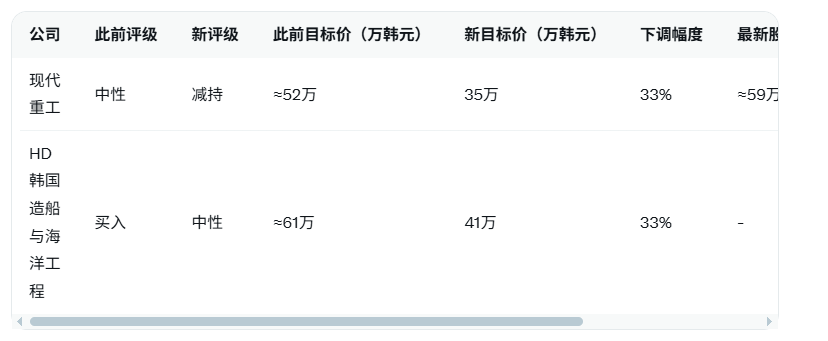
Nomura has therefore adjusted its ratings: Hyundai Heavy Industries was downgraded from "Neutral" to "Underweight," with its target price lowered by 33% to 350,000 won; its subsidiary , HD Korea Shipbuilding & Offshore Engineering, was downgraded from "Buy" to "Neutral," with its target price also lowered by 33% to 410,000 won. Latest market data shows that Hyundai Heavy Industries' current share price is around 590,000 won, and both target prices suggest significant downside potential, highlighting Nomura's strong expectation for valuation recovery.
This adjustment reflects a turning point in the industry cycle. In the first half of the year, continued congestion in the Suez Canal, coupled with the potential risk of a blockade of the Strait of Hormuz, drove a surge in global freight rates and demand for defense-related vessels (LNG carriers, tankers, and special-purpose vessels), resulting in full order books for South Korean shipbuilders. However, Nomura warns that new ship prices have already shown a downward trend from their 2025 peak, and if the Middle East experiences a period of easing, freight rate corrections will directly impact shipyard gross margins. Coupled with the expansion of global shipbuilding capacity, leading South Korean companies face a double squeeze, and the pressure for valuation corrections cannot be ignored.
The following is a comparison of Nomura's latest rating and target price adjustments (based on the latest data as of March 2026):
Overall, Nomura's cautious stance does not negate the long-term competitiveness of South Korea's shipbuilding industry, but rather serves as a reminder to investors to pay attention to the risks of a cyclical shift. While short-term geopolitical premiums persist, a fundamental turning point is emerging in the second half of the year. Investors are advised to proactively position themselves defensively or wait for a pullback to a better entry point.
Editor's Summary:
Nomura Securities, through its Eon Hwang report, clearly signals that the geopolitical advantages enjoyed by South Korean shipbuilding stocks in the first half of the year cannot mask the valuation pressures brought about by declining new ship prices and easing tensions in the Middle East in the second half. The downgrade of Hyundai Heavy Industries and HD Korea Shipbuilding & Offshore Engineering Co., Ltd., coupled with a 33% reduction in target prices, highlights the inflection point in the industry's transition from high growth to stability. Investors should closely monitor global freight rate indices, the evolving situation in the Middle East, and the competitive dynamics among shipyards in major Asian countries.
Frequently Asked Questions
Q1: Why did Nomura choose this time to downgrade its stake in Hyundai Heavy Industries to "reduce"?
A: Eon Hwang believes that while the Suez Canal congestion and the Strait of Hormuz risks supported defense contracts and freight rate expectations in the first half of the year, driving a surge in orders, new ship prices have shown a downward trend in the second half. Furthermore, if tensions in the Middle East ease, a drop in freight rates will directly compress shipyard profit margins. The current high valuations are unsustainable; therefore, he has downgraded Hyundai Heavy Industries from neutral to underweight, cutting his target price by 33% to 350,000 won, a significant difference from the latest share price of 590,000 won.
Q2: What is the connection between HD Korea Shipbuilding & Marine Engineering Co.'s restructuring logic and Hyundai Heavy Industries?
A: As an intermediate holding company, its rating was downgraded from Buy to Neutral, and the target price was simultaneously cut by 33% to 410,000 won, primarily due to the same industry cycle assessment. Nomura expects the pressure on shipbuilding fundamentals in the second half of the year to be transmitted to the holding company structure. Coupled with global capacity expansion and low-price competition from China, the pressure on the holding company's valuation to recover will increase simultaneously. Investors need to pay attention to the linkage effect between the two.
Q3: How exactly did geopolitical factors support shipbuilding valuations in the first half of the year?
A: Continued congestion in the Suez Canal, coupled with potential risks in the Strait of Hormuz, has boosted global demand for LNG carriers, tankers, and special-purpose vessels. This has increased the likelihood of South Korean shipbuilders winning defense contracts, keeping freight rates high. Eon Hwang points out that this premium will support orders and stock prices in the first half of the year, but it is a short-term catalyst; once the situation in the Middle East eases, the support will quickly dissipate.
Q4: What is the actual impact of the decline in new ship prices on the profitability of South Korean shipbuilders?
A: The decline in new ship prices directly reduces the gross margin of new orders, while existing order books face pressure to revalue their execution profits. Nomura expects intensified price competition among major Asian shipyards to amplify this effect, leading to a downward revision of the 2026 second-half profit forecasts for leading South Korean companies, and consequently driving a correction in high valuations. Current full order books mask this potential risk, but a turning point has already emerged in the second half of the year.
In his latest report, Eon Hwang clearly stated: "The surge in orders driven by geopolitical factors in the first half of the year masked capacity expansion and price pressures. However, once the situation in the Middle East stabilizes, the decline in new shipbuilding prices will directly compress shipyard profit margins, making the current high valuations unsustainable." This judgment is based on the latest developments in the global shipping market: although the current conflict in the Middle East continues to drive demand for LNG carriers and tankers, Nomura expects order growth to slow in the second half of the year, and low-price competition from Chinese shipyards will further suppress the pricing power of South Korean shipbuilders.
Nomura has therefore adjusted its ratings: Hyundai Heavy Industries was downgraded from "Neutral" to "Underweight," with its target price lowered by 33% to 350,000 won; its subsidiary , HD Korea Shipbuilding & Offshore Engineering, was downgraded from "Buy" to "Neutral," with its target price also lowered by 33% to 410,000 won. Latest market data shows that Hyundai Heavy Industries' current share price is around 590,000 won, and both target prices suggest significant downside potential, highlighting Nomura's strong expectation for valuation recovery.
This adjustment reflects a turning point in the industry cycle. In the first half of the year, continued congestion in the Suez Canal, coupled with the potential risk of a blockade of the Strait of Hormuz, drove a surge in global freight rates and demand for defense-related vessels (LNG carriers, tankers, and special-purpose vessels), resulting in full order books for South Korean shipbuilders. However, Nomura warns that new ship prices have already shown a downward trend from their 2025 peak, and if the Middle East experiences a period of easing, freight rate corrections will directly impact shipyard gross margins. Coupled with the expansion of global shipbuilding capacity, leading South Korean companies face a double squeeze, and the pressure for valuation corrections cannot be ignored.
The following is a comparison of Nomura's latest rating and target price adjustments (based on the latest data as of March 2026):
Overall, Nomura's cautious stance does not negate the long-term competitiveness of South Korea's shipbuilding industry, but rather serves as a reminder to investors to pay attention to the risks of a cyclical shift. While short-term geopolitical premiums persist, a fundamental turning point is emerging in the second half of the year. Investors are advised to proactively position themselves defensively or wait for a pullback to a better entry point.
Editor's Summary:
Nomura Securities, through its Eon Hwang report, clearly signals that the geopolitical advantages enjoyed by South Korean shipbuilding stocks in the first half of the year cannot mask the valuation pressures brought about by declining new ship prices and easing tensions in the Middle East in the second half. The downgrade of Hyundai Heavy Industries and HD Korea Shipbuilding & Offshore Engineering Co., Ltd., coupled with a 33% reduction in target prices, highlights the inflection point in the industry's transition from high growth to stability. Investors should closely monitor global freight rate indices, the evolving situation in the Middle East, and the competitive dynamics among shipyards in major Asian countries.
Frequently Asked Questions
Q1: Why did Nomura choose this time to downgrade its stake in Hyundai Heavy Industries to "reduce"?
A: Eon Hwang believes that while the Suez Canal congestion and the Strait of Hormuz risks supported defense contracts and freight rate expectations in the first half of the year, driving a surge in orders, new ship prices have shown a downward trend in the second half. Furthermore, if tensions in the Middle East ease, a drop in freight rates will directly compress shipyard profit margins. The current high valuations are unsustainable; therefore, he has downgraded Hyundai Heavy Industries from neutral to underweight, cutting his target price by 33% to 350,000 won, a significant difference from the latest share price of 590,000 won.
Q2: What is the connection between HD Korea Shipbuilding & Marine Engineering Co.'s restructuring logic and Hyundai Heavy Industries?
A: As an intermediate holding company, its rating was downgraded from Buy to Neutral, and the target price was simultaneously cut by 33% to 410,000 won, primarily due to the same industry cycle assessment. Nomura expects the pressure on shipbuilding fundamentals in the second half of the year to be transmitted to the holding company structure. Coupled with global capacity expansion and low-price competition from China, the pressure on the holding company's valuation to recover will increase simultaneously. Investors need to pay attention to the linkage effect between the two.
Q3: How exactly did geopolitical factors support shipbuilding valuations in the first half of the year?
A: Continued congestion in the Suez Canal, coupled with potential risks in the Strait of Hormuz, has boosted global demand for LNG carriers, tankers, and special-purpose vessels. This has increased the likelihood of South Korean shipbuilders winning defense contracts, keeping freight rates high. Eon Hwang points out that this premium will support orders and stock prices in the first half of the year, but it is a short-term catalyst; once the situation in the Middle East eases, the support will quickly dissipate.
Q4: What is the actual impact of the decline in new ship prices on the profitability of South Korean shipbuilders?
A: The decline in new ship prices directly reduces the gross margin of new orders, while existing order books face pressure to revalue their execution profits. Nomura expects intensified price competition among major Asian shipyards to amplify this effect, leading to a downward revision of the 2026 second-half profit forecasts for leading South Korean companies, and consequently driving a correction in high valuations. Current full order books mask this potential risk, but a turning point has already emerged in the second half of the year.
- Risk Warning and Disclaimer
- The market involves risk, and trading may not be suitable for all investors. This article is for reference only and does not constitute personal investment advice, nor does it take into account certain users’ specific investment objectives, financial situation, or other needs. Any investment decisions made based on this information are at your own risk.