Iranian missiles strike Qatari energy facilities! Saad al-Qaeda reveals 17% LNG production capacity paralyzed for 5 years.
2026-03-20 13:15:30
According to APP, the Iranian missile attack directly crippled Qatar's core energy hub, paralyzing 17% of Qatar Energy's LNG export capacity . Saad al-Qaeda stated that two of Qatar's 14 LNG production lines and one of its two gas-to-liquid (GTL) facilities were severely damaged, with an estimated 12.8 million tons of LNG capacity shut down for three to five years, resulting in a direct revenue loss of approximately $20 billion annually and seriously threatening the energy supply stability of major European and Asian countries.

This incident stems from the rapid escalation of geopolitical conflicts in the Middle East. Israel's attack on Iran's South Pars gas field triggered a chain reaction, with Iran subsequently launching a retaliatory attack on Qatar's Ras Raffar industrial city. Saad al-Qaeda emphasized, "I never imagined Qatar would suffer such an attack, especially from a brotherly Muslim country during Ramadan." He called on all countries to immediately cease hostilities and strictly prohibit attacks on oil and gas facilities, otherwise global energy security would face even greater risks. Iranian President Peshichiyan also publicly condemned the attack, warning that its consequences could spiral out of control and affect the entire world.
Qatar Energy is currently facing dual pressures: on the one hand, it needs to assess the enormous reconstruction costs (latest estimate around $26 billion); on the other hand, it may be forced to declare force majeure on some long-term LNG supply contracts, for up to five years. This will directly impact the gas supply for winter heating in many European countries and the industrial and residential gas supply in major Asian countries. The global LNG market was already tight due to demand recovery, and this event will further push up spot prices, accelerating buyers' shift to alternative sources such as the United States and Australia. However, the supply chain disruptions will be difficult to fully repair in the short term.
The following is a comparison of the damaged facilities and their impact in this attack (based on the latest official data):
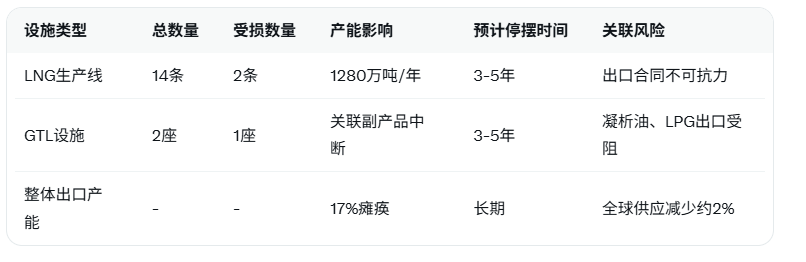
This attack not only severely damaged Qatar's position as one of the world's largest LNG exporters (currently exporting approximately 77 million tons annually, accounting for about 20% of global exports), but also highlighted the vulnerability of energy infrastructure in conflict. In the short term, Europe faces the risk of a worsening shortage of alternatives to Russian pipeline gas, while major Asian industrial companies may experience the impact of soaring gas prices on manufacturing costs. In the long term, the event may accelerate global energy diversification, but it also serves as a reminder that geopolitical risks have become a core variable that must be considered in energy investment.
Editor's Summary:
The Iranian attack on Qatari energy facilities marks the extension of the Middle East conflict into the core energy sector. The direct impact of a 17% capacity shutdown and $20 billion in annual losses will be rapidly transmitted to major European and Asian markets through the global LNG pricing mechanism. The recovery period of 3-5 years and the risk of force majeure further amplify the vulnerability of the supply chain. Investors need to pay close attention to LNG spot price fluctuations, alternative supply dynamics, and the possibility of conflict escalation to assess the systemic impact on the energy sector.
Frequently Asked Questions
Q1: Which buyers will be affected by Qatar Energy's potential declaration of force majeure on long-term contracts?
A: The long-term contracts for the damaged production lines cover buyers in multiple European countries and major Asian countries, with force majeure periods lasting up to 5 years. Saad al-Kaabi explicitly stated that the previously declared short-term force majeure will be significantly extended this time. Buyers will need to turn to the spot market for higher-priced purchases, and countries like South Korea, which heavily rely on Qatari LNG (accounting for 25-30%), will face the risk of supply disruptions.
Q2: How is the $20 billion annual revenue loss calculated, and what is the global impact?
A: Based on current LNG prices and Qatar's export share, a 17% capacity shutdown directly translates to an annual revenue shortfall of approximately $20 billion. Simultaneously, exports of byproducts such as condensate and LPG are also hampered. Global LNG supply will decrease by about 2%, with European winter demand and industrial gas consumption in major Asian countries bearing the brunt. Spot prices are expected to rise sharply in the short term, driving energy inflationary pressures.
Q3: Why did the Iranian attack paralyze 17% of Qatar's LNG production capacity?
A: Qatar's Ras Raffarin Industrial City is the world's largest LNG production base, housing the core capacity of 14 production lines. Iranian missiles precisely targeted two LNG production lines and one GTL facility, directly causing a permanent interruption of 12.8 million tons/year of capacity. Saad al-Qaeda pointed out that this attack was unprecedented, and repairs will take 3-5 years, mainly due to the long reconstruction period and the security assessments involved.
This incident stems from the rapid escalation of geopolitical conflicts in the Middle East. Israel's attack on Iran's South Pars gas field triggered a chain reaction, with Iran subsequently launching a retaliatory attack on Qatar's Ras Raffar industrial city. Saad al-Qaeda emphasized, "I never imagined Qatar would suffer such an attack, especially from a brotherly Muslim country during Ramadan." He called on all countries to immediately cease hostilities and strictly prohibit attacks on oil and gas facilities, otherwise global energy security would face even greater risks. Iranian President Peshichiyan also publicly condemned the attack, warning that its consequences could spiral out of control and affect the entire world.
Qatar Energy is currently facing dual pressures: on the one hand, it needs to assess the enormous reconstruction costs (latest estimate around $26 billion); on the other hand, it may be forced to declare force majeure on some long-term LNG supply contracts, for up to five years. This will directly impact the gas supply for winter heating in many European countries and the industrial and residential gas supply in major Asian countries. The global LNG market was already tight due to demand recovery, and this event will further push up spot prices, accelerating buyers' shift to alternative sources such as the United States and Australia. However, the supply chain disruptions will be difficult to fully repair in the short term.
The following is a comparison of the damaged facilities and their impact in this attack (based on the latest official data):
This attack not only severely damaged Qatar's position as one of the world's largest LNG exporters (currently exporting approximately 77 million tons annually, accounting for about 20% of global exports), but also highlighted the vulnerability of energy infrastructure in conflict. In the short term, Europe faces the risk of a worsening shortage of alternatives to Russian pipeline gas, while major Asian industrial companies may experience the impact of soaring gas prices on manufacturing costs. In the long term, the event may accelerate global energy diversification, but it also serves as a reminder that geopolitical risks have become a core variable that must be considered in energy investment.
Editor's Summary:
The Iranian attack on Qatari energy facilities marks the extension of the Middle East conflict into the core energy sector. The direct impact of a 17% capacity shutdown and $20 billion in annual losses will be rapidly transmitted to major European and Asian markets through the global LNG pricing mechanism. The recovery period of 3-5 years and the risk of force majeure further amplify the vulnerability of the supply chain. Investors need to pay close attention to LNG spot price fluctuations, alternative supply dynamics, and the possibility of conflict escalation to assess the systemic impact on the energy sector.
Frequently Asked Questions
Q1: Which buyers will be affected by Qatar Energy's potential declaration of force majeure on long-term contracts?
A: The long-term contracts for the damaged production lines cover buyers in multiple European countries and major Asian countries, with force majeure periods lasting up to 5 years. Saad al-Kaabi explicitly stated that the previously declared short-term force majeure will be significantly extended this time. Buyers will need to turn to the spot market for higher-priced purchases, and countries like South Korea, which heavily rely on Qatari LNG (accounting for 25-30%), will face the risk of supply disruptions.
Q2: How is the $20 billion annual revenue loss calculated, and what is the global impact?
A: Based on current LNG prices and Qatar's export share, a 17% capacity shutdown directly translates to an annual revenue shortfall of approximately $20 billion. Simultaneously, exports of byproducts such as condensate and LPG are also hampered. Global LNG supply will decrease by about 2%, with European winter demand and industrial gas consumption in major Asian countries bearing the brunt. Spot prices are expected to rise sharply in the short term, driving energy inflationary pressures.
Q3: Why did the Iranian attack paralyze 17% of Qatar's LNG production capacity?
A: Qatar's Ras Raffarin Industrial City is the world's largest LNG production base, housing the core capacity of 14 production lines. Iranian missiles precisely targeted two LNG production lines and one GTL facility, directly causing a permanent interruption of 12.8 million tons/year of capacity. Saad al-Qaeda pointed out that this attack was unprecedented, and repairs will take 3-5 years, mainly due to the long reconstruction period and the security assessments involved.
- Risk Warning and Disclaimer
- The market involves risk, and trading may not be suitable for all investors. This article is for reference only and does not constitute personal investment advice, nor does it take into account certain users’ specific investment objectives, financial situation, or other needs. Any investment decisions made based on this information are at your own risk.