The Iranian conflict has shattered dreams of interest rate cuts! The Bank of England has shifted its hawkish stance, with the market betting on two rate hikes this year.
2026-03-20 14:37:39
Over the past three weeks, UK interest rate expectations have undergone a dramatic reversal. Before the outbreak of the Iran war, the money market widely anticipated two rate cuts by the Bank of England in 2026; now, market pricing has completely reversed, implying the possibility of two rate hikes throughout the year. The pound has therefore appreciated significantly, reflecting extreme market concerns about the inflation outlook.
Earlier this month, the market had expected the Monetary Policy Committee (MPC) to vote by a large majority to cut interest rates by 25 basis points. However, Thursday's meeting yielded a surprising result: all nine members unanimously voted to keep rates unchanged, marking the most unified hawkish stance in recent years.
The committee also significantly raised its inflation forecast: the March CPI inflation rate is expected to be close to 3.5%, nearly 0.5 percentage points higher than the February report; the second-quarter CPI is no longer expected to fall to 2.1%, but is instead expected to remain around 3%. Even if inflation subsequently gradually falls back to 2%, the Bank of England is unlikely to consider cutting interest rates until the third quarter at the earliest.
The money market reacted even more strongly, completely ruling out any possibility of a rate cut in 2026. Instead, it implies that if inflation gets out of control, the Bank of England may be forced to raise interest rates to curb a second wave of effects.
Nikesh Sawjani, senior UK economist at Lloyds Bank, said: “The Monetary Policy Committee is more sensitive to the risk of a second round of effects, and if evidence emerges that such a risk is materializing, the Committee is likely to consider tightening monetary policy as an appropriate deterrent.”
The Bank of England tends to view the energy shock as a temporary inflationary disturbance, but is aware that if households and businesses expect prices to continue rising, it will trigger a wage-price spiral. Workers will demand wage increases to maintain their standard of living, while businesses will pass on costs to protect profits, ultimately leading to a decoupling of inflation expectations.
Since the outbreak of the Iran-Iraq War, Brent crude oil prices have surged by over 40%, and European natural gas prices have even soared by 35%, directly increasing imported inflationary pressures in the UK. Disruptions to shipping in the Strait of Hormuz and attacks on Middle Eastern energy facilities have created long-term structural disruptions to global supply chains.
The Bank of England's communications indicate it still hopes to cut interest rates later this year, but the market no longer believes this narrative. Investors believe that inflation data is likely to continue to exceed expectations in the coming months, forcing the Bank of England to shift to tightening or even raise interest rates to anchor expectations.
In conclusion , the energy crisis triggered by the Iran war and the sharp resurgence of inflation expectations have completely overturned the path of British monetary policy. Two rate cuts, widely anticipated just three weeks ago, have now been completely abandoned by the market, replaced by extreme pricing in zero rate cuts or even two rate hikes throughout the year. The pound sterling and savings rates have consequently risen sharply, reflecting the market's extreme vigilance regarding inflation risks. In the coming months, oil price movements, the evolution of the Middle East conflict, and UK inflation data will directly determine whether the Bank of England will be forced to adopt a hawkish stance.
Investors need to pay close attention to the MPC's attitude toward the second-round effect and actual inflation performance. This round of energy crisis has evolved from regional conflict into the biggest source of uncertainty for the UK economy and monetary policy.
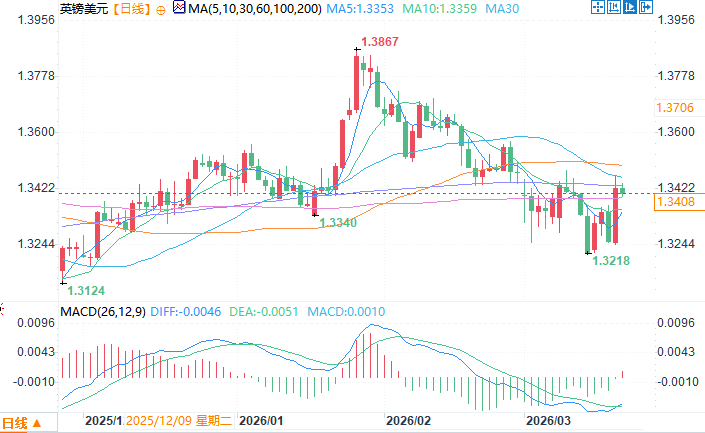
GBP/USD daily chart source: FX678
At 14:24 Beijing time on March 20, the British pound was trading at 1.3408/09 against the US dollar.
The Bank of England's hawkish March decision completely changed market expectations.
Earlier this month, the market had expected the Monetary Policy Committee (MPC) to vote by a large majority to cut interest rates by 25 basis points. However, Thursday's meeting yielded a surprising result: all nine members unanimously voted to keep rates unchanged, marking the most unified hawkish stance in recent years.
The committee also significantly raised its inflation forecast: the March CPI inflation rate is expected to be close to 3.5%, nearly 0.5 percentage points higher than the February report; the second-quarter CPI is no longer expected to fall to 2.1%, but is instead expected to remain around 3%. Even if inflation subsequently gradually falls back to 2%, the Bank of England is unlikely to consider cutting interest rates until the third quarter at the earliest.
Market pricing has been completely reversed: no interest rate cuts throughout the year, and even implying two rate hikes.
The money market reacted even more strongly, completely ruling out any possibility of a rate cut in 2026. Instead, it implies that if inflation gets out of control, the Bank of England may be forced to raise interest rates to curb a second wave of effects.
Nikesh Sawjani, senior UK economist at Lloyds Bank, said: “The Monetary Policy Committee is more sensitive to the risk of a second round of effects, and if evidence emerges that such a risk is materializing, the Committee is likely to consider tightening monetary policy as an appropriate deterrent.”
The Bank of England tends to view the energy shock as a temporary inflationary disturbance, but is aware that if households and businesses expect prices to continue rising, it will trigger a wage-price spiral. Workers will demand wage increases to maintain their standard of living, while businesses will pass on costs to protect profits, ultimately leading to a decoupling of inflation expectations.
The double whammy of energy crisis and inflation expectations
Since the outbreak of the Iran-Iraq War, Brent crude oil prices have surged by over 40%, and European natural gas prices have even soared by 35%, directly increasing imported inflationary pressures in the UK. Disruptions to shipping in the Strait of Hormuz and attacks on Middle Eastern energy facilities have created long-term structural disruptions to global supply chains.
The Bank of England's communications indicate it still hopes to cut interest rates later this year, but the market no longer believes this narrative. Investors believe that inflation data is likely to continue to exceed expectations in the coming months, forcing the Bank of England to shift to tightening or even raise interest rates to anchor expectations.
In conclusion , the energy crisis triggered by the Iran war and the sharp resurgence of inflation expectations have completely overturned the path of British monetary policy. Two rate cuts, widely anticipated just three weeks ago, have now been completely abandoned by the market, replaced by extreme pricing in zero rate cuts or even two rate hikes throughout the year. The pound sterling and savings rates have consequently risen sharply, reflecting the market's extreme vigilance regarding inflation risks. In the coming months, oil price movements, the evolution of the Middle East conflict, and UK inflation data will directly determine whether the Bank of England will be forced to adopt a hawkish stance.
Investors need to pay close attention to the MPC's attitude toward the second-round effect and actual inflation performance. This round of energy crisis has evolved from regional conflict into the biggest source of uncertainty for the UK economy and monetary policy.
GBP/USD daily chart source: FX678
At 14:24 Beijing time on March 20, the British pound was trading at 1.3408/09 against the US dollar.
- Risk Warning and Disclaimer
- The market involves risk, and trading may not be suitable for all investors. This article is for reference only and does not constitute personal investment advice, nor does it take into account certain users’ specific investment objectives, financial situation, or other needs. Any investment decisions made based on this information are at your own risk.