Geopolitical headlines dominate oil prices; WTI crude oil may remain volatile in the short term.
2026-03-20 19:43:12
The current crude oil market is in a typical "news-driven" phase. The escalating conflict in the Middle East has made energy infrastructure security, shipping lane stability, and diplomatic progress the core variables driving price fluctuations. Against this backdrop, the market is highly sensitive to breaking news, with intraday fluctuations frequently reaching $3 to $5, accompanied by a surge in trading volume, reflecting the rapid shift of funds and risk repricing in a highly uncertain environment.
From a pricing logic perspective, the traditional supply and demand framework is marginalized in the short term, with risk premiums becoming the dominant factor. Any news concerning the security of shipping in the Strait of Hormuz, infrastructure development in key oil-producing countries, or escalation of military operations could quickly trigger non-linear price fluctuations.
Benchmark crude oil prices diverged: Brent remained strong, while WTI's performance was relatively limited.
The performance of different benchmark crude oils diverged significantly. Brent and Middle East crude oil, directly exposed to potential supply disruptions, generally showed stronger price trends. Technically, the short-term moving average system is in a bullish alignment, with the 20-day moving average crossing above the 50-day moving average to form a "golden cross," and the Relative Strength Index (RSI) remaining in the mid-to-high range, indicating continued upward momentum.
In contrast, WTI (light sweet crude oil) exhibits a more pronounced range-bound trading pattern. Prices are currently hovering below the $100 mark, with increasing divergence between bulls and bears, and the direction remains unclear.
The core of this difference lies in its regional characteristics: WTI primarily reflects supply and demand within the United States, while Brent more directly reflects global trade flows and geopolitical risks. Currently, the global risk premium is mainly reflected in the Brent system, rather than being fully transmitted to WTI.
Fundamental constraints: US production and inventory levels limit upside potential.
From a fundamental perspective, the supply side of the US crude oil market remains resilient. Shale oil production remains at historically high levels, and commercial inventories are at relatively ample levels, which to some extent weakens the upside potential of WTI crude oil.
Meanwhile, U.S. crude oil exports continue to grow. According to data from the U.S. Energy Information Administration (EIA), export volumes have been breaking records in recent years and are projected to increase further in 2026, supported by expansion of port and pipeline infrastructure. This increased export capacity not only increases global market supply but also improves profit expectations for the U.S. energy industry, providing support for oil prices in the medium to long term.
Overall, in the short term, the US factor is more likely to "suppress the upper limit of volatility" rather than change the overall upward trend.
Technical Analysis: Awaiting Breakout Signal in Key Range
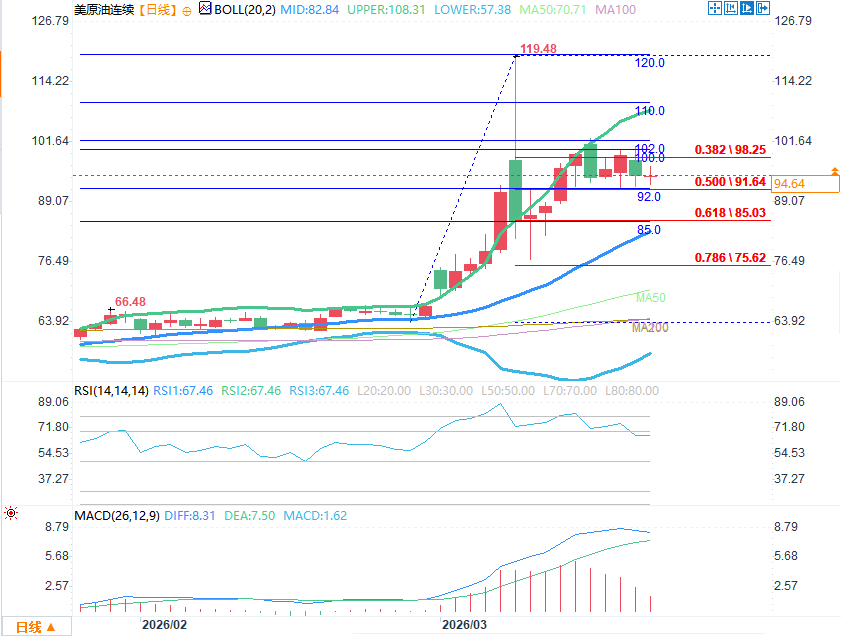
(WTI crude oil daily chart source: FX678)
From a technical perspective, WTI is currently in a typical consolidation phase. The Bollinger Bands are narrowing significantly, indicating that volatility has fallen to a low point; the MACD indicator is close to the zero line, trend momentum is weakening, and the market has entered a window of "waiting for a directional choice."
The $100 mark constitutes a significant psychological and technical resistance level. Historical experience shows that this position has repeatedly become a key area where bulls have failed to break through, and a large number of institutional orders and algorithmic trading strategies are concentrated in this vicinity, reinforcing its resistance properties.
If the price breaks through $102 effectively, accompanied by increased trading volume and a simultaneous strengthening of momentum indicators, it is likely to confirm an upward breakout, opening up further upside potential, with a target range of $110 to $120.
Conversely, if prices fall, support levels to watch are around $92 (corresponding to the 50% retracement of the previous upward range) and around $85 (the 61.8% Fibonacci retracement level). These levels have been repeatedly validated as effective support areas in historical cycles and have strong technical reference value.
Price spread structure: Brent premium reflects regional risk pricing
Currently, Brent crude maintains a premium of approximately $20 over WTI, a price difference primarily stemming from differences in risk exposure. Brent prices are more sensitive to international shipping routes, European energy security, and changes in Asian demand, while WTI is constrained by the supply and demand structure and logistics system within the United States.
Uncertainty surrounding key passages such as the Strait of Hormuz has led to a higher geopolitical risk premium in the Brent system. The widening spread essentially reflects the global market's repricing of "regional risk asymmetry."
Strategic Perspective: Trading Preferences Driven by Risk Premium
In the current environment, market pricing is highly dependent on unforeseen events, and short-selling strategies face significant asymmetric risks. Any news of supply disruptions or escalating conflicts could trigger a rapid price increase, exposing short positions to high volatility.
In comparison, "buying on dips" remains the mainstream strategy that better aligns with the current market structure. This logic stems not only from the continued existence of short-term risk premiums but is also supported by medium-term fundamentals.
From the demand side, global crude oil consumption is projected to maintain steady growth in 2026, supported by expanding industrial activity in emerging markets, increased summer travel demand, and the recovery of air transport. However, with geopolitical uncertainties on the supply side remaining unresolved, the risk of supply-demand mismatch persists.
From a pricing logic perspective, the traditional supply and demand framework is marginalized in the short term, with risk premiums becoming the dominant factor. Any news concerning the security of shipping in the Strait of Hormuz, infrastructure development in key oil-producing countries, or escalation of military operations could quickly trigger non-linear price fluctuations.
Benchmark crude oil prices diverged: Brent remained strong, while WTI's performance was relatively limited.
The performance of different benchmark crude oils diverged significantly. Brent and Middle East crude oil, directly exposed to potential supply disruptions, generally showed stronger price trends. Technically, the short-term moving average system is in a bullish alignment, with the 20-day moving average crossing above the 50-day moving average to form a "golden cross," and the Relative Strength Index (RSI) remaining in the mid-to-high range, indicating continued upward momentum.
In contrast, WTI (light sweet crude oil) exhibits a more pronounced range-bound trading pattern. Prices are currently hovering below the $100 mark, with increasing divergence between bulls and bears, and the direction remains unclear.
The core of this difference lies in its regional characteristics: WTI primarily reflects supply and demand within the United States, while Brent more directly reflects global trade flows and geopolitical risks. Currently, the global risk premium is mainly reflected in the Brent system, rather than being fully transmitted to WTI.
Fundamental constraints: US production and inventory levels limit upside potential.
From a fundamental perspective, the supply side of the US crude oil market remains resilient. Shale oil production remains at historically high levels, and commercial inventories are at relatively ample levels, which to some extent weakens the upside potential of WTI crude oil.
Meanwhile, U.S. crude oil exports continue to grow. According to data from the U.S. Energy Information Administration (EIA), export volumes have been breaking records in recent years and are projected to increase further in 2026, supported by expansion of port and pipeline infrastructure. This increased export capacity not only increases global market supply but also improves profit expectations for the U.S. energy industry, providing support for oil prices in the medium to long term.
Overall, in the short term, the US factor is more likely to "suppress the upper limit of volatility" rather than change the overall upward trend.
Technical Analysis: Awaiting Breakout Signal in Key Range
(WTI crude oil daily chart source: FX678)
From a technical perspective, WTI is currently in a typical consolidation phase. The Bollinger Bands are narrowing significantly, indicating that volatility has fallen to a low point; the MACD indicator is close to the zero line, trend momentum is weakening, and the market has entered a window of "waiting for a directional choice."
The $100 mark constitutes a significant psychological and technical resistance level. Historical experience shows that this position has repeatedly become a key area where bulls have failed to break through, and a large number of institutional orders and algorithmic trading strategies are concentrated in this vicinity, reinforcing its resistance properties.
If the price breaks through $102 effectively, accompanied by increased trading volume and a simultaneous strengthening of momentum indicators, it is likely to confirm an upward breakout, opening up further upside potential, with a target range of $110 to $120.
Conversely, if prices fall, support levels to watch are around $92 (corresponding to the 50% retracement of the previous upward range) and around $85 (the 61.8% Fibonacci retracement level). These levels have been repeatedly validated as effective support areas in historical cycles and have strong technical reference value.
Price spread structure: Brent premium reflects regional risk pricing
Currently, Brent crude maintains a premium of approximately $20 over WTI, a price difference primarily stemming from differences in risk exposure. Brent prices are more sensitive to international shipping routes, European energy security, and changes in Asian demand, while WTI is constrained by the supply and demand structure and logistics system within the United States.
Uncertainty surrounding key passages such as the Strait of Hormuz has led to a higher geopolitical risk premium in the Brent system. The widening spread essentially reflects the global market's repricing of "regional risk asymmetry."
Strategic Perspective: Trading Preferences Driven by Risk Premium
In the current environment, market pricing is highly dependent on unforeseen events, and short-selling strategies face significant asymmetric risks. Any news of supply disruptions or escalating conflicts could trigger a rapid price increase, exposing short positions to high volatility.
In comparison, "buying on dips" remains the mainstream strategy that better aligns with the current market structure. This logic stems not only from the continued existence of short-term risk premiums but is also supported by medium-term fundamentals.
From the demand side, global crude oil consumption is projected to maintain steady growth in 2026, supported by expanding industrial activity in emerging markets, increased summer travel demand, and the recovery of air transport. However, with geopolitical uncertainties on the supply side remaining unresolved, the risk of supply-demand mismatch persists.
- Risk Warning and Disclaimer
- The market involves risk, and trading may not be suitable for all investors. This article is for reference only and does not constitute personal investment advice, nor does it take into account certain users’ specific investment objectives, financial situation, or other needs. Any investment decisions made based on this information are at your own risk.