US threats to seize islands at any time affect gold and oil prices; who will pay the $2 million toll for passage through the Taiwan Strait?
2026-03-20 21:17:11
On Friday (March 20), during the Asian and European trading sessions, international oil prices fluctuated wildly amid escalating geopolitical conflicts in the Middle East.
WTI crude oil experienced a rollercoaster ride, with prices hitting a low and then falling back. In early Asian trading, it plunged more than 3% due to easing signals from Israel, but rebounded rapidly in the European afternoon session due to Iran's continued attacks on energy facilities, with gains once expanding to 1%. As of press time, it was trading around 94.50, with the global energy supply risk premium continuing to rise.
Gold prices rebounded sharply after a rapid decline due to the impact of continuous falling leveraged funds and liquidity. Currently, it has rebounded 3% from Thursday's low and is trading at $4,680 per ounce, up another 0.5%. In addition to its sensitivity to interest rates, the recent decline in gold prices was mainly driven by changes in the investment style of funds and bets on a weaker dollar, as well as the withdrawal of funds from dollar-denominated narratives.

The Israel Defense Forces announced on the 19th that its rear command is easing wartime restrictions in areas of Israel less threatened by Iranian ballistic missiles or Hezbollah rocket attacks, allowing schools in these areas to reopen.
Based on the latest assessment results, the rear command issued defense guidelines and clarified that starting from 6:00 a.m. on March 22, the activity level in several areas in northern and southern Israel will be adjusted from "limited activity" to "partial activity".
This means that in these areas, educational institutions can resume operations as long as suitable shelters can be found in time. Under the same conditions, gatherings of up to 100 people indoors and up to 50 people outdoors are also permitted.
In other parts of Israel, educational activities remain prohibited.
Early Friday morning, the Mina Al-Ahmadi refinery in Kuwait—a key facility with a daily processing capacity of 346,000 barrels—was targeted by an Iranian drone strike, causing multiple units to catch fire.
A statement from Kuwait National Oil Company indicated that preliminary investigations revealed no casualties, and emergency response has been fully activated. The Fire and Rescue Department is working to extinguish the fire at the single unit, while the military is simultaneously countering enemy missile and drone threats. The statement urged the public to adhere to safety guidelines.
This attack is another targeted pressure exerted by Iran on the Gulf energy supply chain, following Thursday's strikes on energy assets in Kuwait and Saudi Arabia.
Infrastructure damaged at Israel's Haifa refinery
Israel Refineries Ltd. confirmed on Friday that its refinery in Haifa, in the north, was directly hit in Thursday’s Iranian missile attack, with power infrastructure supplying service facilities and adjacent areas being struck.
The company stated that the damaged facilities belonged to a third party and were expected to be restored in several days. Currently, most production facilities are operating, and the rest are being restarted. Israeli Energy Minister Cohen stated that the attack damaged the power grid, but the overall impact was limited, causing only short-term power outages in some areas.
The Strait of Hormuz, a vital global energy chokepoint, has been effectively paralyzed due to Iran's continued attacks on merchant ships. Iran has established "safe passages" for approved vessels, with some ships only needing to pay transit fees of up to $2 million.
The Iranian parliament is also considering legislation to impose tolls on passage through the Strait of Hormuz, which would further increase the cost of global energy trade.
Data shows that before the war, an average of 77 ships passed through the strait daily, and the current oil transport volume is less than 10% of that before the conflict, but it still accounts for more than a quarter of the world's total seaborne oil volume.
When asked by the media at the White House on the 19th whether he planned to send more troops to the Middle East during the military action against Iran, US President Trump said, "I will not deploy troops anywhere."
"If I were really going to do that, I certainly wouldn't tell you, but I'm not deploying troops," Israeli Prime Minister Netanyahu said, adding that airstrikes alone cannot achieve "change" and must be combined with ground operations.
Earlier, international media, citing US officials and sources, reported that the Trump administration was considering sending thousands more US troops to the Middle East to support military operations against Iran.
Trump also claimed that the United States could seize Kharg Island, Iran's oil export hub, at any time.
He stated that the reason the US military did not bomb the oil facilities when it previously attacked the island was because reconstruction would take several years.
Iranian state media confirmed that Islamic Revolutionary Guard Corps spokesman Ali Mohammad al-Nani was killed in a joint US-Israeli airstrike at dawn on Friday, further escalating geopolitical tensions.
Despite Israel's pledge not to attack Iran's South Pars gas field, the conflict has not ceased, and its previous airstrikes on Iranian gas facilities have drawn public criticism from US President Trump.
Furthermore, the four-point ceasefire initiative proposed by the Lebanese president, which includes a "comprehensive truce and disarmament of Hezbollah," has been difficult to advance due to the continued escalation of the military conflict.
A joint statement issued by six countries, including the United Kingdom and France, condemned Iran's attack on civilian energy facilities and expressed its willingness to provide support for the reopening of the Strait of Hormuz.
Oman called for a diplomatic solution to the conflict, emphasizing the need to uphold international law and protect global energy supplies.
The US-Japan summit confirmed cooperation to stabilize the energy market, with Japan proposing the establishment of a joint venture to store US crude oil.
The Trump administration made it clear that it would not restrict oil and gas exports, highlighting the United States' role as the world's largest natural gas exporter.
The 32 member countries of the International Energy Agency (IEA) have agreed to release 400 million barrels of emergency oil reserves to provide a buffer for the market.
The ripple effects of the conflict continue to emerge: Iran maintains its intention to rebuild its nuclear capabilities and refuses inspections of key facilities by the International Atomic Energy Agency;
The Pentagon plans to add $200 billion to its war budget, with the Secretary of Defense emphasizing that "destroying the enemy requires funding."
In addition, the Gulf pharmaceutical supply chain has been severely impacted. The closure of key airports such as Dubai and Abu Dhabi has disrupted the transportation of cold chain pharmaceuticals, prompting pharmaceutical companies to turn to Saudi Arabia for transshipment. Some medical institutions have warned that pharmaceutical stocks may be in short supply within 4-6 weeks.
The current core contradiction in the oil market lies in the interplay between "the risk of supply disruptions caused by geopolitical conflicts" and "market sentiment fluctuations".
The conditional passage mechanism at Holmes, the deployment of ground troops by the United States and Israel, and the ongoing struggle for control of the Strait of Holmes may be a new turning point for de-escalation.
Meanwhile, the continued obstruction of the Strait of Hormuz and the successive attacks on energy facilities in the Gulf have led to a significant increase in uncertainty on the global crude oil supply side, and risk premiums will continue to dominate short-term trends.
From a technical perspective, WTI crude oil prices have held above the 0.618 level, and the price trend remains within the strike zone.
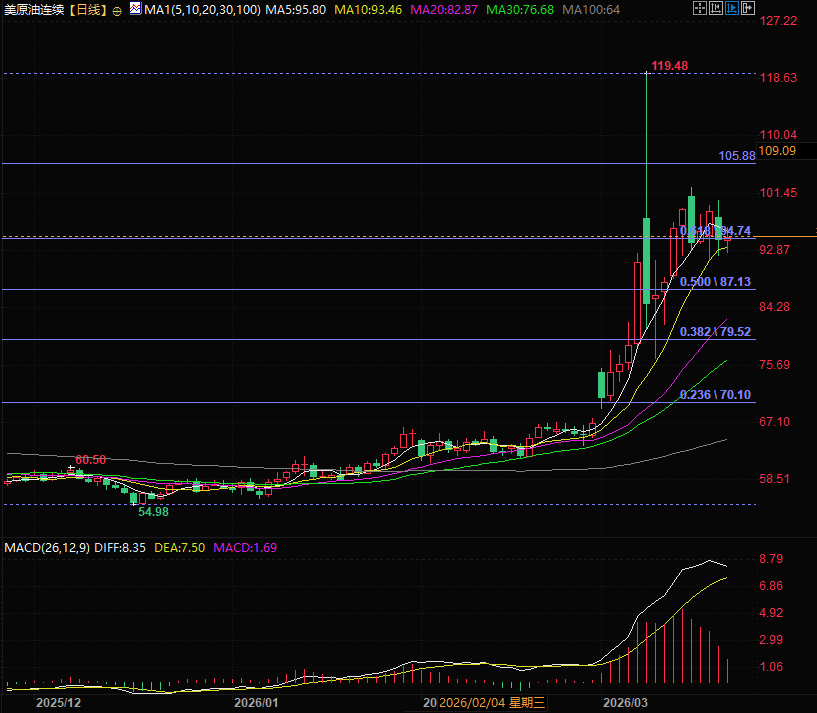
(WTI futures contract daily chart, source: EasyForex)
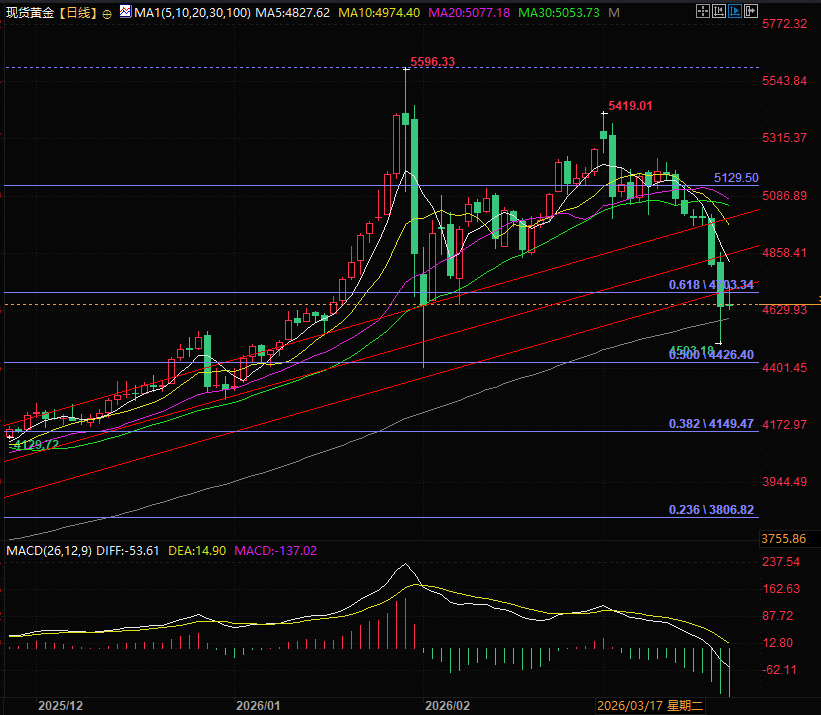
Spot gold has broken below the 0.618 Fibonacci retracement level and the lower trendline of the upward channel, turning support into resistance. Going forward, continued attention should be paid to US Treasury yields and the US dollar index, as well as whether the conflict escalates and whether US domestic economic data shows any problems. Weighing the safe-haven logic, the real interest rate logic, and the logic of selling the dollar, and monitoring the convergence of these logics, gold is expected to continue its rebound if signals emerge.
WTI crude oil experienced a rollercoaster ride, with prices hitting a low and then falling back. In early Asian trading, it plunged more than 3% due to easing signals from Israel, but rebounded rapidly in the European afternoon session due to Iran's continued attacks on energy facilities, with gains once expanding to 1%. As of press time, it was trading around 94.50, with the global energy supply risk premium continuing to rise.
Gold prices rebounded sharply after a rapid decline due to the impact of continuous falling leveraged funds and liquidity. Currently, it has rebounded 3% from Thursday's low and is trading at $4,680 per ounce, up another 0.5%. In addition to its sensitivity to interest rates, the recent decline in gold prices was mainly driven by changes in the investment style of funds and bets on a weaker dollar, as well as the withdrawal of funds from dollar-denominated narratives.
Israel adjusts defense guidelines for several regions, easing restrictions in areas with lower threat levels.
The Israel Defense Forces announced on the 19th that its rear command is easing wartime restrictions in areas of Israel less threatened by Iranian ballistic missiles or Hezbollah rocket attacks, allowing schools in these areas to reopen.
Based on the latest assessment results, the rear command issued defense guidelines and clarified that starting from 6:00 a.m. on March 22, the activity level in several areas in northern and southern Israel will be adjusted from "limited activity" to "partial activity".
This means that in these areas, educational institutions can resume operations as long as suitable shelters can be found in time. Under the same conditions, gatherings of up to 100 people indoors and up to 50 people outdoors are also permitted.
In other parts of Israel, educational activities remain prohibited.
Kuwait’s core oil refinery attacked by drones
Early Friday morning, the Mina Al-Ahmadi refinery in Kuwait—a key facility with a daily processing capacity of 346,000 barrels—was targeted by an Iranian drone strike, causing multiple units to catch fire.
A statement from Kuwait National Oil Company indicated that preliminary investigations revealed no casualties, and emergency response has been fully activated. The Fire and Rescue Department is working to extinguish the fire at the single unit, while the military is simultaneously countering enemy missile and drone threats. The statement urged the public to adhere to safety guidelines.
This attack is another targeted pressure exerted by Iran on the Gulf energy supply chain, following Thursday's strikes on energy assets in Kuwait and Saudi Arabia.
Infrastructure damaged at Israel's Haifa refinery
Israel Refineries Ltd. confirmed on Friday that its refinery in Haifa, in the north, was directly hit in Thursday’s Iranian missile attack, with power infrastructure supplying service facilities and adjacent areas being struck.
The company stated that the damaged facilities belonged to a third party and were expected to be restored in several days. Currently, most production facilities are operating, and the rest are being restarted. Israeli Energy Minister Cohen stated that the attack damaged the power grid, but the overall impact was limited, causing only short-term power outages in some areas.
Iran is seeking a mechanism for passage through the Straits.
The Strait of Hormuz, a vital global energy chokepoint, has been effectively paralyzed due to Iran's continued attacks on merchant ships. Iran has established "safe passages" for approved vessels, with some ships only needing to pay transit fees of up to $2 million.
The Iranian parliament is also considering legislation to impose tolls on passage through the Strait of Hormuz, which would further increase the cost of global energy trade.
Data shows that before the war, an average of 77 ships passed through the strait daily, and the current oil transport volume is less than 10% of that before the conflict, but it still accounts for more than a quarter of the world's total seaborne oil volume.
The confrontation is intense and unpredictable; the US and Israel may send ground troops.
When asked by the media at the White House on the 19th whether he planned to send more troops to the Middle East during the military action against Iran, US President Trump said, "I will not deploy troops anywhere."
"If I were really going to do that, I certainly wouldn't tell you, but I'm not deploying troops," Israeli Prime Minister Netanyahu said, adding that airstrikes alone cannot achieve "change" and must be combined with ground operations.
Earlier, international media, citing US officials and sources, reported that the Trump administration was considering sending thousands more US troops to the Middle East to support military operations against Iran.
Trump also claimed that the United States could seize Kharg Island, Iran's oil export hub, at any time.
He stated that the reason the US military did not bomb the oil facilities when it previously attacked the island was because reconstruction would take several years.
Iranian state media confirmed that Islamic Revolutionary Guard Corps spokesman Ali Mohammad al-Nani was killed in a joint US-Israeli airstrike at dawn on Friday, further escalating geopolitical tensions.
Despite Israel's pledge not to attack Iran's South Pars gas field, the conflict has not ceased, and its previous airstrikes on Iranian gas facilities have drawn public criticism from US President Trump.
Furthermore, the four-point ceasefire initiative proposed by the Lebanese president, which includes a "comprehensive truce and disarmament of Hezbollah," has been difficult to advance due to the continued escalation of the military conflict.
International Response: Multiple Countries Speak Out to Safeguard Stability, Energy Reserves and Cooperation Advance Simultaneously
A joint statement issued by six countries, including the United Kingdom and France, condemned Iran's attack on civilian energy facilities and expressed its willingness to provide support for the reopening of the Strait of Hormuz.
Oman called for a diplomatic solution to the conflict, emphasizing the need to uphold international law and protect global energy supplies.
The US-Japan summit confirmed cooperation to stabilize the energy market, with Japan proposing the establishment of a joint venture to store US crude oil.
The Trump administration made it clear that it would not restrict oil and gas exports, highlighting the United States' role as the world's largest natural gas exporter.
The 32 member countries of the International Energy Agency (IEA) have agreed to release 400 million barrels of emergency oil reserves to provide a buffer for the market.
Chain reaction: The conflict spills over into sectors outside energy, spreading supply chain risks.
The ripple effects of the conflict continue to emerge: Iran maintains its intention to rebuild its nuclear capabilities and refuses inspections of key facilities by the International Atomic Energy Agency;
The Pentagon plans to add $200 billion to its war budget, with the Secretary of Defense emphasizing that "destroying the enemy requires funding."
In addition, the Gulf pharmaceutical supply chain has been severely impacted. The closure of key airports such as Dubai and Abu Dhabi has disrupted the transportation of cold chain pharmaceuticals, prompting pharmaceutical companies to turn to Saudi Arabia for transshipment. Some medical institutions have warned that pharmaceutical stocks may be in short supply within 4-6 weeks.
Summary and Technical Analysis:
The current core contradiction in the oil market lies in the interplay between "the risk of supply disruptions caused by geopolitical conflicts" and "market sentiment fluctuations".
The conditional passage mechanism at Holmes, the deployment of ground troops by the United States and Israel, and the ongoing struggle for control of the Strait of Holmes may be a new turning point for de-escalation.
Meanwhile, the continued obstruction of the Strait of Hormuz and the successive attacks on energy facilities in the Gulf have led to a significant increase in uncertainty on the global crude oil supply side, and risk premiums will continue to dominate short-term trends.
From a technical perspective, WTI crude oil prices have held above the 0.618 level, and the price trend remains within the strike zone.
(WTI futures contract daily chart, source: EasyForex)
Spot gold has broken below the 0.618 Fibonacci retracement level and the lower trendline of the upward channel, turning support into resistance. Going forward, continued attention should be paid to US Treasury yields and the US dollar index, as well as whether the conflict escalates and whether US domestic economic data shows any problems. Weighing the safe-haven logic, the real interest rate logic, and the logic of selling the dollar, and monitoring the convergence of these logics, gold is expected to continue its rebound if signals emerge.
- Risk Warning and Disclaimer
- The market involves risk, and trading may not be suitable for all investors. This article is for reference only and does not constitute personal investment advice, nor does it take into account certain users’ specific investment objectives, financial situation, or other needs. Any investment decisions made based on this information are at your own risk.