Global liquefied natural gas (LNG) exports plummeted 20% to a six-month low due to geopolitical tensions.
2026-03-23 10:20:02
According to APP, global liquefied natural gas (LNG) exports have fallen to their lowest level in six months, wiping out recent supply increases from the US and other regions, as conflict in the Middle East has led to a significant reduction in supply. The latest ship tracking data shows that the 10-day moving average of LNG shipments has fallen by about 20% since the beginning of the month, to 1.1 million tons, the lowest level since September last year. Data shows that this decline is primarily driven by Qatar , followed by the UAE . Almost all exports from these two countries are transported through the Strait of Hormuz to reach major customers in Asia and Europe.

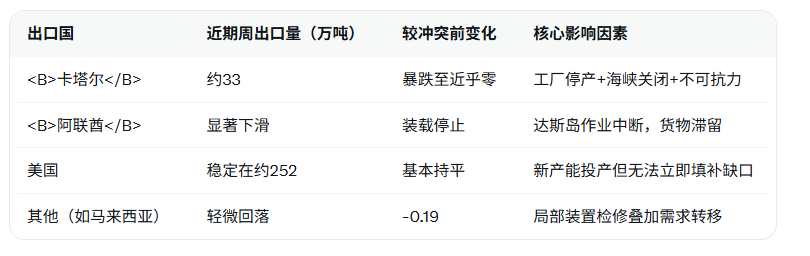
Since the outbreak of the conflict, Qatar's Ras Raffarin industrial city was attacked, forcing the world's largest liquefied natural gas (LNG) production facility to suspend production and issue force majeure notices to some long-term buyers. Loading operations at Das Island in the UAE also ceased. Currently, approximately 9,900 tons of Qatari cargo and 600 tons of UAE cargo are stranded in the Persian Gulf and cannot be shipped out. Saad Al-Qaeda, CEO of Qatar Energy, recently stated that the attack has reduced the country's LNG export capacity by about 17%, and repairs will take weeks or even longer to gradually restore operations.
This disruption directly negated the incremental gains from new US production capacity. Although US exports remained relatively stable, global weekly exports fell to 8.15 million tons, a decrease of 1.57 million tons from the previous week, representing a structural shortage of approximately 19% of global trade. Other regions, such as Peru, also suspended exports due to pipeline failures, further exacerbating the supply-demand imbalance. Without readily available alternative shipping routes, the disruption of the Strait of Hormuz , this crucial choke point, will force a complete restructuring of the global energy landscape.
Comparison of supply changes in major exporting countries
The price response was swift. The European TTF benchmark gas price has risen to approximately $17 per million British thermal units (MMBtu), while Asian spot prices have hovered between $16 and $20, with some periods seeing even more dramatic increases. Asian buyers are facing fierce competition, and some cargo ships originally bound for Europe have temporarily diverted to the Asian market.
For major Asian countries, a significant portion of their liquefied natural gas (LNG) imports comes from the Middle East. A sustained disruption would drive up the cost of industrial power generation and residential gas consumption, potentially forcing some demand to shift towards coal or other alternative energy sources. In the short term, inventory buffers and diversified channels can provide a buffer, but in the long term, it is crucial to accelerate the development of domestic production capacity and international cooperation to enhance supply chain resilience.
Looking ahead, this supply shock is expected to shift the global liquefied natural gas (LNG) market from a state of "oversupply expectation" to one of "4% shortage." If the conflict cannot be resolved within weeks, price volatility will intensify further. While new US production capacity in 2026 will be the main driver of medium-term growth, it is unlikely to fully replace the Middle East deficit in the short term. This again underscores the geopolitical vulnerability of energy trade.
Editor's Summary : Objectively speaking, the recent Middle East conflict has exposed the global liquefied natural gas (LNG) supply chain's over-reliance on a single key shipping route. While non-Middle Eastern supply sources, such as the United States, provide some buffer, their short-term substitution capacity is limited. Major importers, including large Asian countries, need to be wary of a situation where high prices coexist with energy security risks. Market recovery ultimately depends on the stability of the geopolitical situation, and diversification has become an industry consensus.
Since the outbreak of the conflict, Qatar's Ras Raffarin industrial city was attacked, forcing the world's largest liquefied natural gas (LNG) production facility to suspend production and issue force majeure notices to some long-term buyers. Loading operations at Das Island in the UAE also ceased. Currently, approximately 9,900 tons of Qatari cargo and 600 tons of UAE cargo are stranded in the Persian Gulf and cannot be shipped out. Saad Al-Qaeda, CEO of Qatar Energy, recently stated that the attack has reduced the country's LNG export capacity by about 17%, and repairs will take weeks or even longer to gradually restore operations.
This disruption directly negated the incremental gains from new US production capacity. Although US exports remained relatively stable, global weekly exports fell to 8.15 million tons, a decrease of 1.57 million tons from the previous week, representing a structural shortage of approximately 19% of global trade. Other regions, such as Peru, also suspended exports due to pipeline failures, further exacerbating the supply-demand imbalance. Without readily available alternative shipping routes, the disruption of the Strait of Hormuz , this crucial choke point, will force a complete restructuring of the global energy landscape.
Comparison of supply changes in major exporting countries
The price response was swift. The European TTF benchmark gas price has risen to approximately $17 per million British thermal units (MMBtu), while Asian spot prices have hovered between $16 and $20, with some periods seeing even more dramatic increases. Asian buyers are facing fierce competition, and some cargo ships originally bound for Europe have temporarily diverted to the Asian market.
For major Asian countries, a significant portion of their liquefied natural gas (LNG) imports comes from the Middle East. A sustained disruption would drive up the cost of industrial power generation and residential gas consumption, potentially forcing some demand to shift towards coal or other alternative energy sources. In the short term, inventory buffers and diversified channels can provide a buffer, but in the long term, it is crucial to accelerate the development of domestic production capacity and international cooperation to enhance supply chain resilience.
Looking ahead, this supply shock is expected to shift the global liquefied natural gas (LNG) market from a state of "oversupply expectation" to one of "4% shortage." If the conflict cannot be resolved within weeks, price volatility will intensify further. While new US production capacity in 2026 will be the main driver of medium-term growth, it is unlikely to fully replace the Middle East deficit in the short term. This again underscores the geopolitical vulnerability of energy trade.
Editor's Summary : Objectively speaking, the recent Middle East conflict has exposed the global liquefied natural gas (LNG) supply chain's over-reliance on a single key shipping route. While non-Middle Eastern supply sources, such as the United States, provide some buffer, their short-term substitution capacity is limited. Major importers, including large Asian countries, need to be wary of a situation where high prices coexist with energy security risks. Market recovery ultimately depends on the stability of the geopolitical situation, and diversification has become an industry consensus.
- Risk Warning and Disclaimer
- The market involves risk, and trading may not be suitable for all investors. This article is for reference only and does not constitute personal investment advice, nor does it take into account certain users’ specific investment objectives, financial situation, or other needs. Any investment decisions made based on this information are at your own risk.