Israel's actions against Iran have caused the euro to fall below the 1.1600 mark, potentially reigniting the Middle East powder keg.
2026-03-24 11:24:36
On Tuesday (March 24) during the Asian session, the euro fell below the key level of 1.1600 against the US dollar, and is currently trading around 1.1585, down about 0.2% on the day. This decline was mainly due to the strengthening of the US dollar caused by the escalation of the conflict in the Middle East, which significantly increased market risk aversion.
Despite a slight gain in the previous trading day, news of a new Israeli attack on Tehran quickly reversed course, prompting investors to flock to the safe-haven dollar.
The Israel Defense Forces (IDF) announced a new round of airstrikes against Tehran on Tuesday. This comes as President Trump postponed plans to strike Iranian energy infrastructure after stating that he was having "productive" talks with Iran. The IDF made it clear that it will continue operations as directed by the government unless ordered to cease.
This military action highlights the complexity of the situation in the Middle East: despite Trump's diplomatic gestures, Israel has not slowed its pace, leading to a further escalation of regional tensions.
Iranian Foreign Minister Abbas Araqchi stated unequivocally that there is "no dialogue" between Tehran and Washington. Iranian Parliament Speaker Ghalibaf also posted on social media, "No negotiations have been held with the United States." Mohsen Rezaei, a senior military advisor to Iran's Supreme Leader, emphasized that the war will continue until Iran receives full compensation for its damages.
These latest statements stand in stark contrast to Trump's statements in the dialogue, highlighting the significant differences that remain between the two sides' public positions.
Meanwhile, the market saw a surge in safe-haven demand for the US dollar, and the dollar index rose during Tuesday's Asian trading session, currently trading at 99.37, up about 0.2% on the day.
Escalating conflict in the Middle East has directly pushed up energy prices, with oil prices fluctuating at high levels. On Tuesday in Asian trading, US crude oil prices rose, currently trading around $91.20 per barrel, a daily increase of approximately 3.5%. The surge in oil prices has exacerbated global inflation concerns, and the potential risk of disruption in the Strait of Hormuz has once again become a focal point.
This trend contrasts with the optimistic expectation that Trump would postpone the strike, indicating that the market is more focused on Israel's actual actions than on diplomatic signals.
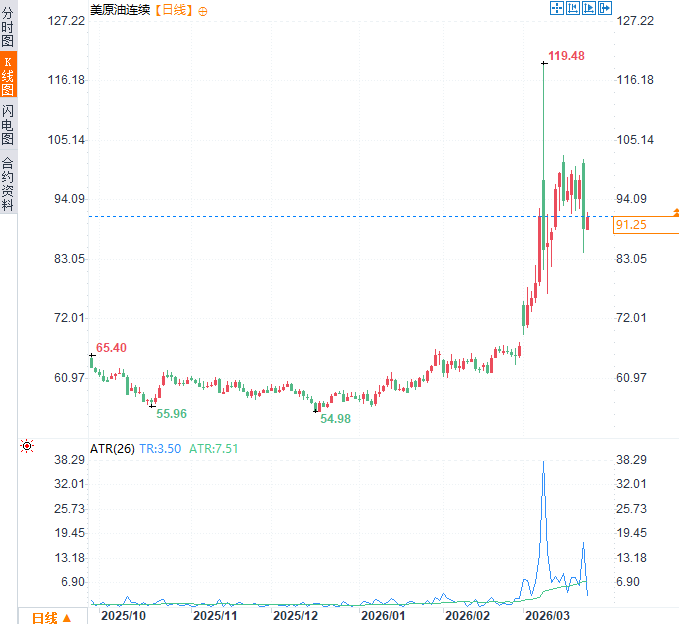
(US crude oil daily chart, source: FX678)
San Francisco Federal Reserve President Mary Daly said on Monday that the Fed cannot "see through" the temporary rise in oil prices unless the conflict with Iran is resolved quickly, otherwise the path of interest rates remains unclear. She emphasized that "there is no single most likely path," and that a prolonged conflict could simultaneously push up inflation and weaken the job market.
The European Central Bank kept interest rates unchanged last week but explicitly identified the conflict with Iran as a source of "significantly greater uncertainty" in the outlook. Officials noted that rising inflation risks coupled with slowing economic growth have led markets to increase expectations of a rate hike later this year. If officials release hawkish signals this week, the euro could receive some support.
The daily chart shows that the euro/dollar pair has entered a downward breakout phase: after falling from the October 2025 high of 1.1778 to 1.1468, it rebounded to 1.2081 in February 2026, followed by a sharp correction, with consecutive large bearish candles effectively breaking through the key level of 1.1625 (now turned into strong resistance), accelerating the decline, and recently touching a low of 1.1410.
The MACD (26,12,9) DIFF/DEA are both below the zero axis, with only a very weak golden cross appearing (the histogram slightly turns to the positive range), indicating that the medium-to-long-term downtrend has not changed; the RSI (14) is below the midline level, and the downward momentum is still being released.
On the upside, the first resistance level is the key psychological level of 1.1600. If it can continue to rise and break through the 1.1625 level, it can strengthen the bullish bias, with the next resistance level at 1.1650.
On the downside, the key support level to watch is the 1.1410-1.1491 range. If 1.1410 is breached, a medium-term downtrend will be confirmed.
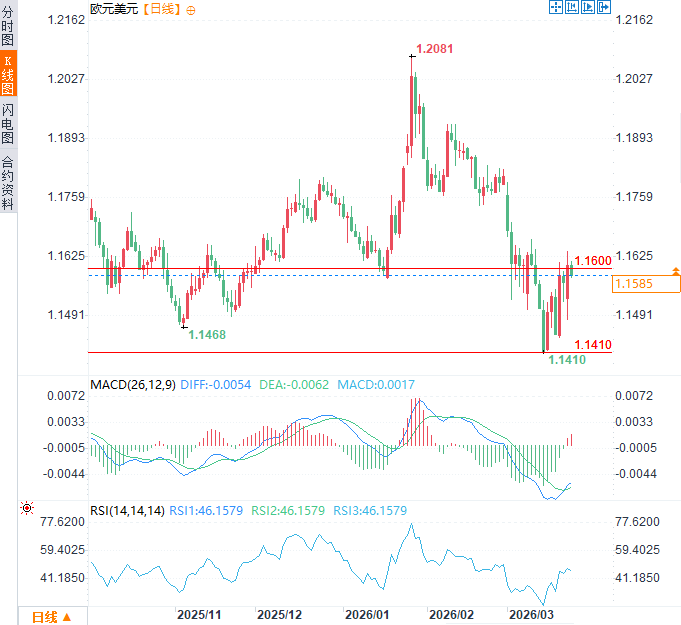
(Euro/USD daily chart, source: FX678)
The Middle East conflict escalated due to a new Israeli strike on Tehran, causing the euro to fall below a key level against the dollar, while oil prices fluctuated at high levels. Trump's signals of delay failed to quell tensions, with Iranian officials collectively denying dialogue and insisting on compensation demands. Both the Federal Reserve and the European Central Bank face the dual challenges of inflation and growth, and risk aversion will continue to dominate the foreign exchange and commodity markets in the short term.
At 11:24 Beijing time, the euro was trading at 1.1587/88 against the US dollar.
Despite a slight gain in the previous trading day, news of a new Israeli attack on Tehran quickly reversed course, prompting investors to flock to the safe-haven dollar.
Escalation of Middle East conflict and Israeli strikes
The Israel Defense Forces (IDF) announced a new round of airstrikes against Tehran on Tuesday. This comes as President Trump postponed plans to strike Iranian energy infrastructure after stating that he was having "productive" talks with Iran. The IDF made it clear that it will continue operations as directed by the government unless ordered to cease.
This military action highlights the complexity of the situation in the Middle East: despite Trump's diplomatic gestures, Israel has not slowed its pace, leading to a further escalation of regional tensions.
Iranian officials strongly deny dialogue
Iranian Foreign Minister Abbas Araqchi stated unequivocally that there is "no dialogue" between Tehran and Washington. Iranian Parliament Speaker Ghalibaf also posted on social media, "No negotiations have been held with the United States." Mohsen Rezaei, a senior military advisor to Iran's Supreme Leader, emphasized that the war will continue until Iran receives full compensation for its damages.
These latest statements stand in stark contrast to Trump's statements in the dialogue, highlighting the significant differences that remain between the two sides' public positions.
Meanwhile, the market saw a surge in safe-haven demand for the US dollar, and the dollar index rose during Tuesday's Asian trading session, currently trading at 99.37, up about 0.2% on the day.
Soaring oil prices and inflationary pressures
Escalating conflict in the Middle East has directly pushed up energy prices, with oil prices fluctuating at high levels. On Tuesday in Asian trading, US crude oil prices rose, currently trading around $91.20 per barrel, a daily increase of approximately 3.5%. The surge in oil prices has exacerbated global inflation concerns, and the potential risk of disruption in the Strait of Hormuz has once again become a focal point.
This trend contrasts with the optimistic expectation that Trump would postpone the strike, indicating that the market is more focused on Israel's actual actions than on diplomatic signals.
(US crude oil daily chart, source: FX678)
Federal Reserve and European Central Bank policy responses
San Francisco Federal Reserve President Mary Daly said on Monday that the Fed cannot "see through" the temporary rise in oil prices unless the conflict with Iran is resolved quickly, otherwise the path of interest rates remains unclear. She emphasized that "there is no single most likely path," and that a prolonged conflict could simultaneously push up inflation and weaken the job market.
The European Central Bank kept interest rates unchanged last week but explicitly identified the conflict with Iran as a source of "significantly greater uncertainty" in the outlook. Officials noted that rising inflation risks coupled with slowing economic growth have led markets to increase expectations of a rate hike later this year. If officials release hawkish signals this week, the euro could receive some support.
Technical Analysis
The daily chart shows that the euro/dollar pair has entered a downward breakout phase: after falling from the October 2025 high of 1.1778 to 1.1468, it rebounded to 1.2081 in February 2026, followed by a sharp correction, with consecutive large bearish candles effectively breaking through the key level of 1.1625 (now turned into strong resistance), accelerating the decline, and recently touching a low of 1.1410.
The MACD (26,12,9) DIFF/DEA are both below the zero axis, with only a very weak golden cross appearing (the histogram slightly turns to the positive range), indicating that the medium-to-long-term downtrend has not changed; the RSI (14) is below the midline level, and the downward momentum is still being released.
On the upside, the first resistance level is the key psychological level of 1.1600. If it can continue to rise and break through the 1.1625 level, it can strengthen the bullish bias, with the next resistance level at 1.1650.
On the downside, the key support level to watch is the 1.1410-1.1491 range. If 1.1410 is breached, a medium-term downtrend will be confirmed.
(Euro/USD daily chart, source: FX678)
Editor's Summary
The Middle East conflict escalated due to a new Israeli strike on Tehran, causing the euro to fall below a key level against the dollar, while oil prices fluctuated at high levels. Trump's signals of delay failed to quell tensions, with Iranian officials collectively denying dialogue and insisting on compensation demands. Both the Federal Reserve and the European Central Bank face the dual challenges of inflation and growth, and risk aversion will continue to dominate the foreign exchange and commodity markets in the short term.
At 11:24 Beijing time, the euro was trading at 1.1587/88 against the US dollar.
- Risk Warning and Disclaimer
- The market involves risk, and trading may not be suitable for all investors. This article is for reference only and does not constitute personal investment advice, nor does it take into account certain users’ specific investment objectives, financial situation, or other needs. Any investment decisions made based on this information are at your own risk.