European Central Bank Governing Council member Aleksandar Vujicic warned of looming stagflation risks, suggesting the April rate hike window may open earlier than expected.
2026-03-24 14:34:23
According to APP, Aleksandar Vujicic , a member of the European Central Bank's Governing Council and slated to become Vice President of the ECB in June 2026, stated that the ECB must maintain "a high degree of flexibility and vigilance" to control prices, as the risk of stagflation stemming from the Iran war is looming. Vujicic pointed out that officials will likely soon know whether the impact of the conflict will necessitate raising interest rates. However, he also warned that recent developments indicate an increasing danger of persistently rising consumer prices coupled with weak economic expansion. "We are not currently seeing stagflation, but the risks are moving in that direction. How far we go in this trend is difficult to predict. There will be a lot of new data and information released before the April meeting; in the current situation, everything is being updated in real time."

This statement is highly consistent with the latest staff forecasts following the ECB's March 19 meeting. The ECB significantly raised its 2026 Eurozone inflation forecast to 2.6% from 1.9%, while core inflation (excluding energy and food) remains at a high level, with soaring energy prices being the main driver. At the same time, the 2026 economic growth forecast was lowered from 1.2% to 0.9%, clearly reflecting the dual pressure of high inflation and geopolitical risks on economic recovery. The Eurozone policy rate is currently maintained at 2%, and the market has fully priced in the probability of a rate hike before July; some institutions even expect a 25 basis point rate hike at the April meeting.
Vujicic recently emphasized at a European Parliament hearing that the war with Iran poses a substantial upward risk of inflation through the oil and gas markets, and its impact on consumer prices extends beyond the short term. Even if the conflict eases, the energy base effect and secondary transmission could still push up medium-term price stickiness. This assessment echoes the warning issued by ECB President Lagarde at her March press conference: the Middle East conflict has a "substantial impact" on inflation, and central banks must assess its dual impact on economic growth and price expectations.
The Eurozone economy is currently exhibiting early signs of stagflation: energy costs are pushing up the Producer Price Index (PPI), while consumer demand remains weak due to high interest rates and uncertainty. Latest data shows that the Eurozone manufacturing PMI remained on the edge of expansion in March, while the services PMI showed signs of slowing due to the drag from energy prices. Analysts point out that if supply disruptions in the Strait of Hormuz continue, oil prices could remain above $100 in the second quarter, further amplifying the spillover effect of commodities on core inflation.
To provide a clear comparison of policy paths under different scenarios, the following table presents the ECB's latest forecast scenarios:
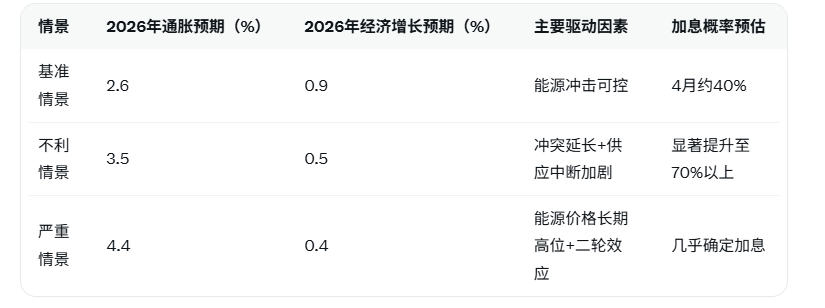
Vujicic 's remarks highlight the conditional dependence of the ECB's decisions: if new data (including the final March CPI, PMI, and energy price trends) confirms an increased risk of stagflation before the April meeting, the central bank will not hesitate to adjust its policy path; conversely, if the conflict eases quickly and energy prices fall, the pace of tightening may slow down.
Editor's Summary : Latest forecasts show that although the Eurozone has not yet fallen into stagflation, the Iran war has significantly raised the 2026 inflation target and suppressed growth expectations. The European Central Bank needs to strike a balance between flexibility and vigilance, and the April meeting will be a key window for testing policy shifts.
This statement is highly consistent with the latest staff forecasts following the ECB's March 19 meeting. The ECB significantly raised its 2026 Eurozone inflation forecast to 2.6% from 1.9%, while core inflation (excluding energy and food) remains at a high level, with soaring energy prices being the main driver. At the same time, the 2026 economic growth forecast was lowered from 1.2% to 0.9%, clearly reflecting the dual pressure of high inflation and geopolitical risks on economic recovery. The Eurozone policy rate is currently maintained at 2%, and the market has fully priced in the probability of a rate hike before July; some institutions even expect a 25 basis point rate hike at the April meeting.
Vujicic recently emphasized at a European Parliament hearing that the war with Iran poses a substantial upward risk of inflation through the oil and gas markets, and its impact on consumer prices extends beyond the short term. Even if the conflict eases, the energy base effect and secondary transmission could still push up medium-term price stickiness. This assessment echoes the warning issued by ECB President Lagarde at her March press conference: the Middle East conflict has a "substantial impact" on inflation, and central banks must assess its dual impact on economic growth and price expectations.
The Eurozone economy is currently exhibiting early signs of stagflation: energy costs are pushing up the Producer Price Index (PPI), while consumer demand remains weak due to high interest rates and uncertainty. Latest data shows that the Eurozone manufacturing PMI remained on the edge of expansion in March, while the services PMI showed signs of slowing due to the drag from energy prices. Analysts point out that if supply disruptions in the Strait of Hormuz continue, oil prices could remain above $100 in the second quarter, further amplifying the spillover effect of commodities on core inflation.
To provide a clear comparison of policy paths under different scenarios, the following table presents the ECB's latest forecast scenarios:
Vujicic 's remarks highlight the conditional dependence of the ECB's decisions: if new data (including the final March CPI, PMI, and energy price trends) confirms an increased risk of stagflation before the April meeting, the central bank will not hesitate to adjust its policy path; conversely, if the conflict eases quickly and energy prices fall, the pace of tightening may slow down.
Editor's Summary : Latest forecasts show that although the Eurozone has not yet fallen into stagflation, the Iran war has significantly raised the 2026 inflation target and suppressed growth expectations. The European Central Bank needs to strike a balance between flexibility and vigilance, and the April meeting will be a key window for testing policy shifts.
- Risk Warning and Disclaimer
- The market involves risk, and trading may not be suitable for all investors. This article is for reference only and does not constitute personal investment advice, nor does it take into account certain users’ specific investment objectives, financial situation, or other needs. Any investment decisions made based on this information are at your own risk.