













Iran denies dialogue, energy facilities attacked, US dollar rebounds, risk aversion dominates market.
2026-03-24 11:27:42
On Tuesday (March 24) during the Asian session, the US dollar index resumed its upward trend, rebounding from near a two-week low the previous day and currently trading around 99.35, with a daily increase of about 0.2%. This trend stemmed from a renewed rise in market risk aversion, with safe-haven buying flowing into the safe-haven US dollar.
Despite a pullback the previous day, negative news related to the Middle East conflict quickly reversed market expectations, pushing dollar bulls back into control.
President Trump's statement on Monday that the US and Iran were having "productive" talks and could reach an agreement soon briefly boosted market optimism. However, this hope for de-escalation quickly faded.
According to Iran's semi-official Fars News Agency, an Israeli or US-Israeli joint operation struck the offices of a gas company and a decompression station in Isfahan province in central Iran, while a gas pipeline leading to a power plant in Khorramshahr was also attacked.
These attacks on energy infrastructure have directly increased the risk of disruption in the Strait of Hormuz, leading to a renewed surge in risk-averse trading globally.
Iran responded swiftly, explicitly denying any dialogue with the United States. The Iranian Foreign Ministry and Parliament Speaker Ghalibaf stated, "No negotiations with the United States have taken place, and Trump's claims are disinformation."
A senior military advisor to Iran's Supreme Leader also emphasized that the war will continue until Iran receives full compensation for the damages. This hardline stance contrasts sharply with Trump's optimistic statements.
Attacks on energy facilities directly spurred a rise in oil prices. Brent crude oil prices fluctuated upwards during Tuesday's Asian trading session, currently trading around $103.85 per barrel, a daily increase of approximately 3.5%. The renewed risk of a complete closure of the Strait of Hormuz further fueled concerns about disruptions to global energy trade. The surge in oil prices directly exacerbated inflationary pressures, becoming a significant macroeconomic factor supporting the US dollar.
The latest data from CME Group's FedWatch tool shows that the probability of a Federal Reserve rate cut before the end of this year is close to zero, and there is even a possibility of a slight rate hike. U.S. Treasury yields subsequently rose slightly, further strengthening the dollar.
The market believes that unless the conflict in the Middle East eases rapidly, the Federal Reserve will struggle to anticipate the inflationary impact of rising oil prices, and its policy path will remain hawkish. This expectation provides continued support for the US dollar index.
The US dollar index is currently at a relatively strong high level on the daily chart: after rising from a low of 97.44 in October 2025 to 100.39 in November, it fell back to 95.57 at the end of January 2026. Subsequently, it rose rapidly in February and March, breaking through the 99.43 level and reaching a nine-month high of 100.54. It is still at a relatively high level.
The MACD (26,12,9) histogram has turned into negative territory, indicating a slight weakening of short-term momentum; the RSI (14) is slightly above the midline level, supporting a mild bullish bias.
On the upside, the first resistance level is at the 100.00 mark. If it can be broken through effectively, the next resistance level is at the recent high of 100.54.
On the downside, the first support level is at the 99.00 mark. If the price retraces and breaks below this level during the day, it may reverse the short-term trend and push the price down to around 98.50.
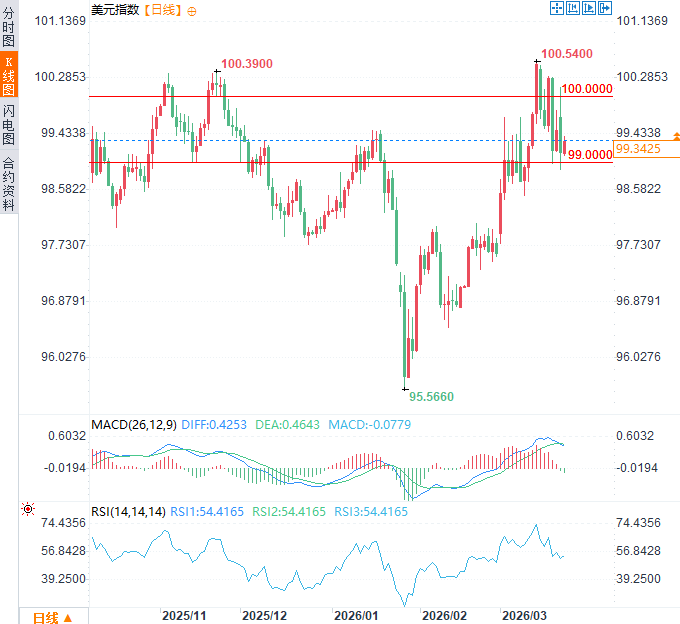
(US Dollar Index Daily Chart, Source: FX678)
The dollar index rebounded due to the rapid fading of hopes for easing tensions in the Middle East. Attacks on Iranian energy facilities and official denials in talks exacerbated risk aversion, while soaring oil prices pushed up inflation expectations, increasing the probability of a Federal Reserve rate hike. In the short term, the dollar will continue to benefit from safe-haven demand, but upcoming global PMI data could provide new guidance for volatility.
At 11:27 Beijing time, the US dollar index is currently at 99.34.
Despite a pullback the previous day, negative news related to the Middle East conflict quickly reversed market expectations, pushing dollar bulls back into control.
Escalation of tensions in the Middle East
President Trump's statement on Monday that the US and Iran were having "productive" talks and could reach an agreement soon briefly boosted market optimism. However, this hope for de-escalation quickly faded.
According to Iran's semi-official Fars News Agency, an Israeli or US-Israeli joint operation struck the offices of a gas company and a decompression station in Isfahan province in central Iran, while a gas pipeline leading to a power plant in Khorramshahr was also attacked.
These attacks on energy infrastructure have directly increased the risk of disruption in the Strait of Hormuz, leading to a renewed surge in risk-averse trading globally.
Iranian officials categorically denied
Iran responded swiftly, explicitly denying any dialogue with the United States. The Iranian Foreign Ministry and Parliament Speaker Ghalibaf stated, "No negotiations with the United States have taken place, and Trump's claims are disinformation."
A senior military advisor to Iran's Supreme Leader also emphasized that the war will continue until Iran receives full compensation for the damages. This hardline stance contrasts sharply with Trump's optimistic statements.
Soaring oil prices and inflation concerns
Attacks on energy facilities directly spurred a rise in oil prices. Brent crude oil prices fluctuated upwards during Tuesday's Asian trading session, currently trading around $103.85 per barrel, a daily increase of approximately 3.5%. The renewed risk of a complete closure of the Strait of Hormuz further fueled concerns about disruptions to global energy trade. The surge in oil prices directly exacerbated inflationary pressures, becoming a significant macroeconomic factor supporting the US dollar.
Federal Reserve policy expectations
The latest data from CME Group's FedWatch tool shows that the probability of a Federal Reserve rate cut before the end of this year is close to zero, and there is even a possibility of a slight rate hike. U.S. Treasury yields subsequently rose slightly, further strengthening the dollar.
The market believes that unless the conflict in the Middle East eases rapidly, the Federal Reserve will struggle to anticipate the inflationary impact of rising oil prices, and its policy path will remain hawkish. This expectation provides continued support for the US dollar index.
Technical Analysis
The US dollar index is currently at a relatively strong high level on the daily chart: after rising from a low of 97.44 in October 2025 to 100.39 in November, it fell back to 95.57 at the end of January 2026. Subsequently, it rose rapidly in February and March, breaking through the 99.43 level and reaching a nine-month high of 100.54. It is still at a relatively high level.
The MACD (26,12,9) histogram has turned into negative territory, indicating a slight weakening of short-term momentum; the RSI (14) is slightly above the midline level, supporting a mild bullish bias.
On the upside, the first resistance level is at the 100.00 mark. If it can be broken through effectively, the next resistance level is at the recent high of 100.54.
On the downside, the first support level is at the 99.00 mark. If the price retraces and breaks below this level during the day, it may reverse the short-term trend and push the price down to around 98.50.
(US Dollar Index Daily Chart, Source: FX678)
Editor's Summary
The dollar index rebounded due to the rapid fading of hopes for easing tensions in the Middle East. Attacks on Iranian energy facilities and official denials in talks exacerbated risk aversion, while soaring oil prices pushed up inflation expectations, increasing the probability of a Federal Reserve rate hike. In the short term, the dollar will continue to benefit from safe-haven demand, but upcoming global PMI data could provide new guidance for volatility.
At 11:27 Beijing time, the US dollar index is currently at 99.34.
- Risk Warning and Disclaimer
- The market involves risk, and trading may not be suitable for all investors. This article is for reference only and does not constitute personal investment advice, nor does it take into account certain users’ specific investment objectives, financial situation, or other needs. Any investment decisions made based on this information are at your own risk.

