The Middle East conflict has become a key variable, significantly increasing the probability of a Bank of Japan interest rate hike in April.
2026-03-24 13:24:33
According to APP, ING economists suggest the Bank of Japan may ignore recent inflation slowdowns and focus instead on price risks. Initial wage negotiations were encouraging, and the Middle East conflict appears to have had little impact. The decline in the preliminary PMI reflects recent oil supply shocks and reduced new orders, which has indeed increased concerns about the outlook. However, the overall figure remains above 50, indicating that businesses view geopolitical risks as temporary. Stubborn core inflation, PMI data, and wage negotiations increase the likelihood of an April rate hike, but the timing remains uncertain. The Middle East situation will play a key role in the Bank of Japan's decision-making. If the situation stabilizes and there are no signs of a decline in production or consumption, an April rate hike would be more likely.
This view is highly consistent with the Bank of Japan's latest statement following its March 19 meeting. Currently, Japan's policy rate remains at a 30-year high of 0.75%, and the market's implied probability of a rate hike in April has risen to approximately 60%. ING economists specifically pointed out that although core inflation may temporarily fall below 2% in the short term due to rice price corrections and subsidies, the upward pressure on oil prices driven by the Middle East conflict is significant. Coupled with the imported effects of a weak yen, the overall price trend remains in line with the central bank's 2% stability target.
Although the latest preliminary manufacturing PMI reading declined, it remained firmly within the expansionary range, making this data a key indicator for policy decisions. The March manufacturing PMI preliminary reading fell to 51.4, a slight decrease from the February high, mainly due to the impact of oil supply shocks on production costs and a slowdown in new orders. However, the index remains above the 50-point threshold separating expansion from contraction, indicating that most companies view geopolitical disturbances as temporary factors and have not altered overall expansionary expectations. This resilience further strengthens the positive signals from wage negotiations—preliminary results of the spring labor negotiations show that large enterprises raised wages more than expected, and small and medium-sized enterprises followed suit more strongly than in previous years, providing a solid foundation for a virtuous cycle of wages and prices.
A recent analysis by ING economists emphasized that "close attention needs to be paid to how the Bank of Japan assesses the economic spillover effects of the Middle East conflict and the outcome of the spring wage negotiations, as these factors will directly determine whether an interest rate hike occurs in April or is postponed to June." This statement highlights the conditional dependence of the decision-making process: if the situation in the Middle East stabilizes, oil prices cease their sustained surge, and production and consumption do not show a significant decline, the Bank of Japan will be more confident in taking action at its April meeting. Conversely, if the prolonged conflict leads to further transmission of energy costs to SME profits and consumer confidence, the timing of the interest rate hike may be delayed.
To visually compare the impact of key variables on policy, the following table presents the projected probability of an April rate hike under different scenarios:
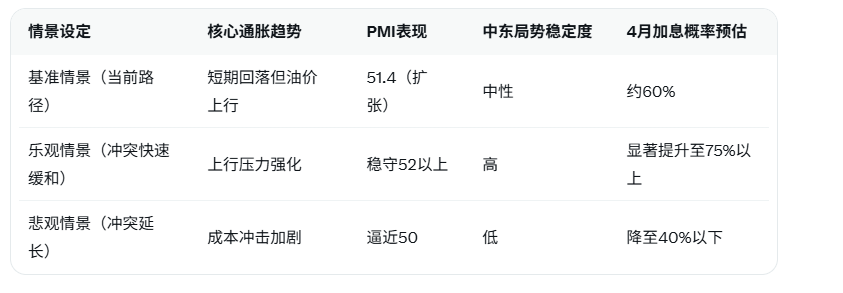
Within this framework, persistent core inflation stickiness provides the strongest support. Even with a slowdown in short-term readings, the sustainability of wage growth has put the Japanese economy on a positive "wage-price spiral," far removed from the "lost three decades" of the past. ING's assessment reminds the market that while geopolitical risks have increased uncertainty, they have not reversed the overall direction of the Bank of Japan's normalization process.
Editor's Summary : Latest economic indicators and market pricing suggest that the Bank of Japan's April rate hike window remains open. Stability in the Middle East will be a key catalyst, while wage negotiations and PMI resilience jointly solidify the foundation for a policy shift. Investors should closely monitor oil prices and the final outcome of the spring rally.
This view is highly consistent with the Bank of Japan's latest statement following its March 19 meeting. Currently, Japan's policy rate remains at a 30-year high of 0.75%, and the market's implied probability of a rate hike in April has risen to approximately 60%. ING economists specifically pointed out that although core inflation may temporarily fall below 2% in the short term due to rice price corrections and subsidies, the upward pressure on oil prices driven by the Middle East conflict is significant. Coupled with the imported effects of a weak yen, the overall price trend remains in line with the central bank's 2% stability target.
Although the latest preliminary manufacturing PMI reading declined, it remained firmly within the expansionary range, making this data a key indicator for policy decisions. The March manufacturing PMI preliminary reading fell to 51.4, a slight decrease from the February high, mainly due to the impact of oil supply shocks on production costs and a slowdown in new orders. However, the index remains above the 50-point threshold separating expansion from contraction, indicating that most companies view geopolitical disturbances as temporary factors and have not altered overall expansionary expectations. This resilience further strengthens the positive signals from wage negotiations—preliminary results of the spring labor negotiations show that large enterprises raised wages more than expected, and small and medium-sized enterprises followed suit more strongly than in previous years, providing a solid foundation for a virtuous cycle of wages and prices.
A recent analysis by ING economists emphasized that "close attention needs to be paid to how the Bank of Japan assesses the economic spillover effects of the Middle East conflict and the outcome of the spring wage negotiations, as these factors will directly determine whether an interest rate hike occurs in April or is postponed to June." This statement highlights the conditional dependence of the decision-making process: if the situation in the Middle East stabilizes, oil prices cease their sustained surge, and production and consumption do not show a significant decline, the Bank of Japan will be more confident in taking action at its April meeting. Conversely, if the prolonged conflict leads to further transmission of energy costs to SME profits and consumer confidence, the timing of the interest rate hike may be delayed.
To visually compare the impact of key variables on policy, the following table presents the projected probability of an April rate hike under different scenarios:
Within this framework, persistent core inflation stickiness provides the strongest support. Even with a slowdown in short-term readings, the sustainability of wage growth has put the Japanese economy on a positive "wage-price spiral," far removed from the "lost three decades" of the past. ING's assessment reminds the market that while geopolitical risks have increased uncertainty, they have not reversed the overall direction of the Bank of Japan's normalization process.
Editor's Summary : Latest economic indicators and market pricing suggest that the Bank of Japan's April rate hike window remains open. Stability in the Middle East will be a key catalyst, while wage negotiations and PMI resilience jointly solidify the foundation for a policy shift. Investors should closely monitor oil prices and the final outcome of the spring rally.
- Risk Warning and Disclaimer
- The market involves risk, and trading may not be suitable for all investors. This article is for reference only and does not constitute personal investment advice, nor does it take into account certain users’ specific investment objectives, financial situation, or other needs. Any investment decisions made based on this information are at your own risk.