The war with Iran has forced central banks to halt gold purchases; gold prices may face even sharper corrections after the recent plunge.
2026-03-24 12:10:53
Central bank demand has been a key driver of the historic bull market in gold prices since the end of 2022. However, this rally may be coming to an end at least for the foreseeable future, as the war in Iran forces policymakers to prioritize energy security and economic stability over reserve diversification.
This shift in priorities comes at a time when the gold market is extremely vulnerable. Gold prices have just experienced their most dramatic weekly drop since the 1980s, which Rob Haworth, senior investment strategist at Bank of America Wealth Management, described as a speculative “top-up” earlier this year.
After hitting a record high at the end of January, gold has struggled to regain its upward momentum despite escalating geopolitical tensions, a rare departure from its traditional role as a safe-haven asset.
Rob Haworth argues that gold's unusual performance reflects a fundamental shift in market dynamics. Rising nominal and real interest rates are diminishing gold's appeal, and instead of flowing into traditional hedging instruments like gold or government bonds, expected safe-haven funds are flowing into the more liquid US dollar.
Even government bonds failed to attract funds, with yields rising to multi-month highs, highlighting how inflation and supply shocks are dominating investor thinking. Rob Haworth points out that even TIPS (Treasury Inflation-Protected Securities) are not safe-haven assets in the current environment.
He said, "They are also sensitive to duration, and real yields are rising, so they are also hurt."
Meanwhile, speculative positions in the gold market are becoming an increasingly significant headwind. Rob Haworth stated that the psychological level of $4,500 is crucial, and if investors are forced to liquidate their positions due to pressure on their overall portfolios, gold prices could face further downward pressure.
He pointed out: "Speculators are now facing a difficult choice. I think many people tried to weather the volatility in February and wait and see, but now a lot of money has been deeply lost, and the situation may worsen further."
Not only are speculators losing money, Rob Haworth also emphasized that they can no longer count on central banks to provide crucial support.
He explained that many of the central banks that previously drove up gold prices are themselves net energy importers. With oil prices soaring and the costs of liquefied natural gas and fertilizers rising sharply, these countries are reallocating their fiscal resources to secure basic energy and material supplies.
Rob Haworth believes that funds that would have been used to increase gold reserves are now being used to "make a living," to purchase energy, food, and critical infrastructure.
This redistribution of funds explains why gold has failed to react positively to the sharp escalation of geopolitical risks. He stated that in the current environment, traditional safe-haven demand has been replaced by a competition for liquidity. Countries and businesses are now prioritizing acquiring dollars to purchase energy and maintain supply chains, rather than accumulating gold.
Rob Haworth said, "The longer this situation continues, the worse it will be. It has driven up oil prices, hurt the global economy, but hasn't helped gold." This highlights a key paradox that investors are currently facing.
Looking ahead, the duration of the conflict, particularly the long-term disruption to energy flows, will be a decisive factor. Rob Haworth believes the four-to-six-week timeframe proposed by the Trump administration is a key turning point.
He stated that if high oil prices persist until mid-April, businesses and consumers will begin to make longer-term adjustments, including passing on higher costs to end markets, which could in turn exacerbate inflationary pressures and further tighten financial conditions.
This scenario presents an extremely unfavorable backdrop for gold. High inflation caused by supply constraints tends to push up bond yields, which historically puts significant pressure on non-yielding assets. At the same time, traditional defensive assets have failed to provide effective protection, further reducing the hedging tools available to investors.
In this environment, Rob Haworth stated that there is currently no evidence of a structural shift away from the dollar or U.S. Treasuries in the market, a shift that could have quickly revitalized gold's appeal.
He added that gold prices are expected to undergo a period of consolidation to digest excess speculative positions and await stabilizing macroeconomic conditions.
He believes that central bank gold purchases may eventually resume, but only if geopolitical disturbances ease and energy markets return to normal. Until then, gold investors will face an unfamiliar market environment. In this environment, war, inflation, and supply shocks are not driving safe-haven demand for gold; instead, they are drawing funds away from the asset.
Rob Haworth concluded, “A reset is happening. Central banks are no longer focused on a specific price level, but on time cycles. They are not price-sensitive, nor are they hedge funds that need to mark the market daily. But right now, due to basic societal needs, they must prioritize assets that are more important and scarcer. ”
Overall, the Iran war is reshaping global capital flows, and central bank gold purchases, which have been the biggest support for gold in recent years, are facing a temporary decline. The gold market will face significant pressure in the short term.
Investors need to closely monitor the duration of the conflict, oil price trends, and changes in the actual allocation of funds among countries to determine when gold can regain support.
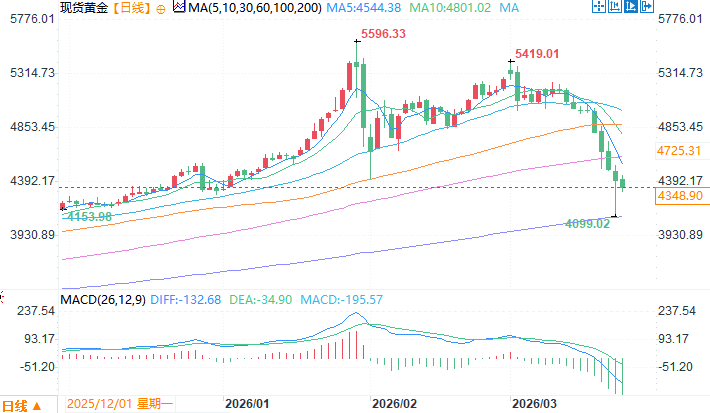
Spot gold daily chart source: EasyForex
At 12:10 PM Beijing time on March 24, spot gold was trading at $4351.90 per ounce.
This shift in priorities comes at a time when the gold market is extremely vulnerable. Gold prices have just experienced their most dramatic weekly drop since the 1980s, which Rob Haworth, senior investment strategist at Bank of America Wealth Management, described as a speculative “top-up” earlier this year.
After hitting a record high at the end of January, gold has struggled to regain its upward momentum despite escalating geopolitical tensions, a rare departure from its traditional role as a safe-haven asset.
Rob Haworth argues that gold's unusual performance reflects a fundamental shift in market dynamics. Rising nominal and real interest rates are diminishing gold's appeal, and instead of flowing into traditional hedging instruments like gold or government bonds, expected safe-haven funds are flowing into the more liquid US dollar.
Even government bonds failed to attract funds, with yields rising to multi-month highs, highlighting how inflation and supply shocks are dominating investor thinking. Rob Haworth points out that even TIPS (Treasury Inflation-Protected Securities) are not safe-haven assets in the current environment.
He said, "They are also sensitive to duration, and real yields are rising, so they are also hurt."
Meanwhile, speculative positions in the gold market are becoming an increasingly significant headwind. Rob Haworth stated that the psychological level of $4,500 is crucial, and if investors are forced to liquidate their positions due to pressure on their overall portfolios, gold prices could face further downward pressure.
He pointed out: "Speculators are now facing a difficult choice. I think many people tried to weather the volatility in February and wait and see, but now a lot of money has been deeply lost, and the situation may worsen further."
Not only are speculators losing money, Rob Haworth also emphasized that they can no longer count on central banks to provide crucial support.
He explained that many of the central banks that previously drove up gold prices are themselves net energy importers. With oil prices soaring and the costs of liquefied natural gas and fertilizers rising sharply, these countries are reallocating their fiscal resources to secure basic energy and material supplies.
Rob Haworth believes that funds that would have been used to increase gold reserves are now being used to "make a living," to purchase energy, food, and critical infrastructure.
This redistribution of funds explains why gold has failed to react positively to the sharp escalation of geopolitical risks. He stated that in the current environment, traditional safe-haven demand has been replaced by a competition for liquidity. Countries and businesses are now prioritizing acquiring dollars to purchase energy and maintain supply chains, rather than accumulating gold.
Rob Haworth said, "The longer this situation continues, the worse it will be. It has driven up oil prices, hurt the global economy, but hasn't helped gold." This highlights a key paradox that investors are currently facing.
Looking ahead, the duration of the conflict, particularly the long-term disruption to energy flows, will be a decisive factor. Rob Haworth believes the four-to-six-week timeframe proposed by the Trump administration is a key turning point.
He stated that if high oil prices persist until mid-April, businesses and consumers will begin to make longer-term adjustments, including passing on higher costs to end markets, which could in turn exacerbate inflationary pressures and further tighten financial conditions.
This scenario presents an extremely unfavorable backdrop for gold. High inflation caused by supply constraints tends to push up bond yields, which historically puts significant pressure on non-yielding assets. At the same time, traditional defensive assets have failed to provide effective protection, further reducing the hedging tools available to investors.
In this environment, Rob Haworth stated that there is currently no evidence of a structural shift away from the dollar or U.S. Treasuries in the market, a shift that could have quickly revitalized gold's appeal.
He added that gold prices are expected to undergo a period of consolidation to digest excess speculative positions and await stabilizing macroeconomic conditions.
He believes that central bank gold purchases may eventually resume, but only if geopolitical disturbances ease and energy markets return to normal. Until then, gold investors will face an unfamiliar market environment. In this environment, war, inflation, and supply shocks are not driving safe-haven demand for gold; instead, they are drawing funds away from the asset.
Rob Haworth concluded, “A reset is happening. Central banks are no longer focused on a specific price level, but on time cycles. They are not price-sensitive, nor are they hedge funds that need to mark the market daily. But right now, due to basic societal needs, they must prioritize assets that are more important and scarcer. ”
Overall, the Iran war is reshaping global capital flows, and central bank gold purchases, which have been the biggest support for gold in recent years, are facing a temporary decline. The gold market will face significant pressure in the short term.
Investors need to closely monitor the duration of the conflict, oil price trends, and changes in the actual allocation of funds among countries to determine when gold can regain support.
Spot gold daily chart source: EasyForex
At 12:10 PM Beijing time on March 24, spot gold was trading at $4351.90 per ounce.
- Risk Warning and Disclaimer
- The market involves risk, and trading may not be suitable for all investors. This article is for reference only and does not constitute personal investment advice, nor does it take into account certain users’ specific investment objectives, financial situation, or other needs. Any investment decisions made based on this information are at your own risk.