













Iran's denial of peace talks triggers risk aversion; Australian PMI unexpectedly collapses, causing a massive sell-off of the Australian dollar.
2026-03-24 11:52:40
The Australian dollar weakened during Asian trading hours on Tuesday (March 24), declining against most major currencies. The AUD/USD pair fluctuated lower, currently trading around 0.6970, down approximately 0.6% on the day. Iran's strong denial of peace talks with the United States, in stark contrast to President Trump's previous optimistic statements, reignited risk aversion in the market, putting pressure on the Australian dollar.
Declining risk appetite boosted the US dollar, with the dollar index rising slightly to around 99.40, a daily gain of about 0.2%. The Australian dollar, a typical risk-sensitive currency, often faces significant selling pressure when geopolitical uncertainty intensifies.

On Monday, US President Trump announced that he had instructed the Department of Defense to suspend military strikes against Iranian power facilities for five days, and stated that he was having "very good and productive conversations" with Tehran on a comprehensive resolution to hostilities in the Middle East. This statement initially eased market tensions, pushing oil prices down and risk assets up.
However, Iran quickly responded strongly. Iranian Parliament Speaker Mohammad Bagher Qalibaf stated unequivocally, "There have been no negotiations with the United States," and accused Trump of spreading disinformation to manipulate the financial and oil markets.
Iranian state media also denied any direct or indirect dialogue, emphasizing that the war would continue until full compensation for damages was received. This reversal of stance led to a rapid return of risk aversion, supporting the US dollar and weakening the Australian dollar.
In addition to geopolitical factors, domestic economic data in Australia also exerted additional downward pressure on the Australian dollar. The preliminary S&P Global Purchasing Managers' Index (PMI) for March showed a sharp drop in the composite PMI to 47.0, a significant decline from 52.4 in February, marking the first contraction in 18 months. The services sector activity index fell even further to 46.6, while the manufacturing PMI declined slightly to 50.1.
A composite PMI below 50 indicates an overall contraction in business activity, primarily dragged down by a sharp decline in service sector output. Slower growth in new orders, weaker job growth, and heightened concerns about supply chain disruptions have exacerbated market doubts about Australia's economic growth prospects.
Investors are focused on Australia's February Consumer Price Index (CPI) data to be released on Wednesday. However, as the data does not fully reflect the recent energy price increases triggered by the conflict with Iran, its actual impact on the Reserve Bank of Australia's (RBA) monetary policy expectations is expected to be limited.
In the short term, the Australian dollar faces dual pressures: persistent geopolitical risks and weak domestic economic data. Key support for the AUD/USD pair is around 0.6900, with further downside potentially testing the psychological level of 0.6800. Resistance is seen in the 0.7050-0.7100 area.
In the medium to long term, the Australian dollar's trajectory will continue to depend on developments in the Middle East, global economic growth prospects, and commodity price performance. A de-escalation of the Iranian conflict and improved risk sentiment would benefit the Australian dollar; conversely, continued tensions would suppress the Australian dollar through energy prices and safe-haven demand. Traders need to closely monitor US economic data and RBA policy signals and manage risk accordingly.
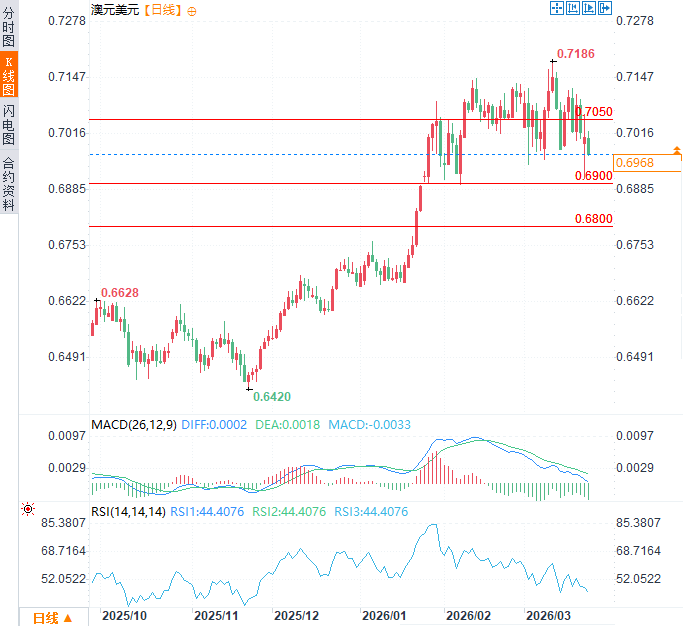
(AUD/USD daily chart, source: FX678)
Iran's denial of talks with the US reversed market expectations and reignited risk aversion, while Australia's March preliminary PMI reading unexpectedly contracted, further weakening the Australian dollar. The Australian dollar fell against the US dollar, facing significant downward pressure in the short term, but any positive developments in the Middle East situation could provide an opportunity for a rebound.
Overall, the current market conditions highlight the significant impact of geopolitical events on risk-sensitive currencies, as well as the vulnerability of the Australian economy to external shocks.
At 11:52 Beijing time, the Australian dollar was trading at 0.6965/66 against the US dollar.
Declining risk appetite boosted the US dollar, with the dollar index rising slightly to around 99.40, a daily gain of about 0.2%. The Australian dollar, a typical risk-sensitive currency, often faces significant selling pressure when geopolitical uncertainty intensifies.
Geopolitical shock
On Monday, US President Trump announced that he had instructed the Department of Defense to suspend military strikes against Iranian power facilities for five days, and stated that he was having "very good and productive conversations" with Tehran on a comprehensive resolution to hostilities in the Middle East. This statement initially eased market tensions, pushing oil prices down and risk assets up.
However, Iran quickly responded strongly. Iranian Parliament Speaker Mohammad Bagher Qalibaf stated unequivocally, "There have been no negotiations with the United States," and accused Trump of spreading disinformation to manipulate the financial and oil markets.
Iranian state media also denied any direct or indirect dialogue, emphasizing that the war would continue until full compensation for damages was received. This reversal of stance led to a rapid return of risk aversion, supporting the US dollar and weakening the Australian dollar.
Australian economic data
In addition to geopolitical factors, domestic economic data in Australia also exerted additional downward pressure on the Australian dollar. The preliminary S&P Global Purchasing Managers' Index (PMI) for March showed a sharp drop in the composite PMI to 47.0, a significant decline from 52.4 in February, marking the first contraction in 18 months. The services sector activity index fell even further to 46.6, while the manufacturing PMI declined slightly to 50.1.
A composite PMI below 50 indicates an overall contraction in business activity, primarily dragged down by a sharp decline in service sector output. Slower growth in new orders, weaker job growth, and heightened concerns about supply chain disruptions have exacerbated market doubts about Australia's economic growth prospects.
Investors are focused on Australia's February Consumer Price Index (CPI) data to be released on Wednesday. However, as the data does not fully reflect the recent energy price increases triggered by the conflict with Iran, its actual impact on the Reserve Bank of Australia's (RBA) monetary policy expectations is expected to be limited.
Market Outlook and Risks
In the short term, the Australian dollar faces dual pressures: persistent geopolitical risks and weak domestic economic data. Key support for the AUD/USD pair is around 0.6900, with further downside potentially testing the psychological level of 0.6800. Resistance is seen in the 0.7050-0.7100 area.
In the medium to long term, the Australian dollar's trajectory will continue to depend on developments in the Middle East, global economic growth prospects, and commodity price performance. A de-escalation of the Iranian conflict and improved risk sentiment would benefit the Australian dollar; conversely, continued tensions would suppress the Australian dollar through energy prices and safe-haven demand. Traders need to closely monitor US economic data and RBA policy signals and manage risk accordingly.
(AUD/USD daily chart, source: FX678)
Editor's Summary
Iran's denial of talks with the US reversed market expectations and reignited risk aversion, while Australia's March preliminary PMI reading unexpectedly contracted, further weakening the Australian dollar. The Australian dollar fell against the US dollar, facing significant downward pressure in the short term, but any positive developments in the Middle East situation could provide an opportunity for a rebound.
Overall, the current market conditions highlight the significant impact of geopolitical events on risk-sensitive currencies, as well as the vulnerability of the Australian economy to external shocks.
At 11:52 Beijing time, the Australian dollar was trading at 0.6965/66 against the US dollar.
- Risk Warning and Disclaimer
- The market involves risk, and trading may not be suitable for all investors. This article is for reference only and does not constitute personal investment advice, nor does it take into account certain users’ specific investment objectives, financial situation, or other needs. Any investment decisions made based on this information are at your own risk.

