Why is Trump's TACO ineffective, and will oil prices continue to rise?
2026-03-24 17:26:51
On Tuesday (March 24), during the Asian and European sessions, after a sharp drop in international oil prices yesterday, prices rebounded and then fell back the following day. Brent crude oil futures are currently trading around $102. Trump has once again used the TACO strategy of applying maximum pressure and releasing conciliatory signals. Meanwhile, the US, Israel, and Iran have not continued to attack energy-related facilities for the time being, and all parties have maintained restraint, which has eased the tense atmosphere of the war to some extent.
In reality, even if oil prices stabilize temporarily due to expectations of a de-escalation in the conflict, this does not mean that the United States can easily extricate itself, nor does it mean that the conflict is over. In other words, oil prices are likely just experiencing a correction rather than a reversal.
The reason is that even if Iran establishes a new access mechanism for the Strait of Hormuz, it does not mean that shipping capacity can be fully restored or oil prices can return to their previous levels, because the United States cannot extricate itself, the war cannot stop, and an accidental clash would force the strait to remain closed.
Why might Trump be unable to achieve his goal of "backing down" (TACO) against Iran? The Persian Gulf war, which he ignited, may have already exceeded his control and evolved into a strategic quagmire that leaves the United States in a dilemma.
Trump's recent announcement of suspending threats to strike Iranian power plants, seemingly a signal of de-escalation, actually exposes the deep-seated dilemma of the United States being unable to extricate itself—whether from a military, political, or diplomatic perspective, the United States is firmly bound to this conflict that is difficult to resolve.
Trump's five-day ceasefire declaration was quickly broken by Iran's tough actions.
On the 24th local time, the Iranian Islamic Revolutionary Guard Corps, in the 78th round of "True Commitment-4" military operation, used multiple types of precision-guided missiles and attack drones to directly strike key targets in Israel, including Eilat, Dimona, and northern Tel Aviv, while also covering some US military bases in the region. It also made it clear that it would expand the scale of the operation according to the situation.
This counterattack not only proves that Iran has not yielded to the US and Israeli attacks, but also demonstrates its determination to continue fighting.
More noteworthy is the fact that Iran's energy minister recently revealed a distributed power generation system, which has rendered the "grid strike" strategy that the United States had high hopes for completely ineffective. The distributed network consisting of more than 150 power plants across the country is more resistant to attack than the centralized power grids of the Persian Gulf countries and Israel. The fact that the gas pipeline of the Khorramshahr power plant was able to continue operating after being attacked further proves that Iran has built a resilient war support system.
The United States' military predicament was foreshadowed from the very beginning. Russian Academy of Sciences expert Vladimir Sazhin's analysis hit the nail on the head: if the United States were to launch a full-scale ground operation, it would need to deploy at least 400,000 to 500,000 army troops and fight in Iran's complex mountainous terrain, harsh climate, and all-people defense environment.
With a population of 93 million and a massive armed force, Iran means that any ground invasion would result in devastating casualties, a cost that could cause Trump to lose the 2026 midterm elections.
The current pace of the US military's mobilization has shattered any illusions of a "quick victory": the forces planned to seize Kharg Island, the heart of Iranian oil, or control the Strait of Hormuz are not yet fully assembled; a Marine Expeditionary Force deployed from Japan has just arrived in the area; and another main force departed from the US West Coast last week. Military experts have already warned that even if the US military possesses the technical capability to seize the island, it will be caught in a "difficult to attack and difficult to defend" predicament due to the continued threat of Iranian shore-based missiles and drones.
Even more serious is that the U.S. military's ammunition stockpile is rapidly depleting, and the Pentagon has urgently requested an additional $200 billion in funding. The systemic decline of U.S. manufacturing makes it difficult to increase weapons production capacity in the short term. This means that the United States can neither achieve its strategic objectives through air strikes nor has it the material basis to continue escalating the war.
Trump desperately needed a "quick victory" to salvage his midterm election losing streak, but Iran's fierce resistance dashed that hopes.
After Iran gained de facto control of the Strait of Hormuz, the global energy market and the lives of ordinary people in the United States were severely impacted. The inflationary pressure caused by soaring oil prices has become an important bargaining chip for the Democratic Party to attack the Republican Party.
Trump's erratic behavior further exacerbated the predicament: he claimed to have reached a fruitful agreement with Iran one day, only to have Tehran deny that any negotiations had taken place the next.
More importantly, the negotiations themselves are no longer feasible: the Iranian regime has been weakened by the war and its core decision-making body has been lost. Even if Pakistan proposes to host the negotiations, it would be difficult to find an effective negotiating party that can represent Iran.
If, as experts have concluded, the Iranian Islamic Revolutionary Guard Corps has seized full power, its hardline stance will only make compromise even more distant.
Iran's leadership has long seen through Trump's contradictory mindset, interpreting his emotional statements and policy swings as signals that their strategic deterrence is working, which renders any idea of a "decent retreat" for the US baseless.
All of America’s potential options are, in essence, “bad choices.”
Continuing the airstrike pattern will not paralyze Iran's control of the Strait of Hormuz, while sending ground troops would violate Trump's campaign promise against "perpetual war" and would inevitably lead to a "Vietnam War-style quagmire."
Choosing to declare victory and withdraw through "TACO" would not only expose Gulf allies to the risk of Iranian retaliation, but would also undermine the core legitimacy of the war due to the failure to control Iranian nuclear materials.
Trump attempted to defuse the crisis through delaying tactics, but the situation in the Persian Gulf had long been beyond his control in this impromptu game—Iran's countermeasures were continuously strengthened during the war, while America's strategic resources were being constantly depleted. This ebb and flow made "withdrawal" an increasingly distant goal.
As mentioned above, Trump is finding it difficult to extricate himself from TACO, so the delay itself may not be for the purpose of extrication, but rather to prepare for medium- to long-term operations, or to wait for some new offensive opportunity, such as waiting for troop weapon resupply.
While Iran is discussing new passage mechanisms through the Straits with other countries, if war breaks out again, this predicament will return to the starting point where no ships dare to pass through the Straits, and it will once again circle back to the global energy lifeline – crude oil.
The Strait of Hormuz carries one-third of the world's seaborne crude oil trade. Iran's absolute control over this waterway means that the United States' predicament of extricating itself will directly translate into long-term turmoil in the crude oil market.
Despite Trump's ceasefire announcement causing a short-term 11% drop in Brent crude oil prices, Goldman Sachs has raised its average price forecast for March and April to $110 per barrel. If the Straits blockade continues for 10 weeks, oil prices could even break through the historical peak of $147 in 2008.
The United States' dilemma has kept the global oil market shrouded in geopolitical risk premiums: as long as the United States cannot truly withdraw, the uncertainty surrounding navigation in the Strait of Hormuz will not be eliminated, and drastic fluctuations in oil prices will become the norm.
This war, triggered by political calculations, ultimately forced the global energy market to pay the price for America's strategic miscalculation, while the United States itself was plunged deeper into a quagmire from the chain reaction in the crude oil supply chain.
From a technical perspective, Brent crude oil is currently facing resistance around 105.5, and the 5-day moving average is also approaching this price level, creating strong downward pressure on oil prices. However, if oil prices can regain and stabilize above 105.5, it indicates that oil prices still have the potential to continue rising, meaning that the price correction is not a reversal but rather a pullback.
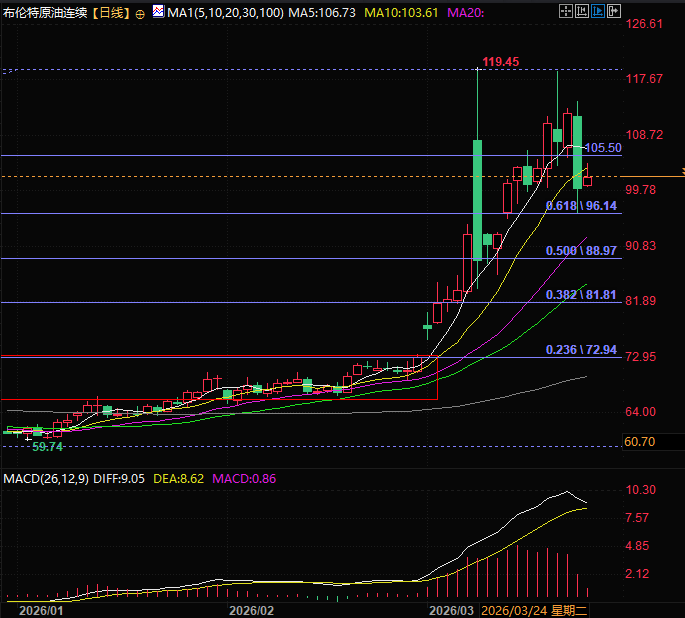
(Brent crude oil futures daily chart, source: EasyForex)
At 17:25 Beijing time, Brent crude oil futures were trading at $102.26 per barrel.
In reality, even if oil prices stabilize temporarily due to expectations of a de-escalation in the conflict, this does not mean that the United States can easily extricate itself, nor does it mean that the conflict is over. In other words, oil prices are likely just experiencing a correction rather than a reversal.
The reason is that even if Iran establishes a new access mechanism for the Strait of Hormuz, it does not mean that shipping capacity can be fully restored or oil prices can return to their previous levels, because the United States cannot extricate itself, the war cannot stop, and an accidental clash would force the strait to remain closed.
Why might Trump be unable to achieve his goal of "backing down" (TACO) against Iran? The Persian Gulf war, which he ignited, may have already exceeded his control and evolved into a strategic quagmire that leaves the United States in a dilemma.
Trump's recent announcement of suspending threats to strike Iranian power plants, seemingly a signal of de-escalation, actually exposes the deep-seated dilemma of the United States being unable to extricate itself—whether from a military, political, or diplomatic perspective, the United States is firmly bound to this conflict that is difficult to resolve.
Iran's tough response: shattering the illusion of a ceasefire and solidifying its war support system.
Trump's five-day ceasefire declaration was quickly broken by Iran's tough actions.
On the 24th local time, the Iranian Islamic Revolutionary Guard Corps, in the 78th round of "True Commitment-4" military operation, used multiple types of precision-guided missiles and attack drones to directly strike key targets in Israel, including Eilat, Dimona, and northern Tel Aviv, while also covering some US military bases in the region. It also made it clear that it would expand the scale of the operation according to the situation.
This counterattack not only proves that Iran has not yielded to the US and Israeli attacks, but also demonstrates its determination to continue fighting.
More noteworthy is the fact that Iran's energy minister recently revealed a distributed power generation system, which has rendered the "grid strike" strategy that the United States had high hopes for completely ineffective. The distributed network consisting of more than 150 power plants across the country is more resistant to attack than the centralized power grids of the Persian Gulf countries and Israel. The fact that the gas pipeline of the Khorramshahr power plant was able to continue operating after being attacked further proves that Iran has built a resilient war support system.
Military Dilemma: Constraints of troop strength, terrain, and production capacity render "quick victory" a pipe dream.
The United States' military predicament was foreshadowed from the very beginning. Russian Academy of Sciences expert Vladimir Sazhin's analysis hit the nail on the head: if the United States were to launch a full-scale ground operation, it would need to deploy at least 400,000 to 500,000 army troops and fight in Iran's complex mountainous terrain, harsh climate, and all-people defense environment.
With a population of 93 million and a massive armed force, Iran means that any ground invasion would result in devastating casualties, a cost that could cause Trump to lose the 2026 midterm elections.
The current pace of the US military's mobilization has shattered any illusions of a "quick victory": the forces planned to seize Kharg Island, the heart of Iranian oil, or control the Strait of Hormuz are not yet fully assembled; a Marine Expeditionary Force deployed from Japan has just arrived in the area; and another main force departed from the US West Coast last week. Military experts have already warned that even if the US military possesses the technical capability to seize the island, it will be caught in a "difficult to attack and difficult to defend" predicament due to the continued threat of Iranian shore-based missiles and drones.
Even more serious is that the U.S. military's ammunition stockpile is rapidly depleting, and the Pentagon has urgently requested an additional $200 billion in funding. The systemic decline of U.S. manufacturing makes it difficult to increase weapons production capacity in the short term. This means that the United States can neither achieve its strategic objectives through air strikes nor has it the material basis to continue escalating the war.
The deadlock on the political and diplomatic front has made it even more difficult for the United States to extricate itself from the situation.
Trump desperately needed a "quick victory" to salvage his midterm election losing streak, but Iran's fierce resistance dashed that hopes.
After Iran gained de facto control of the Strait of Hormuz, the global energy market and the lives of ordinary people in the United States were severely impacted. The inflationary pressure caused by soaring oil prices has become an important bargaining chip for the Democratic Party to attack the Republican Party.
Trump's erratic behavior further exacerbated the predicament: he claimed to have reached a fruitful agreement with Iran one day, only to have Tehran deny that any negotiations had taken place the next.
More importantly, the negotiations themselves are no longer feasible: the Iranian regime has been weakened by the war and its core decision-making body has been lost. Even if Pakistan proposes to host the negotiations, it would be difficult to find an effective negotiating party that can represent Iran.
If, as experts have concluded, the Iranian Islamic Revolutionary Guard Corps has seized full power, its hardline stance will only make compromise even more distant.
Iran's leadership has long seen through Trump's contradictory mindset, interpreting his emotional statements and policy swings as signals that their strategic deterrence is working, which renders any idea of a "decent retreat" for the US baseless.
The dilemma of choices: with no way out, "delaying tactics" are unlikely to break the deadlock.
All of America’s potential options are, in essence, “bad choices.”
Continuing the airstrike pattern will not paralyze Iran's control of the Strait of Hormuz, while sending ground troops would violate Trump's campaign promise against "perpetual war" and would inevitably lead to a "Vietnam War-style quagmire."
Choosing to declare victory and withdraw through "TACO" would not only expose Gulf allies to the risk of Iranian retaliation, but would also undermine the core legitimacy of the war due to the failure to control Iranian nuclear materials.
Trump attempted to defuse the crisis through delaying tactics, but the situation in the Persian Gulf had long been beyond his control in this impromptu game—Iran's countermeasures were continuously strengthened during the war, while America's strategic resources were being constantly depleted. This ebb and flow made "withdrawal" an increasingly distant goal.
Final conclusion: Energy lifeline tied to the world, crude oil market becomes a microcosm of predicament.
As mentioned above, Trump is finding it difficult to extricate himself from TACO, so the delay itself may not be for the purpose of extrication, but rather to prepare for medium- to long-term operations, or to wait for some new offensive opportunity, such as waiting for troop weapon resupply.
While Iran is discussing new passage mechanisms through the Straits with other countries, if war breaks out again, this predicament will return to the starting point where no ships dare to pass through the Straits, and it will once again circle back to the global energy lifeline – crude oil.
The Strait of Hormuz carries one-third of the world's seaborne crude oil trade. Iran's absolute control over this waterway means that the United States' predicament of extricating itself will directly translate into long-term turmoil in the crude oil market.
Despite Trump's ceasefire announcement causing a short-term 11% drop in Brent crude oil prices, Goldman Sachs has raised its average price forecast for March and April to $110 per barrel. If the Straits blockade continues for 10 weeks, oil prices could even break through the historical peak of $147 in 2008.
The United States' dilemma has kept the global oil market shrouded in geopolitical risk premiums: as long as the United States cannot truly withdraw, the uncertainty surrounding navigation in the Strait of Hormuz will not be eliminated, and drastic fluctuations in oil prices will become the norm.
This war, triggered by political calculations, ultimately forced the global energy market to pay the price for America's strategic miscalculation, while the United States itself was plunged deeper into a quagmire from the chain reaction in the crude oil supply chain.
From a technical perspective, Brent crude oil is currently facing resistance around 105.5, and the 5-day moving average is also approaching this price level, creating strong downward pressure on oil prices. However, if oil prices can regain and stabilize above 105.5, it indicates that oil prices still have the potential to continue rising, meaning that the price correction is not a reversal but rather a pullback.
(Brent crude oil futures daily chart, source: EasyForex)
At 17:25 Beijing time, Brent crude oil futures were trading at $102.26 per barrel.
- Risk Warning and Disclaimer
- The market involves risk, and trading may not be suitable for all investors. This article is for reference only and does not constitute personal investment advice, nor does it take into account certain users’ specific investment objectives, financial situation, or other needs. Any investment decisions made based on this information are at your own risk.