The US and Iran embark on a protracted war: a top-level intellectual battle revolving around oil prices and justice.
2026-03-24 21:56:35
The Trump administration claimed that it had made "significant progress" in negotiations with Iran, but Iranian officials with power directly denied the existence of negotiations. This information gap led to violent fluctuations in global financial markets, continued volatility in energy prices, and a sustained increase in demand for safe-haven assets.
On Tuesday (March 24), during the Asian and European sessions, the news of the US-Iran peace talks, after a full day of development, was ultimately reflected in the market with a strong rebound in crude oil prices. WTI crude oil and Brent crude oil have rebounded to nearly 4% of their intraday highs, while gold prices hesitated and closed slightly lower. This also suggests that the US-Iran peace talks are currently mostly an emotional easing, without any substantial benefits.

This article attempts to provide a simple overview of the overall situation by linking objective clues to existing market information.
Abbas Araghchi - Iranian Foreign Minister
Born in 1962, he holds a PhD in political science and is fluent in English and Arabic.
He joined the Revolutionary Guard during the Islamic Revolution in 1979, experienced the Iran-Iraq War, and began his more than 30-year diplomatic career in the Ministry of Foreign Affairs in 1989.
He served as Ambassador to Finland and Japan, Vice Minister of Foreign Affairs in charge of legal and international affairs, and one of the key negotiators in the 2015 Iran nuclear deal.
On August 21, 2024, he was appointed Foreign Minister in a time of crisis. During the US-Israel war against Iran, he led the diplomatic mediation work with Iran, maintained close communication with countries such as Egypt, Pakistan, and Oman, and exchanged views with the Omani Foreign Minister on the situation in the Strait of Hormuz.
Mohammad Bagher Zolghadr - New Secretary of Iran's Supreme National Security Council
A veteran of the Revolutionary Guard, he graduated from the University of Tehran with a Bachelor of Economics and a Master of Public Administration. He joined the Revolutionary Guard after the 1979 revolution, was deeply involved in the Iran-Iraq War, and served as the commander of the Ramadan base.
He served as Deputy Minister of Home Affairs for Security Affairs under the Ahmadinejad government and has served as Secretary of the Committee for Determining National Interests since 2021.
In March 2026, following the assassination of Ali Larijani, he was appointed Secretary of the Supreme National Security Council, approved by Supreme Leader Mojtaba Khamenei, and was responsible for coordinating Iran's security policy and crisis response.
Mohammad Bagher Ghalibaf - Speaker of the Islamic Republic of Iran
Born in northeastern Iran in 1961, he is a representative of the hardliners and holds a doctoral degree.
He joined the Revolutionary Guard in 1979 and rose rapidly through the ranks during the Iran-Iraq War, serving as Commander of the Revolutionary Guard Air Force, Commander of the Iranian Police Force, and Mayor of Tehran (2005-2017).
He has served as Speaker of Parliament since 2020, and his role became even more prominent after Larijani's assassination, as he is seen as a key figure in maintaining the cohesion between the various factions within the Iranian regime. He publicly denied any negotiations with the United States, stating bluntly that Trump's remarks were aimed at manipulating the financial and oil markets.
Masoud Pezeshkian - President of Iran
Born in 1954, he is a cardiac surgeon and a representative of the moderate reformists. In 1997, he joined the Hatami cabinet as Deputy Minister of Health, and later served as the rector of Tabriz University of Medicine and the First Deputy Speaker of Parliament.
He was elected as the 14th President of Iran in July 2024, advocating for easing international pressure through diplomatic means and prioritizing the lifting of sanctions.
During the war, he exchanged views with Pakistani Prime Minister Sharif on the impact on regional security and supported diplomatic efforts to ease tensions.
Esmaeil Kowsari - Member of the Iranian Parliament's Committee on National Security and Foreign Policy
He also serves as a major general and is a key liaison between the Iranian military and parliament.
The statement publicly questioned the United States' track record of credibility in negotiations, emphasized that Iranian decision-makers need to conduct risk assessments before diplomatic contact, and pointed out that the United States is creating division in public opinion through disinformation in an attempt to undermine the credibility of the Iranian government.
Currently, if there were to be negotiations between the US and Iran, the most likely candidates would be Iranian President Masoud Pezeshkian, who has a background in cardiac surgery, and Foreign Minister Abbas Araqchi, who has served in the Ministry of Foreign Affairs for many years.
Amid frequent military strikes, signs of the opening of diplomatic channels have emerged.
Iranian Foreign Minister Araqchi held phone calls with Egypt, Pakistan, and Oman in the past 24 hours. Egyptian Foreign Minister Badr Abdullahti coordinated with multiple countries to prevent regional conflicts from evolving into systemic risks and to avoid triggering disruptions to global energy supply chains and financial markets.
Pakistan is expected to become a key platform for subsequent negotiations, with US Vice President Judd Vance (who privately expresses skepticism about the market risk premium of war) potentially involved. Direct negotiations could begin as early as this week in Islamabad.
Although the US and Iran have not established a direct dialogue channel, Egypt, Pakistan, and Gulf states are playing a role in relaying information, while Oman is holding consultations on the issue of navigation in the Strait of Hormuz—which carries 20% of the world's crude oil transport and whose situation directly determines the medium-term trend of international oil prices.
However, the diplomatic process is fraught with uncertainty. A spokesperson for the Qatari Ministry of Foreign Affairs stated that Doha is not currently involved in the US-Iran negotiations; Iranian Parliament Speaker Ghalibaf bluntly stated: "We have not conducted any negotiations with the US, and the related false information is intended to manipulate the financial and oil markets."
An official Iranian statement said: "The US president's remarks are aimed at lowering international oil prices (a key strategic bargaining chip during the Iranian war) and buying time for his military deployments."
Trump's abrupt announcement on Monday of a negotiation process with Iran and a postponement of the military strike deadline has drawn widespread attention to his strategy for handling the Middle East conflict.
The US president made a series of contradictory statements regarding the war's objectives and timeline. On March 13, he claimed that "my gut feeling tells me the war is about to end," and then threatened to destroy Iran's $10 billion power generation facilities, forcing Iran to adjust its position.
Garrett Martin, a professor of international relations at American University in Washington, commented: "Trump is adept at making sudden policy changes, making it difficult for outsiders to judge whether his actions are well-thought-out strategic plans or purely impromptu decisions."
Such policy shifts typically follow a fixed pattern: first, a military threat is issued to cause international shock, followed by a sudden change of stance claiming key concessions have been made and a promise that the crisis is about to be resolved, leading to severe turmoil in global markets.
Martin analyzed that this policy adjustment was driven by three factors: the spread of market panic, pressure from Gulf countries, and the divergence of positions on the conflict within the core political camp.
Trump told the media that his special envoy Steve Witkov and his son-in-law Jared Kushner (who led negotiations with Iran before the war) had held talks with senior Iranian officials on Sunday evening, but Iran has completely denied the claim.
Israeli Prime Minister Benjamin Netanyahu released a video statement saying that military operations in Lebanon and Iran will continue, and that Trump believes that "the military advantages of the Israeli and U.S. forces can be used to achieve war objectives through agreements."
The US-Israel war in Iraq has evolved into a global conflict in the Middle East, triggering sharp fluctuations in international oil prices and putting pressure on the global energy supply chain to be restructured. This change in the macro environment has also profoundly affected the valuation logic of gold and technology stocks.
Iran has effectively blocked the Strait of Hormuz, a vital energy route that carries approximately 20% of the world's oil and liquefied natural gas. European Commission President Ursula von der Leyen warned that Iran's attempt to block the Strait of Hormuz "must be condemned by the international community." However, Iran is currently actively discussing a passage mechanism for the strait with Gulf states, as well as South Korea and India. Two Indian LPG carriers and a Thai-flagged vessel passed through the strait.
British Prime Minister Keir Starmer became the first European leader to publicly admit to knowing about the contact during his testimony before a special parliamentary committee. However , as a core ally of the United States, Britain did not provide substantial combat support in this war. It can be assumed that in the war of information, Britain would inevitably publish statements favorable to the United States. In addition, given its history of perjury, the reliability of Britain's testimony is questionable and may even serve as a negative indicator.
IG market analyst Tony Sekomore noted, "The current situation remains extremely fragile, and market sentiment is on the verge of exploding." Investors need to closely monitor how the duration and intensity of the conflict will affect their asset allocation needs.
Despite ongoing diplomatic efforts, Iran has made it clear that it is more concerned with establishing a long-term national security guarantee mechanism than with a short-term ceasefire agreement. This strategic consideration will directly affect the duration of the conflict and the performance of safe-haven assets in the market.
Faced with the current global energy crisis, the United States is using social media to ease market concerns while simultaneously buying low and selling high in US stocks and futures. Meanwhile, Iran is actively discussing a passage mechanism for the Strait of Hormuz with neighboring countries. This may be awkward for the United States, as it means that the market can bypass the US to resolve the Strait of Hormuz issue. Furthermore, US pressure has actually boosted global energy prices. If Iran successfully facilitates a passage agreement, it will become the party of justice.
European Commission President Ursula von der Leyen also emphasized that negotiations are the only viable path to resolving the Iranian conflict, and that a solution reached through diplomatic consultations is the fundamental way to end the hostilities in the Middle East. The formation of this political consensus will help stabilize expectations in the energy market.
However, given that hardliners are in power in Iran and the country's fighting capacity has not been significantly weakened, it is difficult for Israel and the United States to stop their series of decapitation strikes, which inevitably leads to a protracted war.
On the one hand, facing the US midterm elections, there is a protracted struggle: will voter support and potential votes decline first, or will Iran's underground missile bases be destroyed first? On the other hand, for Israel, will it eliminate the Iranian nuclear threat first, or will Iran be forced to convert its enriched uranium from civilian to military use to achieve a breakthrough, since Iran has previously been wavering between civilian and military applications?
Global financial markets will continue to fluctuate amid the contradictions between military conflicts and diplomatic signals. Energy and gold prices will remain at high levels of volatility. The central price of oil is expected to continue to rise, while gold prices will fall and enter a value zone. There are signs of a restart in consumer demand for jewelry and other products.
Meanwhile, if more navigation cases occur in the Strait of Hormuz, it is expected to continue to boost gold prices by influencing real interest rates through energy prices.
From a technical perspective, spot gold continues to face resistance at the 0.500 Fibonacci retracement level, as well as the downward-moving 5-day moving average, suggesting a potential double bottom retest.
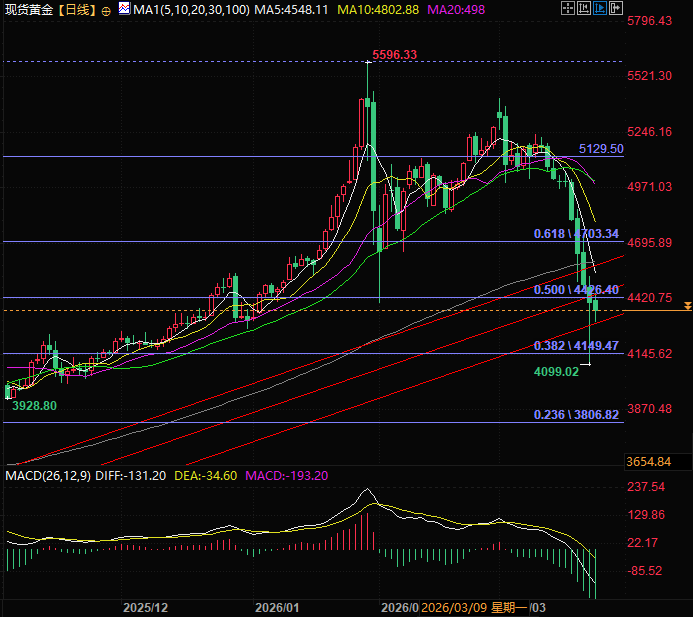
(Spot gold daily chart, source: EasyForex subsidiary)
WTI crude oil faces resistance in the 94-95 range. If prices can return to this range and consolidate, they are likely to continue their upward trend.
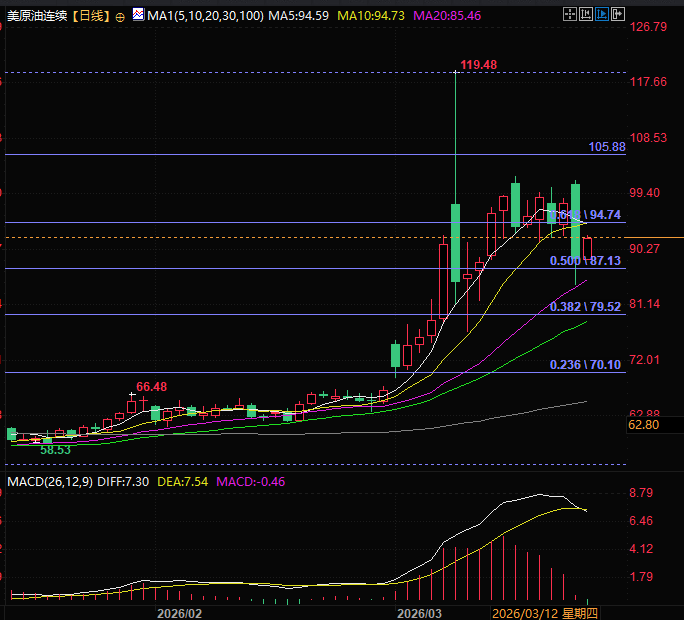
(WTI crude oil futures daily chart, source: FX678's subsidiary EasyForex)
On Tuesday (March 24), during the Asian and European sessions, the news of the US-Iran peace talks, after a full day of development, was ultimately reflected in the market with a strong rebound in crude oil prices. WTI crude oil and Brent crude oil have rebounded to nearly 4% of their intraday highs, while gold prices hesitated and closed slightly lower. This also suggests that the US-Iran peace talks are currently mostly an emotional easing, without any substantial benefits.
This article attempts to provide a simple overview of the overall situation by linking objective clues to existing market information.
Abbas Araghchi - Iranian Foreign Minister
Born in 1962, he holds a PhD in political science and is fluent in English and Arabic.
He joined the Revolutionary Guard during the Islamic Revolution in 1979, experienced the Iran-Iraq War, and began his more than 30-year diplomatic career in the Ministry of Foreign Affairs in 1989.
He served as Ambassador to Finland and Japan, Vice Minister of Foreign Affairs in charge of legal and international affairs, and one of the key negotiators in the 2015 Iran nuclear deal.
On August 21, 2024, he was appointed Foreign Minister in a time of crisis. During the US-Israel war against Iran, he led the diplomatic mediation work with Iran, maintained close communication with countries such as Egypt, Pakistan, and Oman, and exchanged views with the Omani Foreign Minister on the situation in the Strait of Hormuz.
Mohammad Bagher Zolghadr - New Secretary of Iran's Supreme National Security Council
A veteran of the Revolutionary Guard, he graduated from the University of Tehran with a Bachelor of Economics and a Master of Public Administration. He joined the Revolutionary Guard after the 1979 revolution, was deeply involved in the Iran-Iraq War, and served as the commander of the Ramadan base.
He served as Deputy Minister of Home Affairs for Security Affairs under the Ahmadinejad government and has served as Secretary of the Committee for Determining National Interests since 2021.
In March 2026, following the assassination of Ali Larijani, he was appointed Secretary of the Supreme National Security Council, approved by Supreme Leader Mojtaba Khamenei, and was responsible for coordinating Iran's security policy and crisis response.
Mohammad Bagher Ghalibaf - Speaker of the Islamic Republic of Iran
Born in northeastern Iran in 1961, he is a representative of the hardliners and holds a doctoral degree.
He joined the Revolutionary Guard in 1979 and rose rapidly through the ranks during the Iran-Iraq War, serving as Commander of the Revolutionary Guard Air Force, Commander of the Iranian Police Force, and Mayor of Tehran (2005-2017).
He has served as Speaker of Parliament since 2020, and his role became even more prominent after Larijani's assassination, as he is seen as a key figure in maintaining the cohesion between the various factions within the Iranian regime. He publicly denied any negotiations with the United States, stating bluntly that Trump's remarks were aimed at manipulating the financial and oil markets.
Masoud Pezeshkian - President of Iran
Born in 1954, he is a cardiac surgeon and a representative of the moderate reformists. In 1997, he joined the Hatami cabinet as Deputy Minister of Health, and later served as the rector of Tabriz University of Medicine and the First Deputy Speaker of Parliament.
He was elected as the 14th President of Iran in July 2024, advocating for easing international pressure through diplomatic means and prioritizing the lifting of sanctions.
During the war, he exchanged views with Pakistani Prime Minister Sharif on the impact on regional security and supported diplomatic efforts to ease tensions.
Esmaeil Kowsari - Member of the Iranian Parliament's Committee on National Security and Foreign Policy
He also serves as a major general and is a key liaison between the Iranian military and parliament.
The statement publicly questioned the United States' track record of credibility in negotiations, emphasized that Iranian decision-makers need to conduct risk assessments before diplomatic contact, and pointed out that the United States is creating division in public opinion through disinformation in an attempt to undermine the credibility of the Iranian government.
Currently, if there were to be negotiations between the US and Iran, the most likely candidates would be Iranian President Masoud Pezeshkian, who has a background in cardiac surgery, and Foreign Minister Abbas Araqchi, who has served in the Ministry of Foreign Affairs for many years.
The complex landscape of diplomatic mediation: intermediary diplomacy involving multiple parties
Amid frequent military strikes, signs of the opening of diplomatic channels have emerged.
Iranian Foreign Minister Araqchi held phone calls with Egypt, Pakistan, and Oman in the past 24 hours. Egyptian Foreign Minister Badr Abdullahti coordinated with multiple countries to prevent regional conflicts from evolving into systemic risks and to avoid triggering disruptions to global energy supply chains and financial markets.
Pakistan is expected to become a key platform for subsequent negotiations, with US Vice President Judd Vance (who privately expresses skepticism about the market risk premium of war) potentially involved. Direct negotiations could begin as early as this week in Islamabad.
Although the US and Iran have not established a direct dialogue channel, Egypt, Pakistan, and Gulf states are playing a role in relaying information, while Oman is holding consultations on the issue of navigation in the Strait of Hormuz—which carries 20% of the world's crude oil transport and whose situation directly determines the medium-term trend of international oil prices.
However, the diplomatic process is fraught with uncertainty. A spokesperson for the Qatari Ministry of Foreign Affairs stated that Doha is not currently involved in the US-Iran negotiations; Iranian Parliament Speaker Ghalibaf bluntly stated: "We have not conducted any negotiations with the US, and the related false information is intended to manipulate the financial and oil markets."
An official Iranian statement said: "The US president's remarks are aimed at lowering international oil prices (a key strategic bargaining chip during the Iranian war) and buying time for his military deployments."
Trump's Negotiation Strategy: Policy U-turns and Market Manipulation Controversies
Trump's abrupt announcement on Monday of a negotiation process with Iran and a postponement of the military strike deadline has drawn widespread attention to his strategy for handling the Middle East conflict.
The US president made a series of contradictory statements regarding the war's objectives and timeline. On March 13, he claimed that "my gut feeling tells me the war is about to end," and then threatened to destroy Iran's $10 billion power generation facilities, forcing Iran to adjust its position.
Garrett Martin, a professor of international relations at American University in Washington, commented: "Trump is adept at making sudden policy changes, making it difficult for outsiders to judge whether his actions are well-thought-out strategic plans or purely impromptu decisions."
Such policy shifts typically follow a fixed pattern: first, a military threat is issued to cause international shock, followed by a sudden change of stance claiming key concessions have been made and a promise that the crisis is about to be resolved, leading to severe turmoil in global markets.
Martin analyzed that this policy adjustment was driven by three factors: the spread of market panic, pressure from Gulf countries, and the divergence of positions on the conflict within the core political camp.
Trump told the media that his special envoy Steve Witkov and his son-in-law Jared Kushner (who led negotiations with Iran before the war) had held talks with senior Iranian officials on Sunday evening, but Iran has completely denied the claim.
Israeli Prime Minister Benjamin Netanyahu released a video statement saying that military operations in Lebanon and Iran will continue, and that Trump believes that "the military advantages of the Israeli and U.S. forces can be used to achieve war objectives through agreements."
Global Impact: The Chain Reaction of Energy Security and Market Volatility
The US-Israel war in Iraq has evolved into a global conflict in the Middle East, triggering sharp fluctuations in international oil prices and putting pressure on the global energy supply chain to be restructured. This change in the macro environment has also profoundly affected the valuation logic of gold and technology stocks.
Iran has effectively blocked the Strait of Hormuz, a vital energy route that carries approximately 20% of the world's oil and liquefied natural gas. European Commission President Ursula von der Leyen warned that Iran's attempt to block the Strait of Hormuz "must be condemned by the international community." However, Iran is currently actively discussing a passage mechanism for the strait with Gulf states, as well as South Korea and India. Two Indian LPG carriers and a Thai-flagged vessel passed through the strait.
British Prime Minister Keir Starmer became the first European leader to publicly admit to knowing about the contact during his testimony before a special parliamentary committee. However , as a core ally of the United States, Britain did not provide substantial combat support in this war. It can be assumed that in the war of information, Britain would inevitably publish statements favorable to the United States. In addition, given its history of perjury, the reliability of Britain's testimony is questionable and may even serve as a negative indicator.
IG market analyst Tony Sekomore noted, "The current situation remains extremely fragile, and market sentiment is on the verge of exploding." Investors need to closely monitor how the duration and intensity of the conflict will affect their asset allocation needs.
Outlook: Negotiation Prospects and the Long-Term Presence of Risk Premiums
Despite ongoing diplomatic efforts, Iran has made it clear that it is more concerned with establishing a long-term national security guarantee mechanism than with a short-term ceasefire agreement. This strategic consideration will directly affect the duration of the conflict and the performance of safe-haven assets in the market.
Faced with the current global energy crisis, the United States is using social media to ease market concerns while simultaneously buying low and selling high in US stocks and futures. Meanwhile, Iran is actively discussing a passage mechanism for the Strait of Hormuz with neighboring countries. This may be awkward for the United States, as it means that the market can bypass the US to resolve the Strait of Hormuz issue. Furthermore, US pressure has actually boosted global energy prices. If Iran successfully facilitates a passage agreement, it will become the party of justice.
European Commission President Ursula von der Leyen also emphasized that negotiations are the only viable path to resolving the Iranian conflict, and that a solution reached through diplomatic consultations is the fundamental way to end the hostilities in the Middle East. The formation of this political consensus will help stabilize expectations in the energy market.
However, given that hardliners are in power in Iran and the country's fighting capacity has not been significantly weakened, it is difficult for Israel and the United States to stop their series of decapitation strikes, which inevitably leads to a protracted war.
On the one hand, facing the US midterm elections, there is a protracted struggle: will voter support and potential votes decline first, or will Iran's underground missile bases be destroyed first? On the other hand, for Israel, will it eliminate the Iranian nuclear threat first, or will Iran be forced to convert its enriched uranium from civilian to military use to achieve a breakthrough, since Iran has previously been wavering between civilian and military applications?
Global financial markets will continue to fluctuate amid the contradictions between military conflicts and diplomatic signals. Energy and gold prices will remain at high levels of volatility. The central price of oil is expected to continue to rise, while gold prices will fall and enter a value zone. There are signs of a restart in consumer demand for jewelry and other products.
Meanwhile, if more navigation cases occur in the Strait of Hormuz, it is expected to continue to boost gold prices by influencing real interest rates through energy prices.
From a technical perspective, spot gold continues to face resistance at the 0.500 Fibonacci retracement level, as well as the downward-moving 5-day moving average, suggesting a potential double bottom retest.
(Spot gold daily chart, source: EasyForex subsidiary)
WTI crude oil faces resistance in the 94-95 range. If prices can return to this range and consolidate, they are likely to continue their upward trend.
(WTI crude oil futures daily chart, source: FX678's subsidiary EasyForex)
- Risk Warning and Disclaimer
- The market involves risk, and trading may not be suitable for all investors. This article is for reference only and does not constitute personal investment advice, nor does it take into account certain users’ specific investment objectives, financial situation, or other needs. Any investment decisions made based on this information are at your own risk.