Weather pressures futures markets, fueling bearish expectations for natural gas prices.
2026-03-24 23:46:24
On Tuesday (March 24), natural gas futures attempted to rebound during the US trading session after a sharp sell-off that pushed them to a three-week low. Traders are weighing bearish signals from the US domestic market against tightening overseas supply. While the market shows signs of stabilizing, supply growth continues to outpace demand, and seasonal consumption demand has begun to decline.

From the oscillator chart and moving averages, the current trend is downward, with an overall bearish bias. On Monday, US natural gas futures failed to break through the 50-day moving average of $3.132 and fell below two minor swing lows of $2.965 and $2.919, confirming a shift in momentum to the downside. A further break below the swing low of $2.807 would reconfirm the downtrend, with the next major target at $2.689.
If the price can recover the 50-day moving average, it will be the first signal of a strengthening trend, at which point the momentum will turn upward, potentially testing the minor high of $3.292 and refocusing on the major pullback range of $3.405-$3.570. This range includes the 200-day moving average at $3.489 and the major swing high of $3.488.
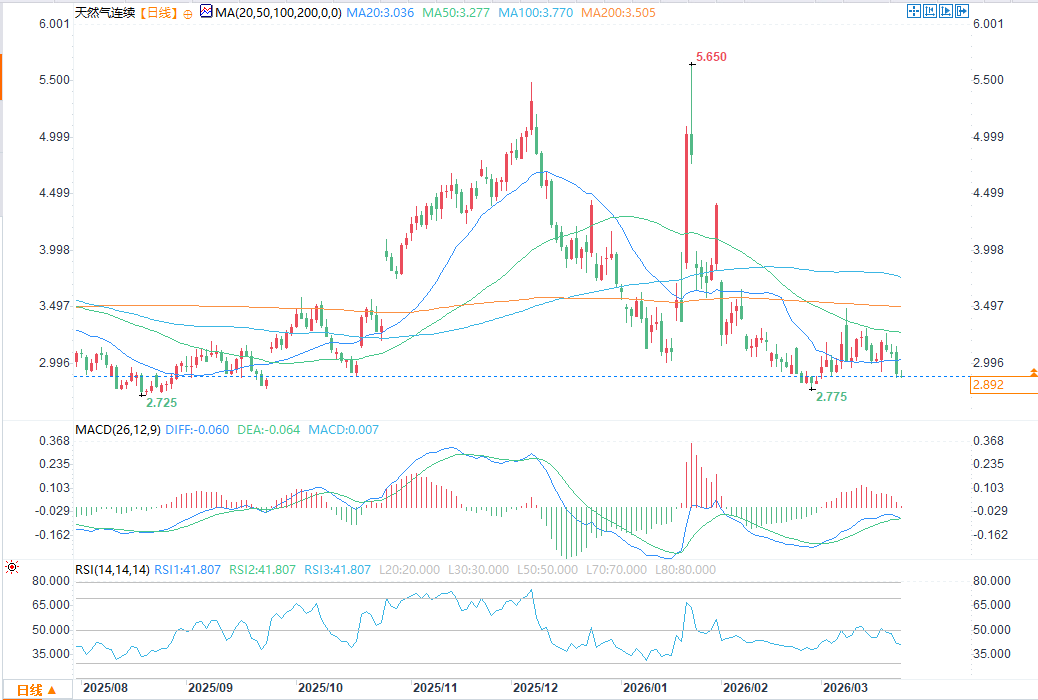
(Daily chart of natural gas source: EasyForex)
The weather forecast is bearish, putting downward pressure on the market.
The current core market factor is the weather. Forecasts indicate that temperatures across most of the US will remain above average until early April, leading to a faster-than-usual decline in heating demand, and the transition season has begun. The late-season demand buffer that typically supports gas prices in late March has not materialized this year, and no cold snap is expected to alter this pattern. For traders, the path of least resistance remains downward. Any rebounds will be met with selling pressure, and near-month contracts continue to face downward pressure unless bullish signals emerge in the forecast.
The oversupply continues to worsen
U.S. dry natural gas production is nearing record highs, with recent daily production averaging approximately 112-113 billion cubic feet. Demand growth has failed to keep pace, leading to a widening supply-demand gap.
U.S. Energy Information Administration (EIA) Natural Gas Storage Analysis
The latest inventory report further exacerbated the bearish sentiment: Mid-March saw an injection of 35 billion cubic feet of inventory, whereas the market typically sees inventory withdrawals rather than injections during the same period in previous years. Current inventory levels are already higher than the same period last year and slightly above the five-year average. The market has entered a period of oversupply earlier than most traders anticipated.
Premature inventory buildup sends a clear signal to the market: unless production slows, every rebound presents a shorting opportunity. Previously, market supply and demand had tightened, but the situation has now completely reversed.
LNG demand provides limited support for natural gas.
Amid warmer weather, increased production, and declining domestic demand, LNG exports are one of the few factors supporting gas prices. Continued European purchases of US natural gas are supportive of prices, but export facilities are nearing capacity, and terminal processing capacity has its limits. Even with high export volumes, US natural gas inventories continue to accumulate. This means that LNG exports alone cannot offset the oversupply pressure; they can only prevent a price collapse, not drive prices up.
Global supply disruptions add uncertainty
Qatar's Ras Lafan export facilities suffered severe damage, and repairs could take years, resulting in a significant reduction in the effective global LNG supply. Geopolitical tensions in the Middle East have also disrupted key shipping routes, tightening supplies in Europe and Asia and pushing up international gas prices.
In the long term, US exports are expected to benefit, but traders are not currently pricing in this. The current fundamentals of oversupply in the US outweigh all other positive factors.
Manufacturers have not slowed down production.
Natural gas production has not declined. Most of the natural gas currently circulating in the market is associated gas from oil extraction. Due to high crude oil prices, producers continue drilling for oil, resulting in the production of natural gas as a byproduct. Lower gas prices will not change this production logic.
The situation in West Texas is most representative: local gas prices have fallen into negative territory, pipeline transportation is congested, natural gas has nowhere to go, and producers even have to pay for transshipment. Unless oil drilling activity slows down or new pipeline capacity comes online, this situation is unlikely to change.
Market Outlook
Tuesday's rebound did not change the overall pattern. Warm weather, early inventory buildup, and record production all point to a bearish outlook. Global supply disruptions and LNG demand can only buffer the decline, not reverse the trend. Currently, the US domestic oversupply dominates the market, and every rebound will be met with selling pressure until the weather turns cold or production declines.
From the oscillator chart and moving averages, the current trend is downward, with an overall bearish bias. On Monday, US natural gas futures failed to break through the 50-day moving average of $3.132 and fell below two minor swing lows of $2.965 and $2.919, confirming a shift in momentum to the downside. A further break below the swing low of $2.807 would reconfirm the downtrend, with the next major target at $2.689.
If the price can recover the 50-day moving average, it will be the first signal of a strengthening trend, at which point the momentum will turn upward, potentially testing the minor high of $3.292 and refocusing on the major pullback range of $3.405-$3.570. This range includes the 200-day moving average at $3.489 and the major swing high of $3.488.
(Daily chart of natural gas source: EasyForex)
The weather forecast is bearish, putting downward pressure on the market.
The current core market factor is the weather. Forecasts indicate that temperatures across most of the US will remain above average until early April, leading to a faster-than-usual decline in heating demand, and the transition season has begun. The late-season demand buffer that typically supports gas prices in late March has not materialized this year, and no cold snap is expected to alter this pattern. For traders, the path of least resistance remains downward. Any rebounds will be met with selling pressure, and near-month contracts continue to face downward pressure unless bullish signals emerge in the forecast.
The oversupply continues to worsen
U.S. dry natural gas production is nearing record highs, with recent daily production averaging approximately 112-113 billion cubic feet. Demand growth has failed to keep pace, leading to a widening supply-demand gap.
U.S. Energy Information Administration (EIA) Natural Gas Storage Analysis
The latest inventory report further exacerbated the bearish sentiment: Mid-March saw an injection of 35 billion cubic feet of inventory, whereas the market typically sees inventory withdrawals rather than injections during the same period in previous years. Current inventory levels are already higher than the same period last year and slightly above the five-year average. The market has entered a period of oversupply earlier than most traders anticipated.
Premature inventory buildup sends a clear signal to the market: unless production slows, every rebound presents a shorting opportunity. Previously, market supply and demand had tightened, but the situation has now completely reversed.
LNG demand provides limited support for natural gas.
Amid warmer weather, increased production, and declining domestic demand, LNG exports are one of the few factors supporting gas prices. Continued European purchases of US natural gas are supportive of prices, but export facilities are nearing capacity, and terminal processing capacity has its limits. Even with high export volumes, US natural gas inventories continue to accumulate. This means that LNG exports alone cannot offset the oversupply pressure; they can only prevent a price collapse, not drive prices up.
Global supply disruptions add uncertainty
Qatar's Ras Lafan export facilities suffered severe damage, and repairs could take years, resulting in a significant reduction in the effective global LNG supply. Geopolitical tensions in the Middle East have also disrupted key shipping routes, tightening supplies in Europe and Asia and pushing up international gas prices.
In the long term, US exports are expected to benefit, but traders are not currently pricing in this. The current fundamentals of oversupply in the US outweigh all other positive factors.
Manufacturers have not slowed down production.
Natural gas production has not declined. Most of the natural gas currently circulating in the market is associated gas from oil extraction. Due to high crude oil prices, producers continue drilling for oil, resulting in the production of natural gas as a byproduct. Lower gas prices will not change this production logic.
The situation in West Texas is most representative: local gas prices have fallen into negative territory, pipeline transportation is congested, natural gas has nowhere to go, and producers even have to pay for transshipment. Unless oil drilling activity slows down or new pipeline capacity comes online, this situation is unlikely to change.
Market Outlook
Tuesday's rebound did not change the overall pattern. Warm weather, early inventory buildup, and record production all point to a bearish outlook. Global supply disruptions and LNG demand can only buffer the decline, not reverse the trend. Currently, the US domestic oversupply dominates the market, and every rebound will be met with selling pressure until the weather turns cold or production declines.
- Risk Warning and Disclaimer
- The market involves risk, and trading may not be suitable for all investors. This article is for reference only and does not constitute personal investment advice, nor does it take into account certain users’ specific investment objectives, financial situation, or other needs. Any investment decisions made based on this information are at your own risk.