Thursday countdown begins! Mediators push for US-Iran summit; will Trump's "major progress" materialize?
2026-03-25 10:47:32
Mediators from Turkey, Egypt, and Pakistan are pushing to arrange a meeting between US and Iranian officials by Thursday (March 26) to end the nearly four-week-long conflict. However, significant differences remain between the two sides, and Iran has not yet formally approved face-to-face talks in Islamabad.
US President Trump said on Tuesday that negotiations had made "significant progress," with Iran making concessions including not possessing nuclear weapons, and that Iran was "very eager to reach an agreement." Multiple media outlets reported that the US had submitted a 15-point ceasefire proposal to Iran through intermediary channels.
On Wednesday during Asian trading hours, US crude oil prices fluctuated downwards, currently trading around $88.40 per barrel, down about 4.2% from Tuesday's settlement price.

Arab officials and informed U.S. officials revealed that Turkey, Egypt, and Pakistan conveyed messages to both sides over the past two days. The foreign ministers of the three countries held separate talks with U.S. special envoy Steve Witkov and Iranian Foreign Minister Abbas Araqchi.
The mediators hope to facilitate a direct or indirect meeting as soon as possible to discuss core issues such as ending the war, the nuclear issue, regional security, and the opening of the Strait of Hormuz. White House Press Secretary Carolyn Levitt emphasized that these are sensitive diplomatic discussions, the United States will not negotiate through the media, and stated that Operation Epic Fury will continue.
At the White House, Trump stated that the United States is engaging in dialogue with "appropriate people" in Iran, and that Iran has made "generous" concessions, including on issues related to non-nuclear energy and the Strait of Hormuz. He claimed that there is "significant consensus" between the two sides and that strikes against Iranian power plants have been suspended for five days.
The report states that the 15-point proposal submitted by the United States includes core demands such as dismantling Iran's main nuclear facilities, ceasing support for proxy forces in the region, limiting missile programs, and ensuring the openness of the Strait of Hormuz. In exchange, the US plans to offer concessions such as the complete lifting of sanctions and support for civilian nuclear programs, and suggests a one-month ceasefire to allow for further negotiations.
Iranian officials are highly suspicious of the United States, claiming that the Trump administration launched two attacks during high-level diplomatic events, and media leaks have also angered Tehran. After consolidating power within the regime, the Islamic Revolutionary Guard Corps has made strong demands of the United States, including closing all U.S. military bases in the Gulf region and providing war reparations.
U.S. officials consider these demands "absurd and unrealistic," and assess that Iran believes it still has leverage, as its blockade of the Strait of Hormuz is putting pressure on global energy markets and on Trump. Iranian Parliament Speaker Ghalibaf dismissed the reports as "fake news."
Pakistani Prime Minister Sheikh Sharif posted on the X platform on Tuesday, saying that Pakistan is “ready and honored” to host meaningful and fruitful talks between the US and Iran to reach a comprehensive solution.
Pakistani government sources say discussions about the meeting are in their final stages and could take place within a week if both sides agree. Pakistan maintains traditional relations with Iran and also enjoys good relations with the Trump administration, making it an ideal mediator and host.
In the short term, whether a meeting can be arranged before Thursday will be a key turning point. If mediation is successful and substantive negotiations begin, the conflict is expected to gradually ease, and oil prices will face downward pressure; conversely, if Iran maintains a hardline stance or the United States continues its military buildup, the war could become protracted.
The US is accelerating its military deployment in the region, increasing the risk of a protracted conflict. Investors need to closely monitor the latest developments in the mediation process, subsequent statements from Trump, official responses from Iran, and oil price trends. Geopolitical uncertainty will continue to dominate the market.
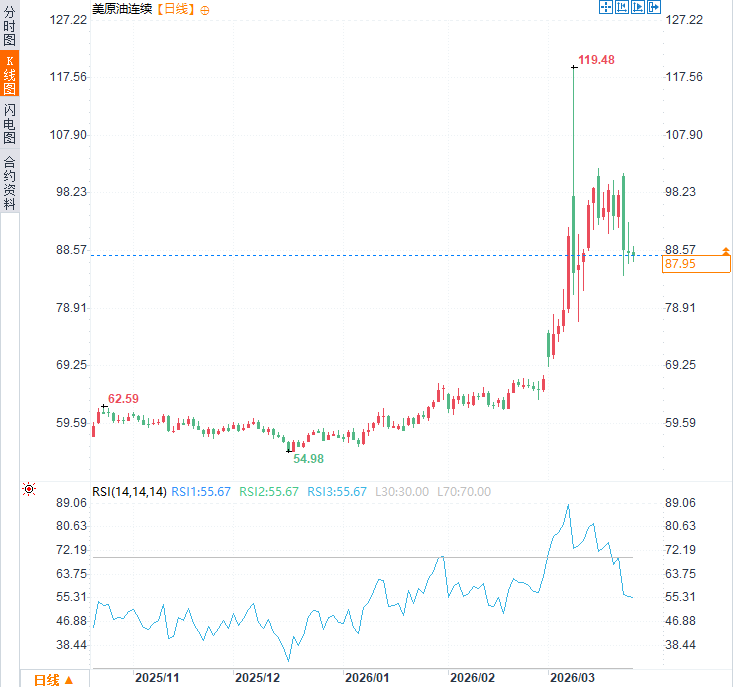
(US crude oil daily chart, source: FX678)
Turkey, Egypt, and Pakistan, among other mediators, are intensifying efforts to push for a US-Iran summit before Thursday. Trump optimistically declared significant progress in negotiations and stated he had submitted a 15-point ceasefire plan. However, Iran remains highly suspicious of the US, and the Revolutionary Guard's strong demands, including the closure of US military bases, have made an agreement more difficult. Pakistan has offered to host the talks, providing a new channel for diplomacy. Overall, while current diplomatic efforts show positive signs, significant trust deficits and differences in positions remain between the two sides, and there is considerable uncertainty as to whether the conflict can be resolved quickly. Global energy markets and the macroeconomy will continue to face pressure.
At 10:46 Beijing time, US crude oil futures were trading at $88.46 per barrel.
US President Trump said on Tuesday that negotiations had made "significant progress," with Iran making concessions including not possessing nuclear weapons, and that Iran was "very eager to reach an agreement." Multiple media outlets reported that the US had submitted a 15-point ceasefire proposal to Iran through intermediary channels.
On Wednesday during Asian trading hours, US crude oil prices fluctuated downwards, currently trading around $88.40 per barrel, down about 4.2% from Tuesday's settlement price.
The mediators facilitated the meeting.
Arab officials and informed U.S. officials revealed that Turkey, Egypt, and Pakistan conveyed messages to both sides over the past two days. The foreign ministers of the three countries held separate talks with U.S. special envoy Steve Witkov and Iranian Foreign Minister Abbas Araqchi.
The mediators hope to facilitate a direct or indirect meeting as soon as possible to discuss core issues such as ending the war, the nuclear issue, regional security, and the opening of the Strait of Hormuz. White House Press Secretary Carolyn Levitt emphasized that these are sensitive diplomatic discussions, the United States will not negotiate through the media, and stated that Operation Epic Fury will continue.
Trump's optimistic statement and 15-point plan
At the White House, Trump stated that the United States is engaging in dialogue with "appropriate people" in Iran, and that Iran has made "generous" concessions, including on issues related to non-nuclear energy and the Strait of Hormuz. He claimed that there is "significant consensus" between the two sides and that strikes against Iranian power plants have been suspended for five days.
The report states that the 15-point proposal submitted by the United States includes core demands such as dismantling Iran's main nuclear facilities, ceasing support for proxy forces in the region, limiting missile programs, and ensuring the openness of the Strait of Hormuz. In exchange, the US plans to offer concessions such as the complete lifting of sanctions and support for civilian nuclear programs, and suggests a one-month ceasefire to allow for further negotiations.
Iranian concerns and the Revolutionary Guard's tough demands
Iranian officials are highly suspicious of the United States, claiming that the Trump administration launched two attacks during high-level diplomatic events, and media leaks have also angered Tehran. After consolidating power within the regime, the Islamic Revolutionary Guard Corps has made strong demands of the United States, including closing all U.S. military bases in the Gulf region and providing war reparations.
U.S. officials consider these demands "absurd and unrealistic," and assess that Iran believes it still has leverage, as its blockade of the Strait of Hormuz is putting pressure on global energy markets and on Trump. Iranian Parliament Speaker Ghalibaf dismissed the reports as "fake news."
Pakistan's willingness to host
Pakistani Prime Minister Sheikh Sharif posted on the X platform on Tuesday, saying that Pakistan is “ready and honored” to host meaningful and fruitful talks between the US and Iran to reach a comprehensive solution.
Pakistani government sources say discussions about the meeting are in their final stages and could take place within a week if both sides agree. Pakistan maintains traditional relations with Iran and also enjoys good relations with the Trump administration, making it an ideal mediator and host.
Market Outlook and Risks
In the short term, whether a meeting can be arranged before Thursday will be a key turning point. If mediation is successful and substantive negotiations begin, the conflict is expected to gradually ease, and oil prices will face downward pressure; conversely, if Iran maintains a hardline stance or the United States continues its military buildup, the war could become protracted.
The US is accelerating its military deployment in the region, increasing the risk of a protracted conflict. Investors need to closely monitor the latest developments in the mediation process, subsequent statements from Trump, official responses from Iran, and oil price trends. Geopolitical uncertainty will continue to dominate the market.
(US crude oil daily chart, source: FX678)
Editor's Summary
Turkey, Egypt, and Pakistan, among other mediators, are intensifying efforts to push for a US-Iran summit before Thursday. Trump optimistically declared significant progress in negotiations and stated he had submitted a 15-point ceasefire plan. However, Iran remains highly suspicious of the US, and the Revolutionary Guard's strong demands, including the closure of US military bases, have made an agreement more difficult. Pakistan has offered to host the talks, providing a new channel for diplomacy. Overall, while current diplomatic efforts show positive signs, significant trust deficits and differences in positions remain between the two sides, and there is considerable uncertainty as to whether the conflict can be resolved quickly. Global energy markets and the macroeconomy will continue to face pressure.
At 10:46 Beijing time, US crude oil futures were trading at $88.46 per barrel.
- Risk Warning and Disclaimer
- The market involves risk, and trading may not be suitable for all investors. This article is for reference only and does not constitute personal investment advice, nor does it take into account certain users’ specific investment objectives, financial situation, or other needs. Any investment decisions made based on this information are at your own risk.