High US Treasury yields are supporting the dollar, but caution is advised in the short term due to potential geopolitical turmoil.
2026-03-25 13:38:42
On Wednesday during Asian trading hours, the US dollar index continued its rebound, trading around 99.30, demonstrating strong resilience. Despite rising market expectations of easing tensions in the Middle East, the dollar's overall performance remained robust, reflecting a shift in the driving logic from risk aversion to interest rates and fundamental pricing.
Market research indicates that the United States is pushing for negotiations with Iran through diplomatic channels, including proposing several solutions and a phased ceasefire agreement. This progress has alleviated market concerns about escalating the conflict to some extent, theoretically weakening the safe-haven demand for the US dollar. However, in reality, Iran denies any substantial breakthrough, and the two sides continue communication through third-party channels, leaving the geopolitical situation highly uncertain .

Against this backdrop, the US dollar has not weakened significantly, primarily because market focus has gradually shifted to the path of monetary policy. Recent statements from Federal Reserve officials indicate that current inflationary pressures remain above target levels, and policy adjustments need to be approached with caution. Chicago Fed President Goolsby pointed out that energy price shocks could pose a risk to both inflation and employment objectives, a factor that will directly influence the pace of interest rate cuts.
Meanwhile, Federal Reserve Governor Barr stated that interest rates may need to remain at higher levels for longer before inflation falls back to the target level. This statement reinforced market expectations of "high interest rates remaining for a longer period," thus supporting the dollar's performance.
From a market pricing perspective, investor expectations for a Federal Reserve rate cut have cooled significantly. Increased uncertainty surrounding the rate-cutting path has become a key factor in maintaining the dollar's strength . Meanwhile, high US Treasury yields further enhance the attractiveness of dollar assets, putting downward pressure on non-US currencies.
It's important to note that the current dollar trend exhibits a typical "dual-engine" characteristic. On one hand, easing geopolitical tensions are reducing safe-haven demand; on the other hand, interest rates and yields continue to provide support. This interplay of bullish and bearish factors makes it difficult for the dollar to form a unidirectional trend, instead resulting in more high-level fluctuations.
From a market sentiment perspective, investors are gradually shifting from geopolitical drivers to fundamental drivers. As the situation progresses into the negotiation phase, the market will pay closer attention to inflation data, the Federal Reserve's policy path, and the economic growth outlook. The pricing logic for the US dollar is transitioning from "safe-haven-driven" to "interest rate-driven."
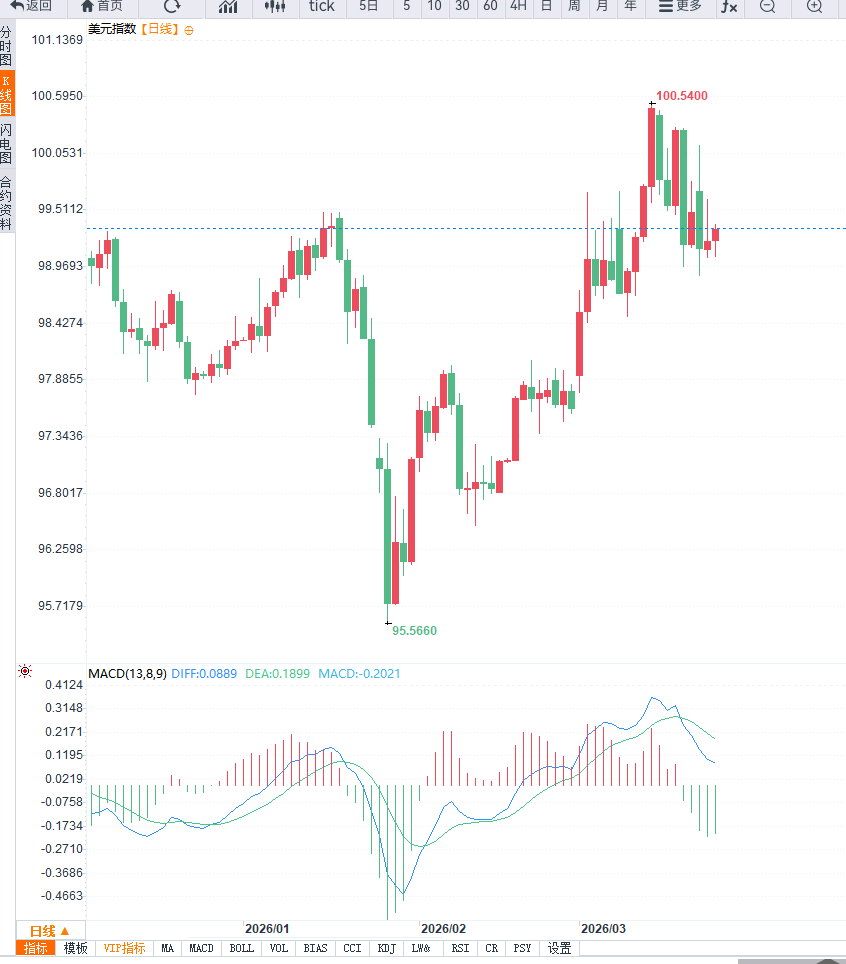
From a technical perspective, the US dollar index remains within a high range on the daily chart, with prices holding above 99, indicating strong support. Previous pullbacks failed to break key support, and momentum indicators are gradually recovering, suggesting that the bulls still hold a certain advantage. The area around 100.00 forms key resistance ; a break above this level would further strengthen the upward trend. On the downside, 98.50 forms significant support , corresponding to the lower edge of the recent consolidation range.
From the 4-hour chart, the short-term trend shows a fluctuating upward pattern with gradually rising lows, but the upside potential is limited, indicating that the market is still in a wait-and-see mode. Short-term support has formed around 99.00 , while the 99.80 area constitutes a phased resistance. A breakout from this range could open up new trading opportunities.
Editor's Summary : The current strength of the US dollar index stems more from interest rate expectations and yield support than from simple safe-haven demand. With geopolitical tensions gradually easing, market focus is returning to fundamentals. In the short term, the dollar will maintain high-level fluctuations, but its medium-term trend will depend on the inflation path and the pace of the Federal Reserve's policies. Investors should pay close attention to changes in interest rate cut expectations and breakouts at key technical levels.
Market research indicates that the United States is pushing for negotiations with Iran through diplomatic channels, including proposing several solutions and a phased ceasefire agreement. This progress has alleviated market concerns about escalating the conflict to some extent, theoretically weakening the safe-haven demand for the US dollar. However, in reality, Iran denies any substantial breakthrough, and the two sides continue communication through third-party channels, leaving the geopolitical situation highly uncertain .
Against this backdrop, the US dollar has not weakened significantly, primarily because market focus has gradually shifted to the path of monetary policy. Recent statements from Federal Reserve officials indicate that current inflationary pressures remain above target levels, and policy adjustments need to be approached with caution. Chicago Fed President Goolsby pointed out that energy price shocks could pose a risk to both inflation and employment objectives, a factor that will directly influence the pace of interest rate cuts.
Meanwhile, Federal Reserve Governor Barr stated that interest rates may need to remain at higher levels for longer before inflation falls back to the target level. This statement reinforced market expectations of "high interest rates remaining for a longer period," thus supporting the dollar's performance.
From a market pricing perspective, investor expectations for a Federal Reserve rate cut have cooled significantly. Increased uncertainty surrounding the rate-cutting path has become a key factor in maintaining the dollar's strength . Meanwhile, high US Treasury yields further enhance the attractiveness of dollar assets, putting downward pressure on non-US currencies.
It's important to note that the current dollar trend exhibits a typical "dual-engine" characteristic. On one hand, easing geopolitical tensions are reducing safe-haven demand; on the other hand, interest rates and yields continue to provide support. This interplay of bullish and bearish factors makes it difficult for the dollar to form a unidirectional trend, instead resulting in more high-level fluctuations.
From a market sentiment perspective, investors are gradually shifting from geopolitical drivers to fundamental drivers. As the situation progresses into the negotiation phase, the market will pay closer attention to inflation data, the Federal Reserve's policy path, and the economic growth outlook. The pricing logic for the US dollar is transitioning from "safe-haven-driven" to "interest rate-driven."
From a technical perspective, the US dollar index remains within a high range on the daily chart, with prices holding above 99, indicating strong support. Previous pullbacks failed to break key support, and momentum indicators are gradually recovering, suggesting that the bulls still hold a certain advantage. The area around 100.00 forms key resistance ; a break above this level would further strengthen the upward trend. On the downside, 98.50 forms significant support , corresponding to the lower edge of the recent consolidation range.
From the 4-hour chart, the short-term trend shows a fluctuating upward pattern with gradually rising lows, but the upside potential is limited, indicating that the market is still in a wait-and-see mode. Short-term support has formed around 99.00 , while the 99.80 area constitutes a phased resistance. A breakout from this range could open up new trading opportunities.
Editor's Summary : The current strength of the US dollar index stems more from interest rate expectations and yield support than from simple safe-haven demand. With geopolitical tensions gradually easing, market focus is returning to fundamentals. In the short term, the dollar will maintain high-level fluctuations, but its medium-term trend will depend on the inflation path and the pace of the Federal Reserve's policies. Investors should pay close attention to changes in interest rate cut expectations and breakouts at key technical levels.
- Risk Warning and Disclaimer
- The market involves risk, and trading may not be suitable for all investors. This article is for reference only and does not constitute personal investment advice, nor does it take into account certain users’ specific investment objectives, financial situation, or other needs. Any investment decisions made based on this information are at your own risk.