With geopolitical tensions easing, have oil prices peaked?
2026-03-25 11:02:17
According to APP, oil prices have recently fallen sharply due to the US's active efforts to end the conflict with Iran. Latest market data shows that Brent crude futures fell by about 11% at one point, settling at around $99.94 per barrel, while WTI crude fell to around $88.13 per barrel, a significant drop from the peak of the conflict. Despite this, Ajay Parmar, head of oil markets at ICIS, a commodities research firm, emphasized in his latest statement that " oil prices will continue to fluctuate because the market is influenced by both fundamental factors and rhetoric. The fundamentals have not changed—there are still nearly 10 million barrels per day of oil supply disruptions in the Middle East, and we expect oil prices to remain high until this conflict ends."
Ajay Parmar 's latest view aligns closely with current market dynamics. While the US president's statements have spurred negotiations and temporarily delayed the strike on Iranian energy facilities, leading to a rapid release of geopolitical risk premiums, the fundamental situation of supply disruptions in the Middle East has not been reversed. According to the latest assessment by the International Energy Agency, Gulf oil-producing countries have cumulatively reduced production by nearly 10 million barrels per day due to the conflict, accounting for nearly 10% of global demand—a record for the largest supply shock in history. In the short term, although oil prices have fallen due to positive rhetoric, volatility has further amplified: market risk appetite has recovered somewhat but has failed to truly rebound, and investors remain highly vigilant about the timing of supply recovery.
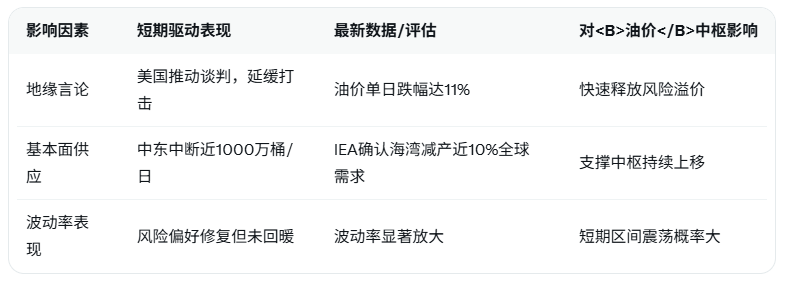
From a fundamental perspective, the Middle East conflict has directly disrupted shipping in the Strait of Hormuz, coupled with voluntary production cuts by regional oil-producing countries, resulting in a significant contraction in the actual global supply of crude oil. Even if negotiations achieve some progress, restoring production and transportation will still take weeks or even months, meaning that the long-term upward trend in oil prices has been largely established. The market is currently in a dual game of "geopolitical sentiment dominating + fundamental support," and the probability of range-bound trading in the short term is significantly higher than a one-sided trend. The following is a comparison of key factors influencing oil prices recently:
In-depth analysis reveals that this round of oil price declines is more driven by sentiment than by fundamental improvements. Tight global refinery inventories and limited capacity on alternative routes have further amplified the supply gap. For downstream industries, while gasoline and diesel prices have eased somewhat following the decline in crude oil prices, the energy cost pressures on low- and middle-income families have not been fundamentally alleviated. For the global economy, the rise in the central oil price will continue to transmit to inflation expectations, indirectly affecting the pace of monetary policy.
Editor's Summary : The recent sharp drop in oil prices reflects positive signals from the US pushing for an end to the Iran conflict. However, ICIS expert Ajay Parmar's latest statement clearly indicates that the fundamental situation of nearly 10 million barrels per day of supply disruption in the Middle East remains unchanged. The probability of short-term range-bound trading has increased significantly, and the upward trend of the central oil price still has strong support. The market needs to continue to pay attention to the progress of negotiations and the actual recovery of supply.
Ajay Parmar 's latest view aligns closely with current market dynamics. While the US president's statements have spurred negotiations and temporarily delayed the strike on Iranian energy facilities, leading to a rapid release of geopolitical risk premiums, the fundamental situation of supply disruptions in the Middle East has not been reversed. According to the latest assessment by the International Energy Agency, Gulf oil-producing countries have cumulatively reduced production by nearly 10 million barrels per day due to the conflict, accounting for nearly 10% of global demand—a record for the largest supply shock in history. In the short term, although oil prices have fallen due to positive rhetoric, volatility has further amplified: market risk appetite has recovered somewhat but has failed to truly rebound, and investors remain highly vigilant about the timing of supply recovery.
From a fundamental perspective, the Middle East conflict has directly disrupted shipping in the Strait of Hormuz, coupled with voluntary production cuts by regional oil-producing countries, resulting in a significant contraction in the actual global supply of crude oil. Even if negotiations achieve some progress, restoring production and transportation will still take weeks or even months, meaning that the long-term upward trend in oil prices has been largely established. The market is currently in a dual game of "geopolitical sentiment dominating + fundamental support," and the probability of range-bound trading in the short term is significantly higher than a one-sided trend. The following is a comparison of key factors influencing oil prices recently:
In-depth analysis reveals that this round of oil price declines is more driven by sentiment than by fundamental improvements. Tight global refinery inventories and limited capacity on alternative routes have further amplified the supply gap. For downstream industries, while gasoline and diesel prices have eased somewhat following the decline in crude oil prices, the energy cost pressures on low- and middle-income families have not been fundamentally alleviated. For the global economy, the rise in the central oil price will continue to transmit to inflation expectations, indirectly affecting the pace of monetary policy.
Editor's Summary : The recent sharp drop in oil prices reflects positive signals from the US pushing for an end to the Iran conflict. However, ICIS expert Ajay Parmar's latest statement clearly indicates that the fundamental situation of nearly 10 million barrels per day of supply disruption in the Middle East remains unchanged. The probability of short-term range-bound trading has increased significantly, and the upward trend of the central oil price still has strong support. The market needs to continue to pay attention to the progress of negotiations and the actual recovery of supply.
- Risk Warning and Disclaimer
- The market involves risk, and trading may not be suitable for all investors. This article is for reference only and does not constitute personal investment advice, nor does it take into account certain users’ specific investment objectives, financial situation, or other needs. Any investment decisions made based on this information are at your own risk.