High UK inflation reinforces expectations of interest rate hikes, causing the GBP/USD pair to enter a period of consolidation and correction.
2026-03-25 11:19:21
The UK Office for National Statistics is about to release February inflation data, and the market widely expects price pressures to remain resilient. As a core reference indicator for the Bank of England's policy decisions, the CPI data will directly affect expectations of interest rate paths and have a significant impact on the pound's exchange rate.
Market expectations suggest that UK overall inflation in February is projected to remain at 3.0% year-on-year, rising to 0.4% month-on-month; core inflation is expected to rise slightly to 3.1% year-on-year, indicating that underlying inflation remains sticky. Although factors such as energy subsidies may cause short-term fluctuations in the data, overall price pressures have not eased significantly, especially given rising energy prices, which pose a risk of renewed inflation increases.
The Bank of England kept interest rates unchanged at 3.75% at its previous meeting, but its policy stance was clearly hawkish. The Monetary Policy Committee unanimously voted to maintain the rate, reflecting a high level of concern about inflation risks. Governor Andrew Bailey pointed out that rising energy prices are being passed on to end-consumer demand and could push up household spending. Energy prices are a key driver of current inflation , while also increasing the risk of a "double-dip" inflation effect.
Regarding policy expectations, the market currently anticipates more than 67 basis points of room for interest rate hikes this year, and widely bets that the Bank of England will raise rates by 25 basis points at its April meeting. The continued rise in interest rate hike expectations has become a significant driver supporting the pound's rebound .
Meanwhile, the dollar's trajectory remains uncertain. On one hand, high US interest rates are supporting the dollar; on the other hand, if inflationary pressures persist, expectations of a Federal Reserve rate cut may be further delayed. The dollar's oscillation between "interest rate support" and "risk sentiment volatility" makes it difficult for the pound to establish a clear trend against the dollar.
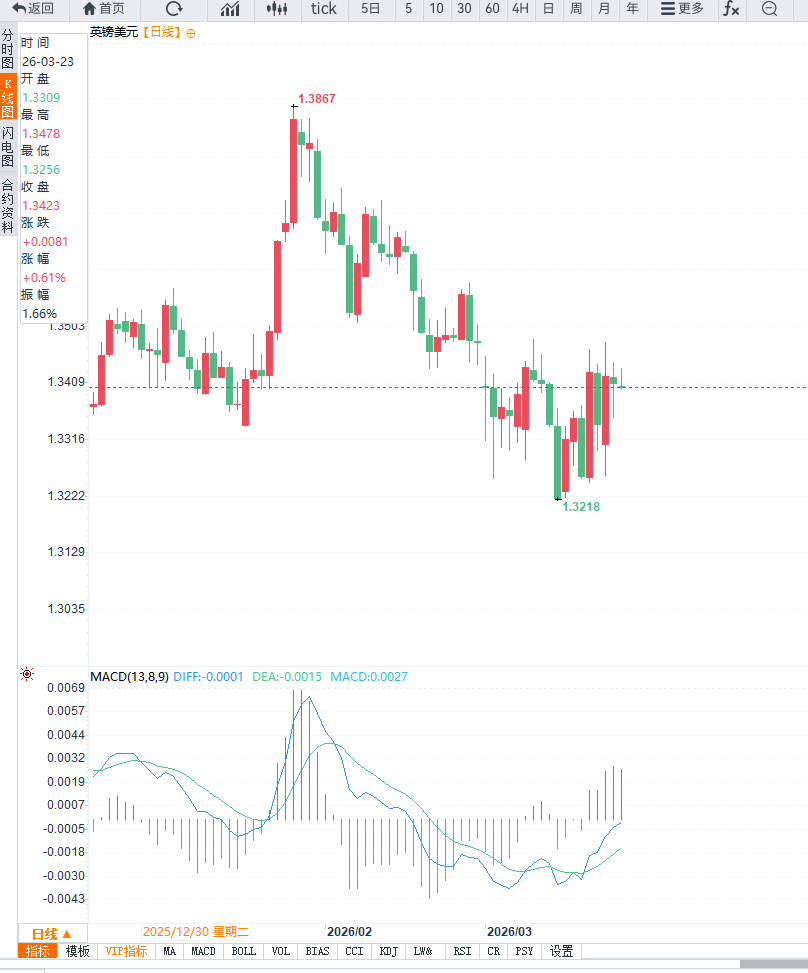
From a market structure perspective, the pound against the dollar has broken out of its previous weak range around 1.3200 and rebounded to around 1.3400. The exchange rate has shifted from a "downtrend" to a "consolidation and correction phase," indicating a revision of market pessimism regarding the pound.
From a technical perspective, GBP/USD rebounded after forming a bottom at 1.3200 on the daily chart and is currently trading in the 1.33-1.35 range. The moving average system is gradually flattening, indicating a shift from a downtrend to consolidation. The 1.3500 level forms a key resistance ; a break above this level could open up further upside potential. On the downside , 1.3300 forms significant support , corresponding to the lower edge of the current range.
From the 4-hour chart, the short-term trend shows a fluctuating upward pattern with gradually rising lows, but the upside potential is limited, and the highs have failed to break through consistently, forming a range-bound trading pattern. Short-term support is formed around 1.3350 , while the 1.3480-1.3500 area presents significant resistance. A breakout from this range could trigger a new directional move.
Editor's Summary : UK inflation data remains the core variable in the current market, and its results will directly impact the Bank of England's policy path and the pound's exchange rate. Given the sticky nature of inflation, expectations of interest rate hikes provide support for the pound, but the dollar's interest rate advantage and economic uncertainty still limit its upside potential. In the short term, the pound/dollar exchange rate has entered a period of consolidation and correction; its medium-term direction will depend on further changes in inflation and policy expectations.
Market expectations suggest that UK overall inflation in February is projected to remain at 3.0% year-on-year, rising to 0.4% month-on-month; core inflation is expected to rise slightly to 3.1% year-on-year, indicating that underlying inflation remains sticky. Although factors such as energy subsidies may cause short-term fluctuations in the data, overall price pressures have not eased significantly, especially given rising energy prices, which pose a risk of renewed inflation increases.
The Bank of England kept interest rates unchanged at 3.75% at its previous meeting, but its policy stance was clearly hawkish. The Monetary Policy Committee unanimously voted to maintain the rate, reflecting a high level of concern about inflation risks. Governor Andrew Bailey pointed out that rising energy prices are being passed on to end-consumer demand and could push up household spending. Energy prices are a key driver of current inflation , while also increasing the risk of a "double-dip" inflation effect.
Regarding policy expectations, the market currently anticipates more than 67 basis points of room for interest rate hikes this year, and widely bets that the Bank of England will raise rates by 25 basis points at its April meeting. The continued rise in interest rate hike expectations has become a significant driver supporting the pound's rebound .
Meanwhile, the dollar's trajectory remains uncertain. On one hand, high US interest rates are supporting the dollar; on the other hand, if inflationary pressures persist, expectations of a Federal Reserve rate cut may be further delayed. The dollar's oscillation between "interest rate support" and "risk sentiment volatility" makes it difficult for the pound to establish a clear trend against the dollar.
From a market structure perspective, the pound against the dollar has broken out of its previous weak range around 1.3200 and rebounded to around 1.3400. The exchange rate has shifted from a "downtrend" to a "consolidation and correction phase," indicating a revision of market pessimism regarding the pound.
From a technical perspective, GBP/USD rebounded after forming a bottom at 1.3200 on the daily chart and is currently trading in the 1.33-1.35 range. The moving average system is gradually flattening, indicating a shift from a downtrend to consolidation. The 1.3500 level forms a key resistance ; a break above this level could open up further upside potential. On the downside , 1.3300 forms significant support , corresponding to the lower edge of the current range.
From the 4-hour chart, the short-term trend shows a fluctuating upward pattern with gradually rising lows, but the upside potential is limited, and the highs have failed to break through consistently, forming a range-bound trading pattern. Short-term support is formed around 1.3350 , while the 1.3480-1.3500 area presents significant resistance. A breakout from this range could trigger a new directional move.
Editor's Summary : UK inflation data remains the core variable in the current market, and its results will directly impact the Bank of England's policy path and the pound's exchange rate. Given the sticky nature of inflation, expectations of interest rate hikes provide support for the pound, but the dollar's interest rate advantage and economic uncertainty still limit its upside potential. In the short term, the pound/dollar exchange rate has entered a period of consolidation and correction; its medium-term direction will depend on further changes in inflation and policy expectations.
- Risk Warning and Disclaimer
- The market involves risk, and trading may not be suitable for all investors. This article is for reference only and does not constitute personal investment advice, nor does it take into account certain users’ specific investment objectives, financial situation, or other needs. Any investment decisions made based on this information are at your own risk.