LME nickel futures rose 2.30% in the latest trading session after Indonesian President Prabowo approved export tariffs on nickel, passing on cost pressures from the world's largest producer to the market.
2026-03-25 17:02:29
According to APP, nickel futures on the London Metal Exchange ( LME ) rose 2.30% after Indonesia , the world's largest producer, approved tariffs on nickel exports. Indonesia's finance minister stated that President Prabowo Subianto approved tariffs on coal and nickel exports on Wednesday, with specific rates still under discussion. Indonesia has been considering imposing windfall profits taxes on commodities as the war in Iran has driven up oil prices, leading to increasing budgetary pressures. As a net importer of crude oil and fuels, Indonesia is also vulnerable to potential inflationary and growth pressures from energy supply disruptions caused by the conflict. Indonesia has long sought to upgrade its resource value chain by halting all raw material exports and encouraging businesses to invest in metal processing.
This latest policy directly boosted nickel futures prices, with the market quickly pricing in the risk of rising supply costs. As the world's largest nickel producer, Indonesia 's export tariff measures are seen as a direct response to its budget deficit, while also continuing its long-standing strategy of localizing resources. Latest market data shows that the LME nickel futures main contract surged rapidly following the policy news, with trading volume increasing simultaneously, reflecting investors' immediate reaction to rising costs in the global nickel supply chain. Although the details of the tariff rate have not yet been finalized, the market has already priced in the potential for reduced exports and the relocation of processing links.
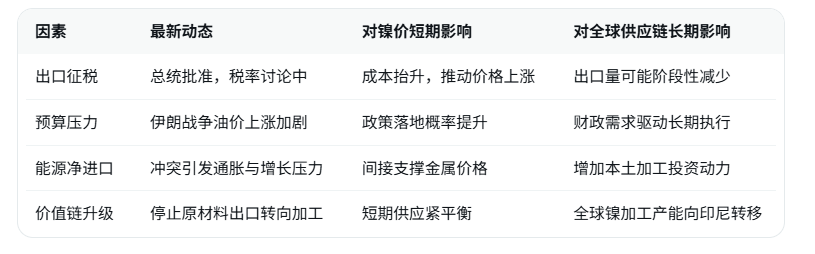
From a driving perspective, this price surge is primarily due to the combined impact of supply-side policy shocks and geopolitical energy pressures. Indonesia's tight budget stems directly from the Iranian conflict pushing up international oil prices. As a net energy importer, its finances face a double squeeze: on the one hand, rising oil prices increase import costs; on the other hand, commodity export revenue needs to be further amplified through taxation. The core of the policy is to promote investment in downstream smelting and processing industries, achieving a transformation from raw material exports to high value-added products, which is consistent with the path of gradually restricting raw ore exports over the past few years. The following is a comparison of the key influencing factors of Indonesia's nickel export tax policy:
In-depth analysis shows that while Indonesia's move may push up global nickel prices in the short term, it will help stabilize domestic finances and attract foreign investment into downstream industries in the long run. For downstream industries such as global stainless steel and new energy batteries, cost pressures will gradually be transmitted, potentially stimulating companies to seek diversified supply sources or accelerate cost reduction through technology. In the short term, LME nickel futures are likely to maintain high-level fluctuations driven by sentiment, and attention should be paid to the final details of the tax rate implementation and the verification of actual export data. If the tax rate exceeds market expectations, the upward momentum of prices may further strengthen; conversely, if the supporting processing investment policies are implemented smoothly, the supply recovery speed may be faster than expected. For investors, this event highlights the policy-driven nature of the commodity market, and it is crucial to track the subsequent implementation efforts in Indonesia and changes in global nickel inventories.
Editor's Summary
LME nickel futures rose 2.30% recently, directly benefiting from Indonesian President Prabowo's approval of a nickel export tax. Budgetary pressures and a resource value chain upgrade strategy jointly drove the policy's implementation. Short-term cost transmission supports the price center, but in the long term, the details of the tax rate and the pace of global supply chain adjustments need to be observed.
This latest policy directly boosted nickel futures prices, with the market quickly pricing in the risk of rising supply costs. As the world's largest nickel producer, Indonesia 's export tariff measures are seen as a direct response to its budget deficit, while also continuing its long-standing strategy of localizing resources. Latest market data shows that the LME nickel futures main contract surged rapidly following the policy news, with trading volume increasing simultaneously, reflecting investors' immediate reaction to rising costs in the global nickel supply chain. Although the details of the tariff rate have not yet been finalized, the market has already priced in the potential for reduced exports and the relocation of processing links.
From a driving perspective, this price surge is primarily due to the combined impact of supply-side policy shocks and geopolitical energy pressures. Indonesia's tight budget stems directly from the Iranian conflict pushing up international oil prices. As a net energy importer, its finances face a double squeeze: on the one hand, rising oil prices increase import costs; on the other hand, commodity export revenue needs to be further amplified through taxation. The core of the policy is to promote investment in downstream smelting and processing industries, achieving a transformation from raw material exports to high value-added products, which is consistent with the path of gradually restricting raw ore exports over the past few years. The following is a comparison of the key influencing factors of Indonesia's nickel export tax policy:
In-depth analysis shows that while Indonesia's move may push up global nickel prices in the short term, it will help stabilize domestic finances and attract foreign investment into downstream industries in the long run. For downstream industries such as global stainless steel and new energy batteries, cost pressures will gradually be transmitted, potentially stimulating companies to seek diversified supply sources or accelerate cost reduction through technology. In the short term, LME nickel futures are likely to maintain high-level fluctuations driven by sentiment, and attention should be paid to the final details of the tax rate implementation and the verification of actual export data. If the tax rate exceeds market expectations, the upward momentum of prices may further strengthen; conversely, if the supporting processing investment policies are implemented smoothly, the supply recovery speed may be faster than expected. For investors, this event highlights the policy-driven nature of the commodity market, and it is crucial to track the subsequent implementation efforts in Indonesia and changes in global nickel inventories.
Editor's Summary
LME nickel futures rose 2.30% recently, directly benefiting from Indonesian President Prabowo's approval of a nickel export tax. Budgetary pressures and a resource value chain upgrade strategy jointly drove the policy's implementation. Short-term cost transmission supports the price center, but in the long term, the details of the tax rate and the pace of global supply chain adjustments need to be observed.
- Risk Warning and Disclaimer
- The market involves risk, and trading may not be suitable for all investors. This article is for reference only and does not constitute personal investment advice, nor does it take into account certain users’ specific investment objectives, financial situation, or other needs. Any investment decisions made based on this information are at your own risk.