Crude oil at $150: Is the countdown to a global recession beginning?
2026-03-25 17:57:26
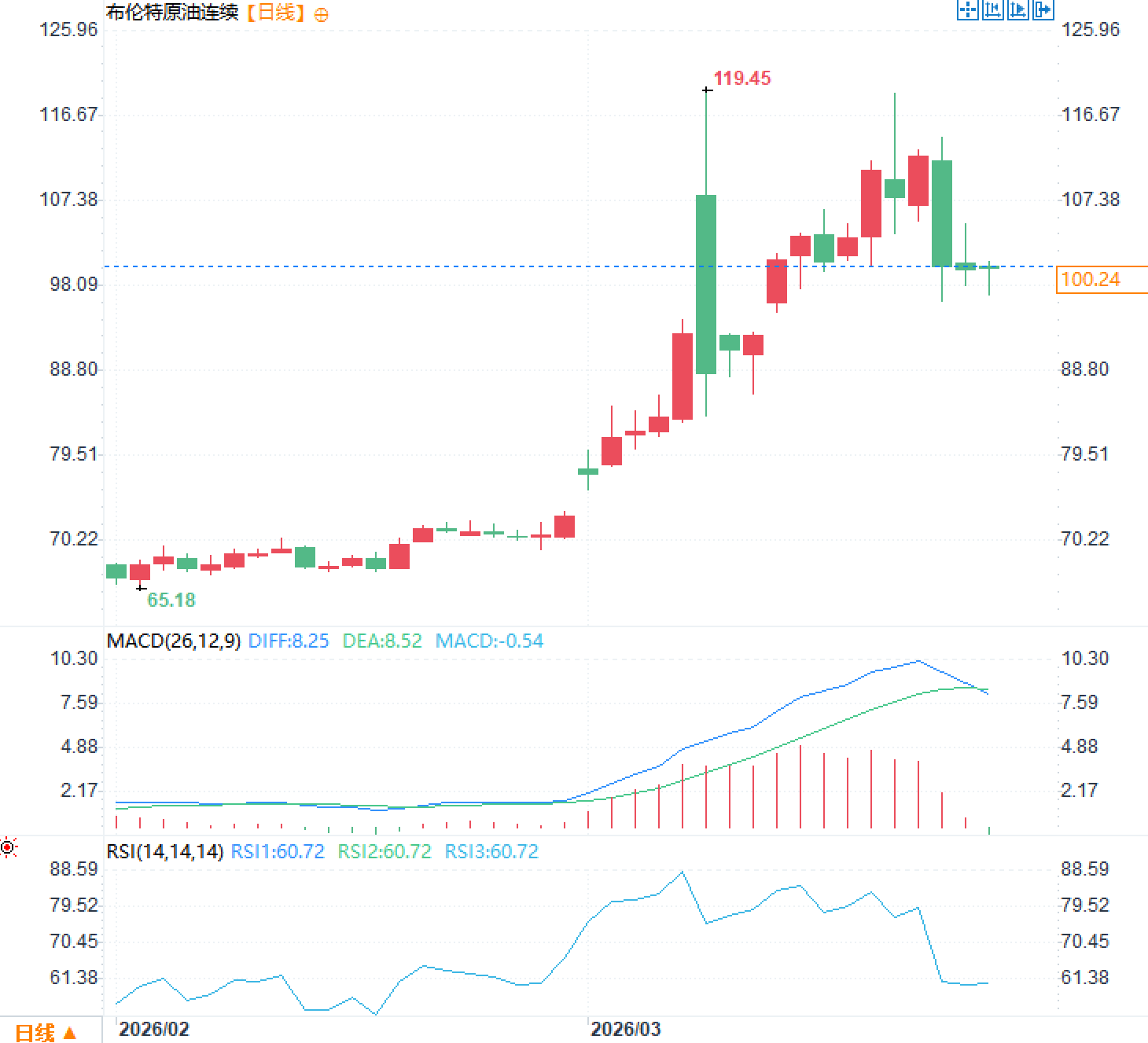
On Wednesday, March 25, Brent crude oil futures traded in a narrow range amid ongoing geopolitical uncertainty, currently hovering around $100 per barrel. This level is approaching its year-to-date high, reflecting the intense struggle between potential supply-side disruptions and global demand expectations. Blackstone Group CEO Larry Fink recently stated that if the Iranian threat persists and oil prices remain high for an extended period, it will have a profound impact on the global economy. He emphasized that the current situation makes it difficult to predict its ultimate trajectory, but it is highly likely to lead to one of two extreme scenarios.
Larry Fink explicitly pointed out two extreme possibilities for the current Middle East conflict. The first is a rapid de-escalation, with Iran reintegrating into the international energy market, which would push crude oil prices quickly back to pre-war levels or even lower. In the interview, he hinted that in this scenario, oil prices could fall below $50 per barrel, as additional supply would quickly fill the market gap. The second scenario is a protracted conflict, with the threat of conflict with Iran persisting, causing oil prices to remain in the $100 to near $150 per barrel range for an extended period. In this scenario, the global economy would face severe challenges, potentially triggering a significant and steep recession. Fink emphasized that if oil prices remain at $150 per barrel for several years, it will reshape the energy landscape, but in the short term, it will amplify inflationary pressures and suppress economic growth. Traders are closely monitoring shipping dynamics in the Strait of Hormuz, which handles approximately 20% of global crude oil shipments. Further disruptions would directly push up the forward curve slope of Brent futures.
If crude oil prices, as Fink predicts, remain in the $100-$150 range for an extended period, their impact on the economy will manifest through multiple channels. First, there will be inflationary transmission; high oil prices will directly increase transportation, manufacturing, and agricultural costs, leading to persistent core inflationary pressures. Major central banks such as the Federal Reserve and the European Central Bank will face the dilemma of slowing growth and rising prices, limiting their room for policy rate adjustments and potentially prolonging the tightening cycle. Second, corporate profits will be squeezed, particularly in the aviation, logistics, and chemical sectors, where cost structures will deteriorate, and shrinking profit margins will be transmitted to stock market valuations. Historical data shows that for every $10 increase in oil prices per barrel, global GDP growth may decline by 0.2% to 0.5%. Furthermore, consumer spending will be suppressed; rising household energy bills will compress disposable income, weakening demand for retail and durable goods. In contrast, energy-producing countries and related companies may benefit, but the overall economic balance will be disrupted.
The following is a brief comparison of crude oil prices and their economic impact under two scenarios:
In the interview, Fink specifically mentioned that if oil prices remain around $150 per barrel for an extended period, many countries will accelerate their shift to renewable energy sources such as solar and wind power. This shift is not a short-term expedient but a structural adjustment that will reshape the global energy supply and demand landscape. In the short term, the risk premium from conflict will continue to dominate pricing, but a high-price environment will stimulate higher returns on renewable energy investments, attracting more capital inflows into related sectors. Traders need to pay attention to the impact of this long-term trend on traditional energy futures curves; high oil prices will drive up the premium of forward contracts, while also benefiting new energy-related derivatives. Regarding the overall market, Fink clearly stated that the current environment bears no resemblance to the 2007-2008 financial crisis; institutional investment remains strong, and there is no bubble. The technological race in the field of artificial intelligence continues, but this is a positive factor rather than a risk. Traders can use this to assess the relative strength of the energy sector in a high-oil-price scenario, but should be wary of the potential drag on liquidity from macroeconomic tightening.
Fink's in-depth analysis of crude oil price scenarios
Larry Fink explicitly pointed out two extreme possibilities for the current Middle East conflict. The first is a rapid de-escalation, with Iran reintegrating into the international energy market, which would push crude oil prices quickly back to pre-war levels or even lower. In the interview, he hinted that in this scenario, oil prices could fall below $50 per barrel, as additional supply would quickly fill the market gap. The second scenario is a protracted conflict, with the threat of conflict with Iran persisting, causing oil prices to remain in the $100 to near $150 per barrel range for an extended period. In this scenario, the global economy would face severe challenges, potentially triggering a significant and steep recession. Fink emphasized that if oil prices remain at $150 per barrel for several years, it will reshape the energy landscape, but in the short term, it will amplify inflationary pressures and suppress economic growth. Traders are closely monitoring shipping dynamics in the Strait of Hormuz, which handles approximately 20% of global crude oil shipments. Further disruptions would directly push up the forward curve slope of Brent futures.
Global economic transmission mechanism under high oil price scenario
If crude oil prices, as Fink predicts, remain in the $100-$150 range for an extended period, their impact on the economy will manifest through multiple channels. First, there will be inflationary transmission; high oil prices will directly increase transportation, manufacturing, and agricultural costs, leading to persistent core inflationary pressures. Major central banks such as the Federal Reserve and the European Central Bank will face the dilemma of slowing growth and rising prices, limiting their room for policy rate adjustments and potentially prolonging the tightening cycle. Second, corporate profits will be squeezed, particularly in the aviation, logistics, and chemical sectors, where cost structures will deteriorate, and shrinking profit margins will be transmitted to stock market valuations. Historical data shows that for every $10 increase in oil prices per barrel, global GDP growth may decline by 0.2% to 0.5%. Furthermore, consumer spending will be suppressed; rising household energy bills will compress disposable income, weakening demand for retail and durable goods. In contrast, energy-producing countries and related companies may benefit, but the overall economic balance will be disrupted.
The following is a brief comparison of crude oil prices and their economic impact under two scenarios:
| scene | Oil price level (USD per barrel) | Major economic impacts |
|---|---|---|
| The conflict was quickly resolved, and Iran returned to the market. | Below pre-war levels, possibly falling below 50 | Inflation eases rapidly, central banks have more policy space, and global growth rebounds. |
| The conflict is protracted, and the Iranian threat continues. | 100 to close to 150 | Significant recession risk, persistent inflation, pressure on corporate profits, and accelerated energy transition. |
Accelerated Energy Transition and Long-Term Market Outlook
In the interview, Fink specifically mentioned that if oil prices remain around $150 per barrel for an extended period, many countries will accelerate their shift to renewable energy sources such as solar and wind power. This shift is not a short-term expedient but a structural adjustment that will reshape the global energy supply and demand landscape. In the short term, the risk premium from conflict will continue to dominate pricing, but a high-price environment will stimulate higher returns on renewable energy investments, attracting more capital inflows into related sectors. Traders need to pay attention to the impact of this long-term trend on traditional energy futures curves; high oil prices will drive up the premium of forward contracts, while also benefiting new energy-related derivatives. Regarding the overall market, Fink clearly stated that the current environment bears no resemblance to the 2007-2008 financial crisis; institutional investment remains strong, and there is no bubble. The technological race in the field of artificial intelligence continues, but this is a positive factor rather than a risk. Traders can use this to assess the relative strength of the energy sector in a high-oil-price scenario, but should be wary of the potential drag on liquidity from macroeconomic tightening.
Frequently Asked Questions
Question 1: What do the two extreme scenarios Fink refers to mean for crude oil futures traders?
A: Fink's analysis points to a dual-risk framework in the market. A rapid resolution to the conflict would lead to oversupply, potentially causing a steep decline in Brent futures, with near-month contracts bearing the brunt of the pressure, making short-selling strategies or closing out long positions worth considering. However, in the long-term scenario, oil prices will remain in a high range, with increased volatility. Traders need to pay attention to inventory data and geopolitical catalysts, and the premium for longer-term contracts will widen.
Question 2: If high oil prices persist, how will they affect the policy choices of major central banks around the world?
A: The transmission of oil price increases to inflation will force institutions such as the Federal Reserve and the European Central Bank to make a difficult balance between growth and prices. High oil prices push up imported inflation, which may delay the pace of interest rate cuts and even trigger repeated expectations of interest rate hikes. Traders need to track the release of central bank meeting minutes and inflation data from various countries. The correlation between Brent futures and bond yields will increase, and volatility in interest rate futures will also intensify. Historical experience shows that in such environments, the lag in monetary policy will amplify the downside risks to the economy, and we need to be wary of signals of policy shifts.
Question 3: How does Fink's mention of an accelerated energy transition change the long-term logic of the energy futures market?
A: If oil prices remain high for an extended period, investment in solar and wind power will accelerate, and the peak demand for traditional crude oil may arrive earlier than expected. This will gradually lower the long-term equilibrium price of Brent futures, and the price curve structure may shift from a premium to a discount.
- Risk Warning and Disclaimer
- The market involves risk, and trading may not be suitable for all investors. This article is for reference only and does not constitute personal investment advice, nor does it take into account certain users’ specific investment objectives, financial situation, or other needs. Any investment decisions made based on this information are at your own risk.