The dollar is unusually weak, but the market is not betting on peace.
2026-03-25 18:31:16
On Wednesday (March 25), during the Asian and European sessions, the US dollar index rebounded after hitting a low. Recently, the US dollar index has been pulling back ahead of market news, but has shown resilience after news of a continuous easing of tensions was released. Why has the US dollar been weaker than the US Treasury yield recently, or does the recent weakness of the US dollar represent the market betting that the war is about to end?
The ongoing situation in the Middle East continues to disrupt global financial markets. The rivalry between the US and Iran directly impacts the US dollar index (DXY) and US Treasury yields. The US's proposed 15-point ceasefire, while seemingly signaling a willingness to negotiate, is actually more of a delaying tactic. The significant volatility in various assets and the weakening and stabilizing US dollar index have become the key focus of the current foreign exchange market.

First, we need to understand the core demands of both the US and Iran, which is key to understanding the current market volatility.
On the one hand, the United States is continuously increasing its troops in the Middle East and plans to send amphibious warships and Marine Corps expeditionary forces to the U.S. Central Command's area of responsibility in the Middle East this Friday (27th) – the deadline set by Trump for Iran to open the Strait of Hormuz. On the other hand, it has put forward a one-month ceasefire proposal and submitted a peace negotiation plan to Iran containing 15 points.
The 15-point proposal reportedly demands that Iran dismantle its existing nuclear capabilities, transfer its stockpile of highly enriched uranium, dismantle key nuclear facilities, cease supporting regional allies' armed forces, limit the size and range of its ballistic missiles, and ensure the Strait of Hormuz remains open.
In exchange, Iran may receive benefits such as the lifting of international sanctions and US support for its civilian nuclear program.
However, considering the US troop buildup, this 15-point ceasefire demand seems more like a delaying tactic, aimed at buying time for US troop deployments and easing short-term geopolitical pressures, rather than genuinely seeking a peaceful resolution to the dispute.
Iran, on the other hand, took a hard line, explicitly rejecting the diplomatic progress claimed by the United States. A spokesperson for its Joint Command of Armed Forces bluntly stated that the United States "is negotiating with itself."
Iran's core demands are full compensation, complete lifting of international sanctions, and international legal guarantees of non-interference in Iranian affairs by the United States. The military advisor to Iran's new Supreme Leader has emphasized that the Iran-US dispute has lasted for 47 years and must be "brought to a close."
Furthermore, Iran has proposed establishing a "Middle East security military alliance without the participation of the United States and Israel." Iranian Parliament Speaker Ghalibaf also clearly stated that he is closely monitoring the deployment of US troops in the Middle East and warned the outside world not to test Iran's determination to defend its territory. This tough statement has further exacerbated market concerns about the escalation of the situation in the Middle East and directly shattered the market's optimistic expectations for US-Iran peace talks.
It is worth noting that against the backdrop of escalating US-Iran tensions and rising market risk aversion, a clear divergence has emerged in the financial markets: US Treasury yields have continued to rise sharply, while the US dollar index has not followed suit, showing a divergence.
The core driving force behind the rise in US Treasury yields comes from the dual support of inflationary pressures and geopolitical risks.
The recent conflict between the US and Iran has cut off about one-fifth of the world's oil and gas supply, causing oil prices to rise again and market concerns about inflation to continue to rise. Against the backdrop of rising inflation, central banks around the world do not have the conditions to cut interest rates, and the Federal Reserve's room for interest rate cuts is further limited, and the possibility of raising interest rates cannot be ruled out.
Among them, the yield on two-year US Treasury bonds, which reflects the Fed's policy expectations, performed particularly well. Higher yields on US Treasury bonds can attract cross-border capital inflows and should theoretically become an important force supporting the US dollar.
But why did the US dollar index fail to rise in tandem with US Treasury yields? The core reason lies in the mutual checks and balances of multiple factors, which broke the previous correlation between US Treasury bonds and the US dollar.
On the one hand, although rising US Treasury yields have the advantage of attracting funds, the US's own fiscal sustainability issues have raised market concerns. The huge debt and persistently high fiscal deficit have reduced the overall attractiveness of dollar assets, resulting in some funds flowing into US Treasuries but not simultaneously increasing their holdings of dollar cash or dollar assets, thus making it difficult to drive the dollar index higher.
On the other hand, while the uncertainty of the US-Iran conflict supports the demand for US Treasury bonds as a safe haven, it also raises concerns in the market about the prospects for the US economic recovery. Escalating geopolitical conflicts may further push up energy prices, exacerbate domestic inflationary pressures in the US, drag down consumption and investment, and thus weaken the safe-haven attributes of the US dollar.
In addition, policy adjustments by central banks of major global economies have also created a check and balance. Some central banks have maintained stable interest rates or raised them moderately, narrowing the interest rate differential between the US dollar and other major currencies. This has led to a diversion of funds and made it difficult to form a combined force to push the US dollar index up in tandem, ultimately resulting in a divergence between US Treasury yields and the US dollar index.
While the strengthening of oil prices represents market bets on the continued war, the dollar has weakened recently due to various countries maintaining interest rates, similar to the UK's unanimous approval of certain policies. However, this does not mean that funds believe the war is slowing down or that the premium for the war is decreasing. On the contrary, the dollar even rebounded on Tuesday and Wednesday despite the release of positive news about the war, indicating that funds do not believe there has been any substantial easing of tensions.
From a technical perspective, the US dollar continues to trade within a range, firmly holding the lower edge of the range. As the conflict progresses, its safe-haven appeal will likely continue to dominate its price movement.
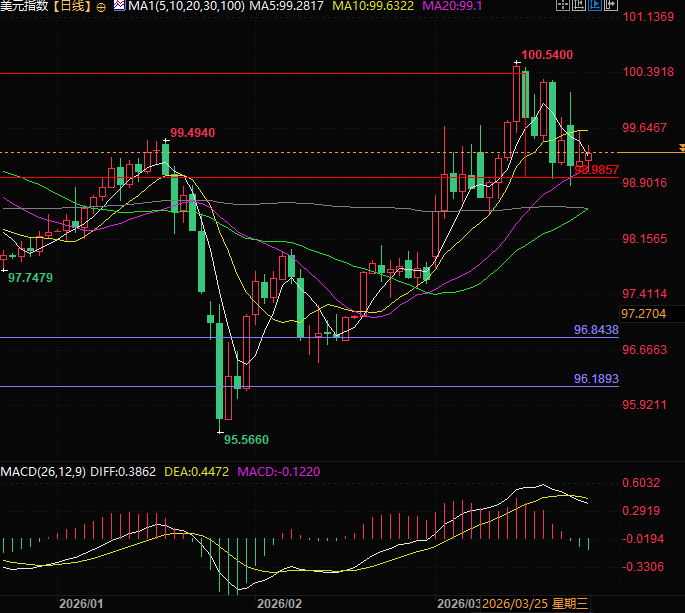
(US Dollar Index Daily Chart, Source: EasyForex)
At 18:27 Beijing time, the US dollar index is currently at 99.33.
The ongoing situation in the Middle East continues to disrupt global financial markets. The rivalry between the US and Iran directly impacts the US dollar index (DXY) and US Treasury yields. The US's proposed 15-point ceasefire, while seemingly signaling a willingness to negotiate, is actually more of a delaying tactic. The significant volatility in various assets and the weakening and stabilizing US dollar index have become the key focus of the current foreign exchange market.
With the core demands of both the US and Iran locked in a standoff, the 15-point ceasefire demand is merely a delaying tactic.
First, we need to understand the core demands of both the US and Iran, which is key to understanding the current market volatility.
On the one hand, the United States is continuously increasing its troops in the Middle East and plans to send amphibious warships and Marine Corps expeditionary forces to the U.S. Central Command's area of responsibility in the Middle East this Friday (27th) – the deadline set by Trump for Iran to open the Strait of Hormuz. On the other hand, it has put forward a one-month ceasefire proposal and submitted a peace negotiation plan to Iran containing 15 points.
The 15-point proposal reportedly demands that Iran dismantle its existing nuclear capabilities, transfer its stockpile of highly enriched uranium, dismantle key nuclear facilities, cease supporting regional allies' armed forces, limit the size and range of its ballistic missiles, and ensure the Strait of Hormuz remains open.
In exchange, Iran may receive benefits such as the lifting of international sanctions and US support for its civilian nuclear program.
However, considering the US troop buildup, this 15-point ceasefire demand seems more like a delaying tactic, aimed at buying time for US troop deployments and easing short-term geopolitical pressures, rather than genuinely seeking a peaceful resolution to the dispute.
Iran, on the other hand, took a hard line, explicitly rejecting the diplomatic progress claimed by the United States. A spokesperson for its Joint Command of Armed Forces bluntly stated that the United States "is negotiating with itself."
Iran's core demands are full compensation, complete lifting of international sanctions, and international legal guarantees of non-interference in Iranian affairs by the United States. The military advisor to Iran's new Supreme Leader has emphasized that the Iran-US dispute has lasted for 47 years and must be "brought to a close."
Furthermore, Iran has proposed establishing a "Middle East security military alliance without the participation of the United States and Israel." Iranian Parliament Speaker Ghalibaf also clearly stated that he is closely monitoring the deployment of US troops in the Middle East and warned the outside world not to test Iran's determination to defend its territory. This tough statement has further exacerbated market concerns about the escalation of the situation in the Middle East and directly shattered the market's optimistic expectations for US-Iran peace talks.
Market divergence: US Treasury yields continue to rise, while the US dollar index remains absent.
It is worth noting that against the backdrop of escalating US-Iran tensions and rising market risk aversion, a clear divergence has emerged in the financial markets: US Treasury yields have continued to rise sharply, while the US dollar index has not followed suit, showing a divergence.
The core driving force behind the rise in US Treasury yields comes from the dual support of inflationary pressures and geopolitical risks.
The recent conflict between the US and Iran has cut off about one-fifth of the world's oil and gas supply, causing oil prices to rise again and market concerns about inflation to continue to rise. Against the backdrop of rising inflation, central banks around the world do not have the conditions to cut interest rates, and the Federal Reserve's room for interest rate cuts is further limited, and the possibility of raising interest rates cannot be ruled out.
Among them, the yield on two-year US Treasury bonds, which reflects the Fed's policy expectations, performed particularly well. Higher yields on US Treasury bonds can attract cross-border capital inflows and should theoretically become an important force supporting the US dollar.
Deviating from the core issue: Multiple factors constrain the linkage between US Treasury bonds and the US dollar, causing it to fail.
But why did the US dollar index fail to rise in tandem with US Treasury yields? The core reason lies in the mutual checks and balances of multiple factors, which broke the previous correlation between US Treasury bonds and the US dollar.
On the one hand, although rising US Treasury yields have the advantage of attracting funds, the US's own fiscal sustainability issues have raised market concerns. The huge debt and persistently high fiscal deficit have reduced the overall attractiveness of dollar assets, resulting in some funds flowing into US Treasuries but not simultaneously increasing their holdings of dollar cash or dollar assets, thus making it difficult to drive the dollar index higher.
On the other hand, while the uncertainty of the US-Iran conflict supports the demand for US Treasury bonds as a safe haven, it also raises concerns in the market about the prospects for the US economic recovery. Escalating geopolitical conflicts may further push up energy prices, exacerbate domestic inflationary pressures in the US, drag down consumption and investment, and thus weaken the safe-haven attributes of the US dollar.
In addition, policy adjustments by central banks of major global economies have also created a check and balance. Some central banks have maintained stable interest rates or raised them moderately, narrowing the interest rate differential between the US dollar and other major currencies. This has led to a diversion of funds and made it difficult to form a combined force to push the US dollar index up in tandem, ultimately resulting in a divergence between US Treasury yields and the US dollar index.
Summary and Technical Analysis:
While the strengthening of oil prices represents market bets on the continued war, the dollar has weakened recently due to various countries maintaining interest rates, similar to the UK's unanimous approval of certain policies. However, this does not mean that funds believe the war is slowing down or that the premium for the war is decreasing. On the contrary, the dollar even rebounded on Tuesday and Wednesday despite the release of positive news about the war, indicating that funds do not believe there has been any substantial easing of tensions.
From a technical perspective, the US dollar continues to trade within a range, firmly holding the lower edge of the range. As the conflict progresses, its safe-haven appeal will likely continue to dominate its price movement.
(US Dollar Index Daily Chart, Source: EasyForex)
At 18:27 Beijing time, the US dollar index is currently at 99.33.
- Risk Warning and Disclaimer
- The market involves risk, and trading may not be suitable for all investors. This article is for reference only and does not constitute personal investment advice, nor does it take into account certain users’ specific investment objectives, financial situation, or other needs. Any investment decisions made based on this information are at your own risk.