As uncertainty spreads further in the Middle East, is the US dollar poised for a rebound?
2026-03-26 14:14:12
The US dollar index has retreated slightly after a period of continuous rebound, currently trading around 99.60 , indicating a slowdown in short-term upward momentum. Although it remains at a relatively high level overall, the market has begun to enter a period of consolidation due to a confluence of multiple macroeconomic factors.
From a fundamental perspective, the situation in the Middle East remains one of the core variables influencing the dollar's trajectory. Market research indicates that the US is pushing for dialogue with Iran through multiple channels and has proposed several solutions to ease the conflict. However, Iran has not yet shown a clear willingness to negotiate and has outlined its own conditions, emphasizing its control over key energy routes. This makes the future of the situation highly uncertain, leading to fluctuating market risk aversion.

Traditionally, geopolitical risks are generally favorable for the US dollar, but the current environment presents a mixed picture. On the one hand, safe-haven demand does support the dollar's strength; on the other hand, rising energy prices due to conflict are exacerbating inflationary pressures, which in turn affects the Federal Reserve's policy path, causing the dollar's short-term performance to fluctuate.
Rising energy prices have fueled inflation expectations , further reinforcing market expectations that the Federal Reserve will maintain high interest rates. Meanwhile, US economic data is mixed; employment and consumption remain resilient, but some leading indicators suggest a slowdown in growth momentum, putting pressure on the Fed to balance its policy.
Institutional opinions suggest that, given the divergence between inflation and growth targets, the Federal Reserve is likely to maintain a wait-and-see stance in the short term.
Current interest rate market pricing indicates that expectations for rate cuts this year have cooled significantly , and some funds are even beginning to reassess the possibility of future rate hikes. This shift in expectations provides support for the US dollar in the medium term, but in the short term, high market uncertainty has limited the pace of the dollar's rise.
In addition, investors are closely watching the upcoming U.S. initial jobless claims data to assess the state of the labor market. The performance of the job market will directly influence the Federal Reserve's policy decisions, thus becoming a significant driver of short-term dollar volatility.
From a technical perspective, on the daily chart, the US dollar index has regained key support after its previous pullback, and the overall structure remains in a slightly bullish, oscillating pattern. The current price is trading near short-term moving averages, with the 100 level acting as significant resistance . This level also represents a psychological psychological barrier, having been tested multiple times without a decisive breakthrough. On the downside, the 99.00 and 98.50 areas are important support zones; a break below these levels could trigger further pullbacks. Momentum indicators show the RSI in neutral territory, indicating that the market has not yet formed a clear trend.
On the 4-hour chart, the US dollar index is consolidating after a pullback, with short-term trading concentrated between 99.00 and 100.00 . The moving average system is flattening, indicating weakening trend momentum. The MACD indicator shows signs of decline but has not yet formed a sustained bearish structure, suggesting the current correction is more of a technical adjustment. If the price regains the 100 level , the upward trend may resume; conversely, if it falls below 99.00 , it may further test the support area of 98.50 or even 98.00 .
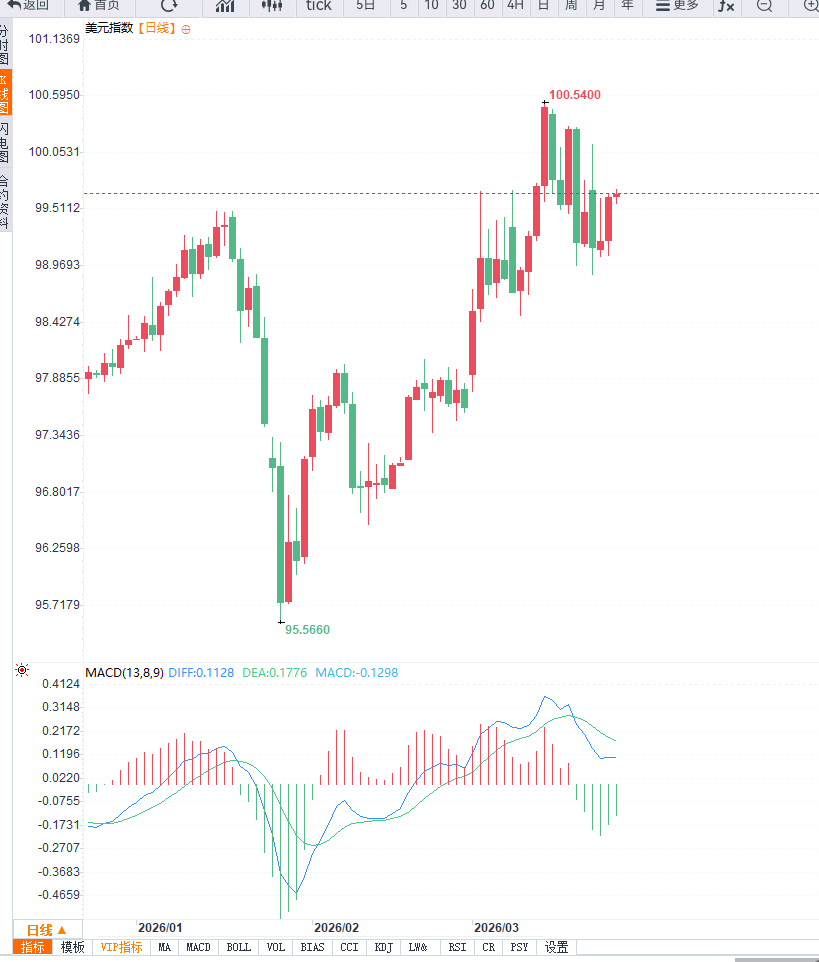
Overall, the US dollar index is currently driven by both "safe-haven demand and policy uncertainty," and its short-term trend is biased towards consolidation, awaiting new macroeconomic data or geopolitical developments to provide directional guidance.
Editor's Summary : The core of the current US dollar index trend lies in the interplay between inflation expectations and policy paths. Rising energy prices reinforce high interest rate expectations, providing medium-term support for the dollar, but geopolitical uncertainties and divergent economic data lead to short-term volatility. From a technical perspective, the index remains oscillating with a slightly bullish bias, but has failed to break through key resistance levels, indicating insufficient upward momentum. In the short term, close attention should be paid to whether the 100 level is breached and the performance of US economic data. Until a clear direction emerges, oscillation will remain the main theme.
From a fundamental perspective, the situation in the Middle East remains one of the core variables influencing the dollar's trajectory. Market research indicates that the US is pushing for dialogue with Iran through multiple channels and has proposed several solutions to ease the conflict. However, Iran has not yet shown a clear willingness to negotiate and has outlined its own conditions, emphasizing its control over key energy routes. This makes the future of the situation highly uncertain, leading to fluctuating market risk aversion.
Traditionally, geopolitical risks are generally favorable for the US dollar, but the current environment presents a mixed picture. On the one hand, safe-haven demand does support the dollar's strength; on the other hand, rising energy prices due to conflict are exacerbating inflationary pressures, which in turn affects the Federal Reserve's policy path, causing the dollar's short-term performance to fluctuate.
Rising energy prices have fueled inflation expectations , further reinforcing market expectations that the Federal Reserve will maintain high interest rates. Meanwhile, US economic data is mixed; employment and consumption remain resilient, but some leading indicators suggest a slowdown in growth momentum, putting pressure on the Fed to balance its policy.
Institutional opinions suggest that, given the divergence between inflation and growth targets, the Federal Reserve is likely to maintain a wait-and-see stance in the short term.
Current interest rate market pricing indicates that expectations for rate cuts this year have cooled significantly , and some funds are even beginning to reassess the possibility of future rate hikes. This shift in expectations provides support for the US dollar in the medium term, but in the short term, high market uncertainty has limited the pace of the dollar's rise.
In addition, investors are closely watching the upcoming U.S. initial jobless claims data to assess the state of the labor market. The performance of the job market will directly influence the Federal Reserve's policy decisions, thus becoming a significant driver of short-term dollar volatility.
From a technical perspective, on the daily chart, the US dollar index has regained key support after its previous pullback, and the overall structure remains in a slightly bullish, oscillating pattern. The current price is trading near short-term moving averages, with the 100 level acting as significant resistance . This level also represents a psychological psychological barrier, having been tested multiple times without a decisive breakthrough. On the downside, the 99.00 and 98.50 areas are important support zones; a break below these levels could trigger further pullbacks. Momentum indicators show the RSI in neutral territory, indicating that the market has not yet formed a clear trend.
On the 4-hour chart, the US dollar index is consolidating after a pullback, with short-term trading concentrated between 99.00 and 100.00 . The moving average system is flattening, indicating weakening trend momentum. The MACD indicator shows signs of decline but has not yet formed a sustained bearish structure, suggesting the current correction is more of a technical adjustment. If the price regains the 100 level , the upward trend may resume; conversely, if it falls below 99.00 , it may further test the support area of 98.50 or even 98.00 .
Overall, the US dollar index is currently driven by both "safe-haven demand and policy uncertainty," and its short-term trend is biased towards consolidation, awaiting new macroeconomic data or geopolitical developments to provide directional guidance.
Editor's Summary : The core of the current US dollar index trend lies in the interplay between inflation expectations and policy paths. Rising energy prices reinforce high interest rate expectations, providing medium-term support for the dollar, but geopolitical uncertainties and divergent economic data lead to short-term volatility. From a technical perspective, the index remains oscillating with a slightly bullish bias, but has failed to break through key resistance levels, indicating insufficient upward momentum. In the short term, close attention should be paid to whether the 100 level is breached and the performance of US economic data. Until a clear direction emerges, oscillation will remain the main theme.
- Risk Warning and Disclaimer
- The market involves risk, and trading may not be suitable for all investors. This article is for reference only and does not constitute personal investment advice, nor does it take into account certain users’ specific investment objectives, financial situation, or other needs. Any investment decisions made based on this information are at your own risk.