The LNG supply gap extends through the global winter, prompting a new round of reassessment of the industry chain.
2026-03-26 16:15:03
According to APP, the LNG industry chain is undergoing a new round of reassessment due to the escalating conflict between the US, Israel, and Iraq, which has damaged Qatar's Ras Lafan, the world's largest LNG hub. Goldman Sachs warns that this supply gap is expected to extend beyond the global downturn of 2026-2027, and may even continue into the entire year of 2027, completely changing the previous optimistic forecast of "the largest supply growth wave in history in 2027." Qatar Energy confirmed that approximately 17% of its LNG export capacity (12.8 million tons per annum) faces a 3-5 year recovery period, equivalent to 4-5% of global LNG supply, directly pushing up the European TTF benchmark price and the central price of Asian spot LNG.

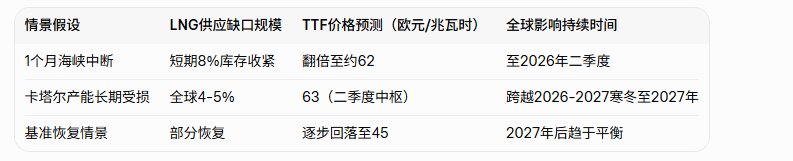
Goldman Sachs' commodities research team recently pointed out that if Qatar's LNG production halt exceeds two months, European TTF natural gas prices could approach €100 per megawatt-hour. Even if the Straits gradually reopen, Qatar's production capacity will not be able to return to full capacity, and the annual LNG export forecast has been significantly reduced by approximately 26 million tons (6% of global supply). Previously, the market generally expected global LNG supply to surge by more than 50% between 2026 and 2030, but the current geopolitical shock has significantly delayed this timeline, and a tight supply balance will dominate market pricing logic in the short term.
To visually represent the supply shock scenario, the following table compares Goldman Sachs' latest forecasts:
Further analysis reveals a clear and far-reaching transmission path for this supply gap across the LNG industry chain: upstream Middle Eastern producers, such as those in Qatar, face massive revenue losses (approximately $20 billion annualized), are forced to declare force majeure during the recovery period, and long-term contract buyers urgently need to find alternative sources of cargo; midstream transportation is hampered by shipping restrictions in the Strait of Hormuz, leading to increased charter and insurance costs due to capacity constraints; downstream major Asian countries and European importers face imported inflationary pressures, with rising costs for industry, power generation, and residential heating. Goldman Sachs analyst Samantha Dart emphasized, "The situation with LNG is different from that of oil; we will not return to full-capacity production, and long-term capacity damage is a foregone conclusion." This assessment, based on the latest conflict developments and recovery cycle models, highlights that the structural impact of geopolitical risks on the energy supply chain far exceeds short-term weather or demand fluctuations.
The logic behind the supply chain reassessment is shifting: non-Middle Eastern LNG exporters, such as those in the US, will be the biggest beneficiaries, as their ability to fill the gap with new capacity directly determines the global price ceiling; major Asian countries, as the world's largest LNG importers, may be forced to accept higher premiums during the procurement window, while accelerating their diversification efforts; Europe, meanwhile, needs to stockpile more inventory in advance for the 2026-2027 winter, and the substitution effect of coal-to-gas and oil-to-gas will further push up the overall price of fossil fuels. In the short term, LNG spot prices have already shown a significant premium, and long-term contracts have begun trading with expectations of a long-term tight balance. If the conflict cannot be quickly resolved, the second quarter will be a crucial window for price increases.
Editor's Summary : Goldman Sachs' latest warning highlights that the LNG supply gap has escalated from a short-term disturbance to a structural risk that will extend beyond the global downturn. The industry chain reassessment will revolve around the pace of capacity recovery, the flexibility of alternative supplies, and the speed of geopolitical easing. Market participants need to pay close attention to the progress of Qatar's facility recovery and the procurement dynamics of major Asian countries.
Goldman Sachs' commodities research team recently pointed out that if Qatar's LNG production halt exceeds two months, European TTF natural gas prices could approach €100 per megawatt-hour. Even if the Straits gradually reopen, Qatar's production capacity will not be able to return to full capacity, and the annual LNG export forecast has been significantly reduced by approximately 26 million tons (6% of global supply). Previously, the market generally expected global LNG supply to surge by more than 50% between 2026 and 2030, but the current geopolitical shock has significantly delayed this timeline, and a tight supply balance will dominate market pricing logic in the short term.
To visually represent the supply shock scenario, the following table compares Goldman Sachs' latest forecasts:
Further analysis reveals a clear and far-reaching transmission path for this supply gap across the LNG industry chain: upstream Middle Eastern producers, such as those in Qatar, face massive revenue losses (approximately $20 billion annualized), are forced to declare force majeure during the recovery period, and long-term contract buyers urgently need to find alternative sources of cargo; midstream transportation is hampered by shipping restrictions in the Strait of Hormuz, leading to increased charter and insurance costs due to capacity constraints; downstream major Asian countries and European importers face imported inflationary pressures, with rising costs for industry, power generation, and residential heating. Goldman Sachs analyst Samantha Dart emphasized, "The situation with LNG is different from that of oil; we will not return to full-capacity production, and long-term capacity damage is a foregone conclusion." This assessment, based on the latest conflict developments and recovery cycle models, highlights that the structural impact of geopolitical risks on the energy supply chain far exceeds short-term weather or demand fluctuations.
The logic behind the supply chain reassessment is shifting: non-Middle Eastern LNG exporters, such as those in the US, will be the biggest beneficiaries, as their ability to fill the gap with new capacity directly determines the global price ceiling; major Asian countries, as the world's largest LNG importers, may be forced to accept higher premiums during the procurement window, while accelerating their diversification efforts; Europe, meanwhile, needs to stockpile more inventory in advance for the 2026-2027 winter, and the substitution effect of coal-to-gas and oil-to-gas will further push up the overall price of fossil fuels. In the short term, LNG spot prices have already shown a significant premium, and long-term contracts have begun trading with expectations of a long-term tight balance. If the conflict cannot be quickly resolved, the second quarter will be a crucial window for price increases.
Editor's Summary : Goldman Sachs' latest warning highlights that the LNG supply gap has escalated from a short-term disturbance to a structural risk that will extend beyond the global downturn. The industry chain reassessment will revolve around the pace of capacity recovery, the flexibility of alternative supplies, and the speed of geopolitical easing. Market participants need to pay close attention to the progress of Qatar's facility recovery and the procurement dynamics of major Asian countries.
- Risk Warning and Disclaimer
- The market involves risk, and trading may not be suitable for all investors. This article is for reference only and does not constitute personal investment advice, nor does it take into account certain users’ specific investment objectives, financial situation, or other needs. Any investment decisions made based on this information are at your own risk.