Uncertainty surrounding the Middle East situation dominated market sentiment, causing gold prices to rise and then fall.
2026-03-26 14:32:37
Gold prices retreated on Thursday after a sustained rebound, consolidating above $4,400 . The core driver of the market remains the development of the situation in the Middle East, with investors closely watching for any substantial progress in negotiations over the next 24 to 48 hours, which will directly impact global risk sentiment and asset pricing logic.
From a geopolitical perspective, the US has released relatively optimistic signals, stating that Iran is willing to push for an agreement to end the nearly four-week-long conflict. However, Iran has adopted a more cautious stance, indicating that it is evaluating proposals but has no immediate intention to engage in direct negotiations. This information discrepancy has further exacerbated market uncertainty, causing funds to repeatedly shift between safe-haven and risk assets.

According to Kyle Rhoda, a senior analyst at Capital.com, gold prices will largely depend on news related to the negotiations in the next 24 to 48 hours, with the real direction likely to emerge early next week.
Meanwhile, market concerns about escalating conflict have not subsided, particularly regarding expectations of potential military action, keeping investors highly vigilant. Against this backdrop, the energy market strengthened again, with Brent crude prices climbing back above $100 per barrel , reflecting continued market anxieties about supply disruptions.
Rising oil prices have directly boosted global inflation expectations, thus significantly impacting monetary policy. Currently, the market generally expects that major central banks will find it difficult to quickly shift to easing policies while energy prices remain high, which puts structural downward pressure on gold. At the same time, the US dollar remains relatively resilient in an uncertain environment, limiting the upside potential for gold.
Nevertheless, safe-haven demand remains, especially given the unresolved geopolitical risks, providing relatively solid support for gold. The current market exhibits a typical dual-game pattern of "interest rate suppression + safe-haven support," causing prices to fluctuate within a range.
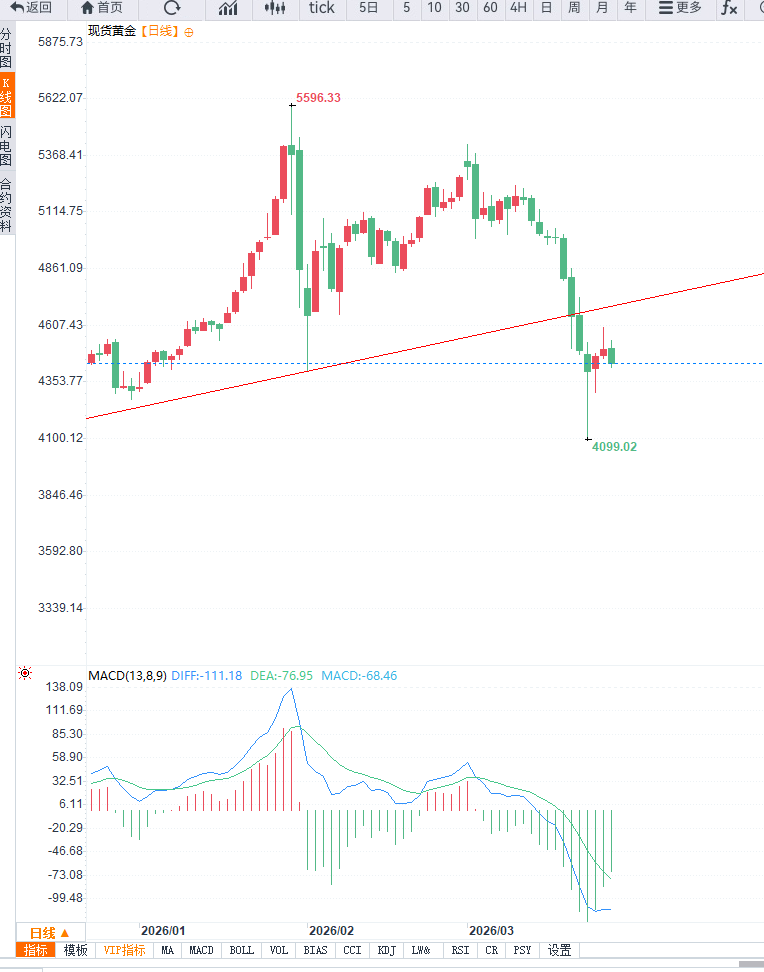
From a technical perspective, on the daily chart, gold rebounded after touching the 200-day moving average around $4100 , but the current rebound is clearly encountering resistance near $4600 , forming a short-term resistance zone. This area also coincides with key moving average resistance, indicating insufficient upward momentum from the bulls. The overall structure remains in a correction phase after the rebound, and the trend has not yet reversed. Looking at momentum indicators, the RSI remains in the neutral-to-weak range, suggesting a lack of sustained upward momentum in the market.
On the 4-hour chart, the price exhibits a clear range-bound structure, with short-term trading concentrated between $4400 and $4600 . The price has repeatedly tested the upper resistance level without success, while the lower support remains relatively solid, forming a typical box pattern. The moving average system is converging, and the MACD indicator is repeatedly crossing, indicating that the market is in a phase of tug-of-war between bulls and bears. If the price breaks through $4600 , it is expected to further explore higher areas; conversely, if it falls below $4400 , it may trigger a new round of pullback, targeting around $4300 .
Overall, gold is currently at a critical stage before choosing a direction, and its short-term trend will be highly dependent on the development of geopolitical situations and changes in market sentiment.
Editor's Summary : The core of gold's current trend lies in the dynamic balance between geopolitical risks and macroeconomic policy expectations. Uncertainty in the Middle East provides a floor for gold prices, but rising energy prices strengthen inflationary pressures, thus limiting central bank easing options and putting downward pressure on gold. Technical structures indicate the market is in a consolidation range awaiting a breakout signal. In the short term, gold prices will likely maintain a high-volatility consolidation pattern, requiring close attention to breakouts from key ranges and the evolution of geopolitical events.
From a geopolitical perspective, the US has released relatively optimistic signals, stating that Iran is willing to push for an agreement to end the nearly four-week-long conflict. However, Iran has adopted a more cautious stance, indicating that it is evaluating proposals but has no immediate intention to engage in direct negotiations. This information discrepancy has further exacerbated market uncertainty, causing funds to repeatedly shift between safe-haven and risk assets.
According to Kyle Rhoda, a senior analyst at Capital.com, gold prices will largely depend on news related to the negotiations in the next 24 to 48 hours, with the real direction likely to emerge early next week.
Meanwhile, market concerns about escalating conflict have not subsided, particularly regarding expectations of potential military action, keeping investors highly vigilant. Against this backdrop, the energy market strengthened again, with Brent crude prices climbing back above $100 per barrel , reflecting continued market anxieties about supply disruptions.
Rising oil prices have directly boosted global inflation expectations, thus significantly impacting monetary policy. Currently, the market generally expects that major central banks will find it difficult to quickly shift to easing policies while energy prices remain high, which puts structural downward pressure on gold. At the same time, the US dollar remains relatively resilient in an uncertain environment, limiting the upside potential for gold.
Nevertheless, safe-haven demand remains, especially given the unresolved geopolitical risks, providing relatively solid support for gold. The current market exhibits a typical dual-game pattern of "interest rate suppression + safe-haven support," causing prices to fluctuate within a range.
From a technical perspective, on the daily chart, gold rebounded after touching the 200-day moving average around $4100 , but the current rebound is clearly encountering resistance near $4600 , forming a short-term resistance zone. This area also coincides with key moving average resistance, indicating insufficient upward momentum from the bulls. The overall structure remains in a correction phase after the rebound, and the trend has not yet reversed. Looking at momentum indicators, the RSI remains in the neutral-to-weak range, suggesting a lack of sustained upward momentum in the market.
On the 4-hour chart, the price exhibits a clear range-bound structure, with short-term trading concentrated between $4400 and $4600 . The price has repeatedly tested the upper resistance level without success, while the lower support remains relatively solid, forming a typical box pattern. The moving average system is converging, and the MACD indicator is repeatedly crossing, indicating that the market is in a phase of tug-of-war between bulls and bears. If the price breaks through $4600 , it is expected to further explore higher areas; conversely, if it falls below $4400 , it may trigger a new round of pullback, targeting around $4300 .
Overall, gold is currently at a critical stage before choosing a direction, and its short-term trend will be highly dependent on the development of geopolitical situations and changes in market sentiment.
Editor's Summary : The core of gold's current trend lies in the dynamic balance between geopolitical risks and macroeconomic policy expectations. Uncertainty in the Middle East provides a floor for gold prices, but rising energy prices strengthen inflationary pressures, thus limiting central bank easing options and putting downward pressure on gold. Technical structures indicate the market is in a consolidation range awaiting a breakout signal. In the short term, gold prices will likely maintain a high-volatility consolidation pattern, requiring close attention to breakouts from key ranges and the evolution of geopolitical events.
- Risk Warning and Disclaimer
- The market involves risk, and trading may not be suitable for all investors. This article is for reference only and does not constitute personal investment advice, nor does it take into account certain users’ specific investment objectives, financial situation, or other needs. Any investment decisions made based on this information are at your own risk.