A former Trump advisor revealed that if the US uses its strategic petroleum reserves, the war with Iran could become protracted.
2026-03-26 15:23:21
Former US President Trump advisor George Papadopoulos recently stated that the US government's plan to use its strategic petroleum reserves may indicate a prolonged conflict with Iran, rather than a short-term resolution. He pointed out that strategic petroleum reserves are typically only used in extreme crises or protracted wars.
The US-Iran conflict has entered its fourth week, with shipping in the Strait of Hormuz continuing to be disrupted, and global oil prices remaining volatile at high levels. Signals of the potential use of strategic reserves have exacerbated market concerns about a prolonged conflict. On Thursday (March 26), during the European session, US crude oil prices fluctuated upwards, currently trading at $93 per barrel, a daily increase of approximately 3%.
Papadopoulos believes that the U.S. strategic petroleum reserve may only last for a month or even less. He emphasized that using this reserve is a "very serious decision" and usually means that the government is prepared to deal with the risk of longer-term energy supply disruptions.
He pointed out that the United States does not want the conflict with Iran to last more than three months, as this is not in the interest of the United States, Europe, and Israel. Three months is considered the final deadline for the United States to allow itself to become involved in such a conflict; exceeding this deadline could trigger domestic political and economic pressure.
U.S. Energy Secretary Chris Wright previously announced plans to release approximately 170 million barrels of oil from the Strategic Petroleum Reserve and replenish it by up to 200 million barrels within a year. The specific release schedule is not yet clear, but such a large-scale release is expected to take approximately 120 days.
This plan aims to alleviate global energy supply tensions caused by the conflict with Iran, but it has also sparked market speculation that the conflict may be protracted. Papadopoulos believes that this move reflects the US government's high regard for energy security, while also suggesting that the prospects for resolving the conflict are not optimistic.
Papadopoulos believes the U.S. government hopes the conflict can be brought under control and resolved within three months. If the conflict drags on beyond this timeframe, it could negatively impact the domestic political situation before the U.S. midterm elections, while also increasing the financial and military burden.
He pointed out that although the Trump administration has sent diplomatic signals, Iran's hardline stance makes negotiations difficult and the risk of a protracted conflict remains.
The use of strategic petroleum reserves will directly impact global oil price trends. If the release proceeds smoothly, oil prices may face downward pressure in the short term; however, if the conflict prolongs, the supply shortage may re-emerge after the reserve release ends, further pushing up energy costs.
For the United States domestically, while releasing reserves may temporarily stabilize the market, relying on reserves in the long term is not a sustainable strategy and could weaken strategic energy security. At the same time, a prolonged conflict will increase military spending and put pressure on the Trump administration's political image ahead of the midterm elections.
In the short term, the market will closely monitor the actual timing and scale of the release of the US strategic petroleum reserve. If the release plan proceeds smoothly, oil price volatility may ease; conversely, if the conflict with Iran escalates again, oil prices may fluctuate significantly once more.
In the medium to long term, whether the conflict can be effectively controlled within three months will be a key variable determining the stability of the global energy market and the trajectory of the US economy. Investors need to pay attention to subsequent announcements from the US Department of Energy, official statements from Iran, and oil price performance; geopolitical risks remain the dominant uncertainty.
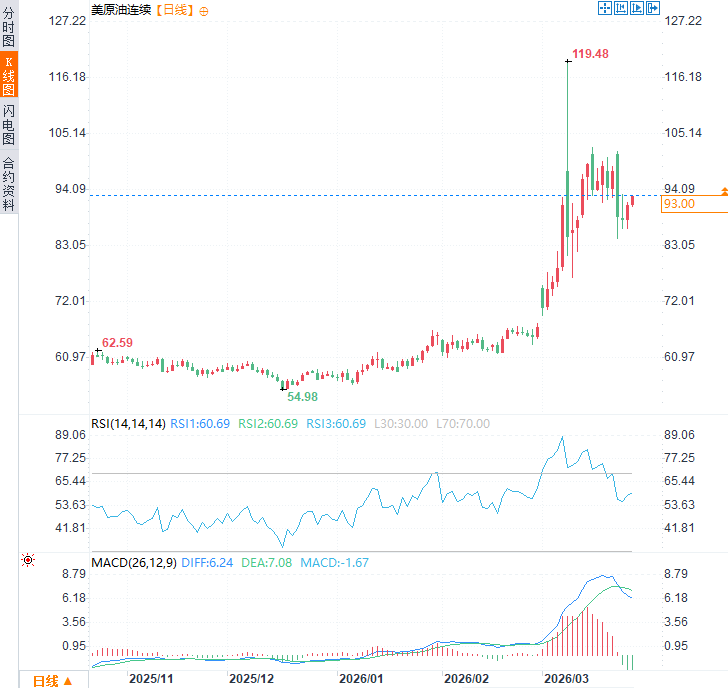
(US crude oil daily chart, source: FX678)
At 15:20 Beijing time, US crude oil futures were trading at $93.06 per barrel.
The US-Iran conflict has entered its fourth week, with shipping in the Strait of Hormuz continuing to be disrupted, and global oil prices remaining volatile at high levels. Signals of the potential use of strategic reserves have exacerbated market concerns about a prolonged conflict. On Thursday (March 26), during the European session, US crude oil prices fluctuated upwards, currently trading at $93 per barrel, a daily increase of approximately 3%.
Former Consultant's Core Viewpoints
Papadopoulos believes that the U.S. strategic petroleum reserve may only last for a month or even less. He emphasized that using this reserve is a "very serious decision" and usually means that the government is prepared to deal with the risk of longer-term energy supply disruptions.
He pointed out that the United States does not want the conflict with Iran to last more than three months, as this is not in the interest of the United States, Europe, and Israel. Three months is considered the final deadline for the United States to allow itself to become involved in such a conflict; exceeding this deadline could trigger domestic political and economic pressure.
Strategic petroleum reserve release plan
U.S. Energy Secretary Chris Wright previously announced plans to release approximately 170 million barrels of oil from the Strategic Petroleum Reserve and replenish it by up to 200 million barrels within a year. The specific release schedule is not yet clear, but such a large-scale release is expected to take approximately 120 days.
This plan aims to alleviate global energy supply tensions caused by the conflict with Iran, but it has also sparked market speculation that the conflict may be protracted. Papadopoulos believes that this move reflects the US government's high regard for energy security, while also suggesting that the prospects for resolving the conflict are not optimistic.
Conflict duration expected
Papadopoulos believes the U.S. government hopes the conflict can be brought under control and resolved within three months. If the conflict drags on beyond this timeframe, it could negatively impact the domestic political situation before the U.S. midterm elections, while also increasing the financial and military burden.
He pointed out that although the Trump administration has sent diplomatic signals, Iran's hardline stance makes negotiations difficult and the risk of a protracted conflict remains.
Political and economic impact
The use of strategic petroleum reserves will directly impact global oil price trends. If the release proceeds smoothly, oil prices may face downward pressure in the short term; however, if the conflict prolongs, the supply shortage may re-emerge after the reserve release ends, further pushing up energy costs.
For the United States domestically, while releasing reserves may temporarily stabilize the market, relying on reserves in the long term is not a sustainable strategy and could weaken strategic energy security. At the same time, a prolonged conflict will increase military spending and put pressure on the Trump administration's political image ahead of the midterm elections.
Market Outlook and Risks
In the short term, the market will closely monitor the actual timing and scale of the release of the US strategic petroleum reserve. If the release plan proceeds smoothly, oil price volatility may ease; conversely, if the conflict with Iran escalates again, oil prices may fluctuate significantly once more.
In the medium to long term, whether the conflict can be effectively controlled within three months will be a key variable determining the stability of the global energy market and the trajectory of the US economy. Investors need to pay attention to subsequent announcements from the US Department of Energy, official statements from Iran, and oil price performance; geopolitical risks remain the dominant uncertainty.
(US crude oil daily chart, source: FX678)
At 15:20 Beijing time, US crude oil futures were trading at $93.06 per barrel.
- Risk Warning and Disclaimer
- The market involves risk, and trading may not be suitable for all investors. This article is for reference only and does not constitute personal investment advice, nor does it take into account certain users’ specific investment objectives, financial situation, or other needs. Any investment decisions made based on this information are at your own risk.