US-Iran negotiations stalls: Middle East situation and energy market under dual pressure
2026-03-26 20:31:27
US President Donald Trump made a series of tough statements on Thursday, pressuring Iran to "take peace agreement negotiations seriously as soon as possible" or face irreversible geopolitical and economic consequences.
"They had better correct their attitude as soon as possible, or it will be too late—once the situation gets out of control, there will be no turning back, and the consequences will be unimaginable!" He warned twice on the Truth social media platform, and his strong words directly affected the nerves of the global energy market, exacerbating market concerns about the stability of the supply chain.
Behind this war of words lies a series of contradictory statements from the US and Iran regarding the negotiation process, leaving the outside world in a state of confusion.
Trump claimed that Iranian negotiators were “different in style” and “eccentric” and had actually been “pleading” with the United States to reach an agreement to end the nearly four-week-long conflict. He also stated that Iran was “completely defeated militarily and has no ability to make a comeback” and refuted Iran’s claim that it was only “studying proposals” as a “lie.”
However, Iran gave a completely different response: According to CCTV News, Iranian Foreign Minister Abbas Araqchi told official media on Wednesday that Iran is only assessing the ceasefire proposals conveyed by the United States through third parties and has absolutely no intention of holding direct negotiations with the United States.
Their statement further emphasized that exchanging information through mediators "is not equivalent to formal negotiations," and the opposing positions of the two sides have allowed the negotiation deadlock to continue to fester.

As negotiations stalled, tensions on the military front escalated simultaneously.
Market sources indicate that the United States is preparing to send thousands of rapidly deployable troops to the Middle East in preparation for possible additional military operations.
Analysts revealed that if negotiations ultimately break down, the United States may take radical measures such as occupying the Harker Island oil port or forcibly reopening the Strait of Hormuz—a vital choke point for global energy transport, carrying more than a quarter of the world's seaborne oil trade and one-fifth of its liquefied natural gas shipments, which would directly threaten the security of global energy channels.
Faced with external pressure, Iran has also issued a warning signal.
Iranian Parliament Speaker Mohammad Bagher Ghalibaf posted on the X platform on Wednesday that intelligence indicates "Iran's enemies" are planning to occupy "an Iranian island" with the support of an unnamed country in the region.
However, military experts pointed out that the current US troop buildup is more inclined towards time-limited military operations rather than long-term ground warfare. This assessment has alleviated the market's panic selling in response to the prospect of a full-scale war to some extent.
The regional diplomatic landscape is also undergoing a subtle shift. Following a series of attacks on its energy infrastructure, Iran's Gulf neighbors are gradually losing patience.
Earlier on Thursday, Saudi Arabia, the United Arab Emirates, and several other Gulf states issued a joint statement strongly condemning Iran's "criminal" attack and making it clear that they are ready to take "self-defense" action at any time in the future.
The escalation of regional tensions directly pushed up international oil prices, with Brent crude prices rebounding above $105 per barrel, further highlighting the direct impact of the Middle East situation on the global energy market.
This geopolitical game surrounding Iran has not only made the contradictions between the US and Iran irreconcilable, but has also closely linked the security risks of the entire Middle East with the stability of the global energy market.
Iran's stance of not negotiating directly with the United States, coupled with the US's military deterrence and strong pressure, as well as the changing attitudes of regional countries, has made the situation highly uncertain.
For the global energy market, shipping security in the Strait of Hormuz and the risk of escalating conflict in the Middle East will remain the core variables driving price fluctuations, and the market will continue to be under pressure in a tense atmosphere in the short term.
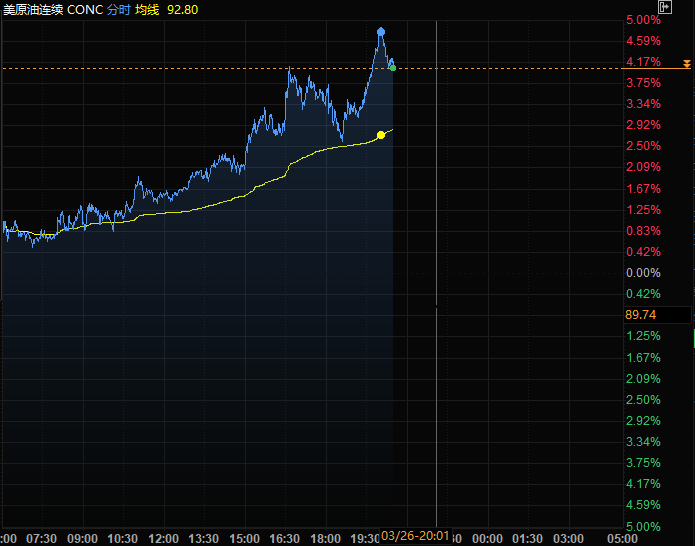
(WTI crude oil futures continuous intraday chart, source: EasyForex)
At 20:30 Beijing time, WTI crude oil futures contracts are currently trading at $94.24 per barrel.
"They had better correct their attitude as soon as possible, or it will be too late—once the situation gets out of control, there will be no turning back, and the consequences will be unimaginable!" He warned twice on the Truth social media platform, and his strong words directly affected the nerves of the global energy market, exacerbating market concerns about the stability of the supply chain.
Behind this war of words lies a series of contradictory statements from the US and Iran regarding the negotiation process, leaving the outside world in a state of confusion.
Trump claimed that Iranian negotiators were “different in style” and “eccentric” and had actually been “pleading” with the United States to reach an agreement to end the nearly four-week-long conflict. He also stated that Iran was “completely defeated militarily and has no ability to make a comeback” and refuted Iran’s claim that it was only “studying proposals” as a “lie.”
However, Iran gave a completely different response: According to CCTV News, Iranian Foreign Minister Abbas Araqchi told official media on Wednesday that Iran is only assessing the ceasefire proposals conveyed by the United States through third parties and has absolutely no intention of holding direct negotiations with the United States.
Their statement further emphasized that exchanging information through mediators "is not equivalent to formal negotiations," and the opposing positions of the two sides have allowed the negotiation deadlock to continue to fester.
Increased military deterrence: US-Iran troop buildup warnings highlight risks to energy supply routes.
As negotiations stalled, tensions on the military front escalated simultaneously.
Market sources indicate that the United States is preparing to send thousands of rapidly deployable troops to the Middle East in preparation for possible additional military operations.
Analysts revealed that if negotiations ultimately break down, the United States may take radical measures such as occupying the Harker Island oil port or forcibly reopening the Strait of Hormuz—a vital choke point for global energy transport, carrying more than a quarter of the world's seaborne oil trade and one-fifth of its liquefied natural gas shipments, which would directly threaten the security of global energy channels.
Faced with external pressure, Iran has also issued a warning signal.
Iranian Parliament Speaker Mohammad Bagher Ghalibaf posted on the X platform on Wednesday that intelligence indicates "Iran's enemies" are planning to occupy "an Iranian island" with the support of an unnamed country in the region.
However, military experts pointed out that the current US troop buildup is more inclined towards time-limited military operations rather than long-term ground warfare. This assessment has alleviated the market's panic selling in response to the prospect of a full-scale war to some extent.
A shift in regional stance: Gulf states' patience is wearing thin, and they are jointly condemning Iran.
The regional diplomatic landscape is also undergoing a subtle shift. Following a series of attacks on its energy infrastructure, Iran's Gulf neighbors are gradually losing patience.
Earlier on Thursday, Saudi Arabia, the United Arab Emirates, and several other Gulf states issued a joint statement strongly condemning Iran's "criminal" attack and making it clear that they are ready to take "self-defense" action at any time in the future.
The escalation of regional tensions directly pushed up international oil prices, with Brent crude prices rebounding above $105 per barrel, further highlighting the direct impact of the Middle East situation on the global energy market.
Uncertain outlook: heightened geopolitical tensions put continued pressure on energy markets.
This geopolitical game surrounding Iran has not only made the contradictions between the US and Iran irreconcilable, but has also closely linked the security risks of the entire Middle East with the stability of the global energy market.
Iran's stance of not negotiating directly with the United States, coupled with the US's military deterrence and strong pressure, as well as the changing attitudes of regional countries, has made the situation highly uncertain.
For the global energy market, shipping security in the Strait of Hormuz and the risk of escalating conflict in the Middle East will remain the core variables driving price fluctuations, and the market will continue to be under pressure in a tense atmosphere in the short term.
(WTI crude oil futures continuous intraday chart, source: EasyForex)
At 20:30 Beijing time, WTI crude oil futures contracts are currently trading at $94.24 per barrel.
- Risk Warning and Disclaimer
- The market involves risk, and trading may not be suitable for all investors. This article is for reference only and does not constitute personal investment advice, nor does it take into account certain users’ specific investment objectives, financial situation, or other needs. Any investment decisions made based on this information are at your own risk.