Gold Analysis: Prices continue to be pressured by rising interest rates
2026-03-26 21:52:24
Gold prices fell again in early US trading on Thursday (March 26), mainly due to rising global interest rates, particularly the continued climb in US Treasury yields. Data showed that gold fell approximately 1.20% that day, with market sentiment clearly becoming more cautious. In the current environment, the short-term pricing logic for gold is increasingly being dominated by interest rate factors.
Gold prices have recently failed to maintain their previous strength, remaining under pressure at high levels. International spot gold prices are currently hovering around $4400-$4450 per ounce. Although they have tested higher levels several times, they have consistently failed to break through effectively, and the overall trend has gradually shifted to a downward oscillation. The safe-haven demand that originally supported gold prices has been significantly weakened in the high-yield environment, with higher bond yields acting as a hedge, further diminishing the attractiveness of gold as a non-interest-bearing asset.
Interest rate environment dominates: the bond market becomes the core variable
From a more fundamental pricing perspective, the bond market remains a key factor determining the direction of major asset classes, a point further reinforced by recent market movements. The yield on the 10-year US Treasury bond has approached the 4.4% mark, currently fluctuating between 4.35% and 4.37%, a slight increase from previous levels. Against this backdrop, the yield comparison between assets has become clearer: bonds offer stable returns, while gold relies entirely on price increases for its gains, directly leading to a significant increase in the opportunity cost of holding gold.

As long as the market continues to reinforce expectations of "higher interest rates and longer periods," gold will struggle to gain sustained upward momentum, a logic that is suppressing all attempts at a rebound.
The backlash of geopolitical conflicts: the hedging logic is "covered up" by interest rates.
Meanwhile, the situation in the Middle East, particularly the conflict surrounding Iran, indirectly affects gold prices through energy price channels. Rising oil prices push up inflation expectations, making the market more inclined to believe that central banks will maintain a high-interest-rate stance.
This leads to a typical "counterintuitive phenomenon": geopolitical risks should be beneficial to gold, but due to the simultaneous rise in inflation and interest rates, they instead put downward pressure on gold prices, ultimately resulting in interest rate factors outweighing safe-haven demand.
Technical structure: The 4600 level forms strong resistance.
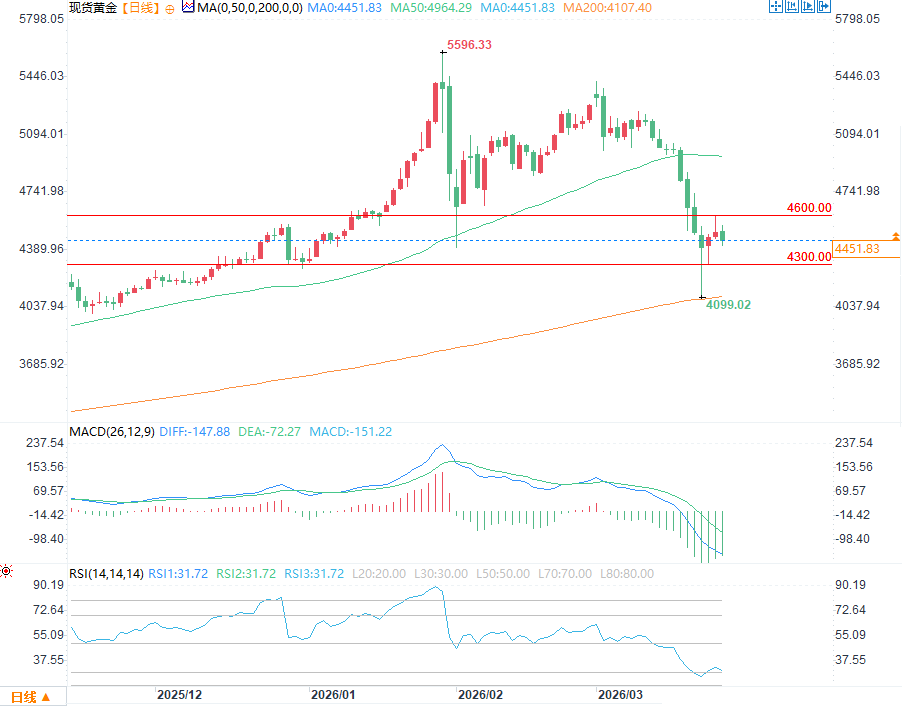
(Spot gold daily chart source: FX678)
From the daily chart, gold has repeatedly encountered resistance around the $4,600/ounce level, which has gradually formed a clear strong resistance zone. The repeated failures to break through this level have reinforced market expectations of selling pressure.
The current candlestick pattern indicates that gold is still in a high-level consolidation phase, with significant upward pressure and some support below, but the overall bearish trend has not fundamentally changed. Gold lacks the conditions to regain strength until US Treasury yields show a significant decline.
interest rates and the US dollar are both exerting downward pressure.
As of the afternoon of March 26th Beijing time, the international spot gold price was around $4430-$4450 per ounce, a slight decrease of about 1% from the previous trading day. Meanwhile, the yield on the 10-year US Treasury note rose to approximately 4.37%, and the US dollar index remained strong, continuing to exert downward pressure on gold.
The market generally expects that major central banks, including the Federal Reserve, will be unlikely to significantly shift towards easing in the short term, and the narrative of "high interest rates being maintained for longer" will continue to dominate. Although gold prices attempted to rebound during the session, both trading volume and momentum were relatively limited, indicating that bullish confidence still needs to be restored. A series of recently released economic data and geopolitical events also point to the fact that inflationary pressures have not completely subsided, and a policy shift will still take time.
Structural factors: Rebalancing of bullish and bearish forces
In addition to this, gold also faces the combined effect of multiple structural factors. On the one hand, the strengthening of the US dollar index makes gold more expensive for non-US investors, and funds continue to flow to higher-yielding US dollar assets (especially US Treasuries); on the other hand, rising energy prices have fueled renewed inflation expectations, weakening market bets on a significant interest rate cut this year.
However, from a longer-term perspective, global central banks (especially in emerging markets) continue to increase their gold holdings to diversify their foreign exchange reserves, providing some floor support for gold prices. Overall, at the current stage, the "opportunity cost" is significantly higher than the "safe-haven premium," which is the core reason why gold is unlikely to rebound quickly.
Market Outlook and Trading Recommendations: Range-bound Thinking Prevails
Looking ahead, gold is likely to maintain a high-level consolidation pattern in the short term, with $4,600 remaining a key resistance level, while support is likely to be found in the $4,200-$4,300 range. The most crucial variable to watch in the market going forward remains the change in the yield on the 10-year US Treasury bond: if the yield falls below 4.2%, gold is expected to see a phase of rebound; conversely, if it continues to rise, gold prices will face further downward pressure.
From an operational perspective, investors are advised to remain cautious, primarily employing a range-bound trading strategy, and avoiding blindly chasing highs or aggressively buying the dip. Simultaneously, positions can be flexibly adjusted based on technical indicators (such as whether the RSI has moved out of oversold territory) and macroeconomic data (such as statements from Federal Reserve officials and PCE inflation data). In the long term, once the global interest rate cycle peaks and enters a downward phase, gold still has the foundation to return to a bull market; however, at the current stage, the overall strategy should remain primarily defensive.
Gold prices have recently failed to maintain their previous strength, remaining under pressure at high levels. International spot gold prices are currently hovering around $4400-$4450 per ounce. Although they have tested higher levels several times, they have consistently failed to break through effectively, and the overall trend has gradually shifted to a downward oscillation. The safe-haven demand that originally supported gold prices has been significantly weakened in the high-yield environment, with higher bond yields acting as a hedge, further diminishing the attractiveness of gold as a non-interest-bearing asset.
Interest rate environment dominates: the bond market becomes the core variable
From a more fundamental pricing perspective, the bond market remains a key factor determining the direction of major asset classes, a point further reinforced by recent market movements. The yield on the 10-year US Treasury bond has approached the 4.4% mark, currently fluctuating between 4.35% and 4.37%, a slight increase from previous levels. Against this backdrop, the yield comparison between assets has become clearer: bonds offer stable returns, while gold relies entirely on price increases for its gains, directly leading to a significant increase in the opportunity cost of holding gold.
As long as the market continues to reinforce expectations of "higher interest rates and longer periods," gold will struggle to gain sustained upward momentum, a logic that is suppressing all attempts at a rebound.
The backlash of geopolitical conflicts: the hedging logic is "covered up" by interest rates.
Meanwhile, the situation in the Middle East, particularly the conflict surrounding Iran, indirectly affects gold prices through energy price channels. Rising oil prices push up inflation expectations, making the market more inclined to believe that central banks will maintain a high-interest-rate stance.
This leads to a typical "counterintuitive phenomenon": geopolitical risks should be beneficial to gold, but due to the simultaneous rise in inflation and interest rates, they instead put downward pressure on gold prices, ultimately resulting in interest rate factors outweighing safe-haven demand.
Technical structure: The 4600 level forms strong resistance.
(Spot gold daily chart source: FX678)
From the daily chart, gold has repeatedly encountered resistance around the $4,600/ounce level, which has gradually formed a clear strong resistance zone. The repeated failures to break through this level have reinforced market expectations of selling pressure.
The current candlestick pattern indicates that gold is still in a high-level consolidation phase, with significant upward pressure and some support below, but the overall bearish trend has not fundamentally changed. Gold lacks the conditions to regain strength until US Treasury yields show a significant decline.
interest rates and the US dollar are both exerting downward pressure.
As of the afternoon of March 26th Beijing time, the international spot gold price was around $4430-$4450 per ounce, a slight decrease of about 1% from the previous trading day. Meanwhile, the yield on the 10-year US Treasury note rose to approximately 4.37%, and the US dollar index remained strong, continuing to exert downward pressure on gold.
The market generally expects that major central banks, including the Federal Reserve, will be unlikely to significantly shift towards easing in the short term, and the narrative of "high interest rates being maintained for longer" will continue to dominate. Although gold prices attempted to rebound during the session, both trading volume and momentum were relatively limited, indicating that bullish confidence still needs to be restored. A series of recently released economic data and geopolitical events also point to the fact that inflationary pressures have not completely subsided, and a policy shift will still take time.
Structural factors: Rebalancing of bullish and bearish forces
In addition to this, gold also faces the combined effect of multiple structural factors. On the one hand, the strengthening of the US dollar index makes gold more expensive for non-US investors, and funds continue to flow to higher-yielding US dollar assets (especially US Treasuries); on the other hand, rising energy prices have fueled renewed inflation expectations, weakening market bets on a significant interest rate cut this year.
However, from a longer-term perspective, global central banks (especially in emerging markets) continue to increase their gold holdings to diversify their foreign exchange reserves, providing some floor support for gold prices. Overall, at the current stage, the "opportunity cost" is significantly higher than the "safe-haven premium," which is the core reason why gold is unlikely to rebound quickly.
Market Outlook and Trading Recommendations: Range-bound Thinking Prevails
Looking ahead, gold is likely to maintain a high-level consolidation pattern in the short term, with $4,600 remaining a key resistance level, while support is likely to be found in the $4,200-$4,300 range. The most crucial variable to watch in the market going forward remains the change in the yield on the 10-year US Treasury bond: if the yield falls below 4.2%, gold is expected to see a phase of rebound; conversely, if it continues to rise, gold prices will face further downward pressure.
From an operational perspective, investors are advised to remain cautious, primarily employing a range-bound trading strategy, and avoiding blindly chasing highs or aggressively buying the dip. Simultaneously, positions can be flexibly adjusted based on technical indicators (such as whether the RSI has moved out of oversold territory) and macroeconomic data (such as statements from Federal Reserve officials and PCE inflation data). In the long term, once the global interest rate cycle peaks and enters a downward phase, gold still has the foundation to return to a bull market; however, at the current stage, the overall strategy should remain primarily defensive.
- Risk Warning and Disclaimer
- The market involves risk, and trading may not be suitable for all investors. This article is for reference only and does not constitute personal investment advice, nor does it take into account certain users’ specific investment objectives, financial situation, or other needs. Any investment decisions made based on this information are at your own risk.