A chart shows that the Baltic Dry Index has risen for two consecutive days, with Capesize vessels leading the market gains.
2026-03-26 23:46:38
Latest data shows that the Baltic Dry Index (BDI) reached 2014 points on March 26, 2026, a three-day high, up 0.65% month-on-month (compared to the previous value), marking the largest increase since March 18, 2026, and the second consecutive day of increase (including zero growth). Looking at the short-term charts, the recent 11 BDI data points show: 6 positive increases, 5 negative increases, and 0 zero increases. Specifically, the Panamax Freight Index (BPI) was 1770 points, down 1.45% from the previous value; the Capesize Freight Index (BCI) was 2974 points, up 2.02%; and the Supramax Freight Index (BSI) was 1205 points, down 0.25%. For detailed 720-day and 10-year trend charts of the Baltic Dry Index and its three main sub-indices, please refer to the specially designed charts.
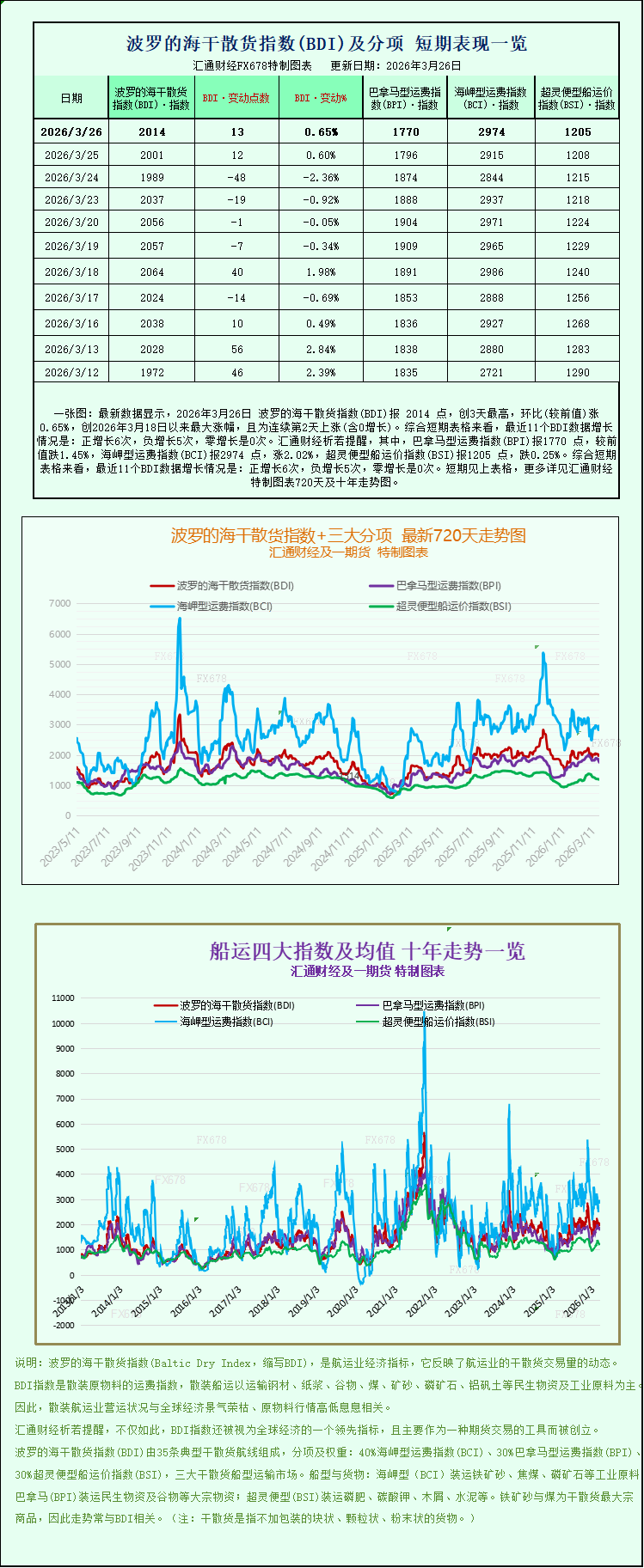
The Baltic Dry Index (BDI) rose for the second consecutive trading day on Thursday, driven primarily by the strong performance of the Capesize vessel market. As a key indicator of global dry bulk shipping rates, the index directly reflects the shipping costs of bulk commodities such as iron ore, coal, and grain, as well as the level of global trade activity.
On the same day, the Baltic Dry Index (BDI), which covers the three major vessel types—Capesize, Panamax, and Supramax—rose 13 points, or 0.7%, to close at 2014 points, maintaining its upward trend despite weakness in small and medium-sized vessels. Among them, the Capesize index, a barometer of the shipping market, performed the best, surging 59 points, or 2%, to close at 2974 points, just shy of its high point in nearly a week. The average daily charter income for Capesize vessels carrying 150,000 tons of bulk raw materials such as iron ore and coal also rose by $534 to $23,471, indicating continued improvement in shipowner profitability.
On the commodities front, concerns about the temporary closure of major iron ore export ports in Australia's Pilbara region due to cyclone weather continued to escalate. Coupled with the gradual release of global steel mill restocking demand, iron ore futures prices rose in response, further boosting demand expectations for ocean dry bulk shipping and becoming an important support for the strengthening of Capesize freight rates.
In contrast to larger vessels, the Panamax and Supramax markets experienced a weak correction. The Panamax index fell 26 points, or 1.5%, to close at 1770 points, a new low in nearly six weeks. Panamax vessels, primarily carrying 60,000 to 70,000 tons of coal, grain, and other cargoes, saw their average daily revenue decrease by $235 to $15,931. The Supramax index also declined by 3 points, or 0.3%, to close at 1205 points, indicating overall downward pressure on freight rates for small and medium-sized bulk carriers.
Geopolitically, the situation in the Middle East remains a potential source of market disruption. US President Trump publicly warned Iran to "take seriously" an agreement aimed at ending nearly four weeks of conflict. This followed a statement from the Iranian Foreign Minister that Tehran was reviewing the US proposal, but the two sides have not yet begun formal negotiations on a ceasefire. This geopolitical uncertainty may indirectly impact subsequent international shipping routes and freight rates.
The Baltic Dry Index (BDI) rose for the second consecutive trading day on Thursday, driven primarily by the strong performance of the Capesize vessel market. As a key indicator of global dry bulk shipping rates, the index directly reflects the shipping costs of bulk commodities such as iron ore, coal, and grain, as well as the level of global trade activity.
On the same day, the Baltic Dry Index (BDI), which covers the three major vessel types—Capesize, Panamax, and Supramax—rose 13 points, or 0.7%, to close at 2014 points, maintaining its upward trend despite weakness in small and medium-sized vessels. Among them, the Capesize index, a barometer of the shipping market, performed the best, surging 59 points, or 2%, to close at 2974 points, just shy of its high point in nearly a week. The average daily charter income for Capesize vessels carrying 150,000 tons of bulk raw materials such as iron ore and coal also rose by $534 to $23,471, indicating continued improvement in shipowner profitability.
On the commodities front, concerns about the temporary closure of major iron ore export ports in Australia's Pilbara region due to cyclone weather continued to escalate. Coupled with the gradual release of global steel mill restocking demand, iron ore futures prices rose in response, further boosting demand expectations for ocean dry bulk shipping and becoming an important support for the strengthening of Capesize freight rates.
In contrast to larger vessels, the Panamax and Supramax markets experienced a weak correction. The Panamax index fell 26 points, or 1.5%, to close at 1770 points, a new low in nearly six weeks. Panamax vessels, primarily carrying 60,000 to 70,000 tons of coal, grain, and other cargoes, saw their average daily revenue decrease by $235 to $15,931. The Supramax index also declined by 3 points, or 0.3%, to close at 1205 points, indicating overall downward pressure on freight rates for small and medium-sized bulk carriers.
Geopolitically, the situation in the Middle East remains a potential source of market disruption. US President Trump publicly warned Iran to "take seriously" an agreement aimed at ending nearly four weeks of conflict. This followed a statement from the Iranian Foreign Minister that Tehran was reviewing the US proposal, but the two sides have not yet begun formal negotiations on a ceasefire. This geopolitical uncertainty may indirectly impact subsequent international shipping routes and freight rates.
- Risk Warning and Disclaimer
- The market involves risk, and trading may not be suitable for all investors. This article is for reference only and does not constitute personal investment advice, nor does it take into account certain users’ specific investment objectives, financial situation, or other needs. Any investment decisions made based on this information are at your own risk.