A New Logic for Fuel Prices in a War of Attrition! Continued Threat from Sporadic Iranian Missiles: Is the Risk Premium Becoming Persistent?
2026-03-27 11:41:32
Since the outbreak of the conflict on February 28, the United States and Israel have carried out continuous and intense airstrikes against Iranian missile targets, including launch sites, production facilities, and underground bases. Despite nearly a month of high-intensity attacks, Iran is still able to launch longer-range missiles sporadically from deep within its territory. Although the number has decreased significantly to about a dozen per day, some missiles have successfully penetrated defenses, causing actual damage to vulnerable areas in Israel and the Gulf Arab states.
This phenomenon highlights the resilience of Iran's missile arsenal. In the early stages of the war, Iran attempted a large-scale salvo, but as the combined US-Israeli strikes intensified, it shifted to a strategy of dispersed, small-scale launches, focusing on oil facilities, hotels, and civilian areas to achieve multiple objectives: prolonging the conflict, increasing the economic cost to its adversaries, and preserving its strength.
On Friday (March 27) during the Asian session, US crude oil prices fluctuated downwards and are currently trading around $93.75 per barrel, down about 0.75% from yesterday's settlement price.
In a video statement, U.S. Central Command Commander Admiral Brad Cooper stated that the U.S. military has struck more than 10,000 targets inside Iran, while Israel has struck thousands more. Iran's drone and missile launch rates have decreased by more than 90%, and over two-thirds of its missile, drone, and naval vessel production facilities have been destroyed or severely damaged.
Israeli military data further indicates that of the approximately 470 mobile missile launchers Iran possessed pre-war, about 330 have been destroyed or disabled. Half of these were directly destroyed, while the other half were rendered unusable due to blocked tunnel entrances. Pre-war Iranian ballistic missile stockpile was estimated at 2,500 missiles; currently, its large-scale, single-launch capability has been largely lost.
Despite the progress made, the joint US-Israeli operation still faces challenges: Iran has moved its launch sites deeper inland, increasing the difficulty of the strike.
Iran maintains a limited but continuous launch capability by decentralizing command operations, utilizing the terrain advantages of its vast territory, and rapidly clearing tunnels and mobile launchers. Each independent command only needs to launch one or two missiles per day to maintain the current frequency. Operators often wait until the aircraft are far away before quickly moving out, or salvage resources from bombed underground facilities.
The Khorramshahr missile, a key component of Iran's arsenal with a range exceeding 1,200 miles and capable of carrying heavy warheads, was used in the attacks on Dimona and Arad in Israel over the weekend. Its upgraded version uses a more stable propellant and reduces preparation time, but has also experienced problems such as explosions and fuel leaks during launch.
Military analysts point out that Iran is achieving a "small-scale victory" effect through these low-cost, sporadic strikes, putting its adversaries under continuous economic and psychological pressure .
The Imam Hussein Strategic Missile Headquarters, located in the mountains south of Yazd, is a key hub for Iran's Khorramshahr missiles. This underground facility has been attacked by US and Israeli warplanes at least three times, including initial damage to surface structures and hillside entrances during the early stages of the war, as well as subsequent targeted airstrikes. Satellite imagery shows partial collapse and thick smoke at the base last week.
Nevertheless, it remains unclear whether Iran can still launch missiles from this location. Yazd, located approximately 500 miles from the coastline in an isolated desert, is a highly challenging target for both the US and Israel. Israel first attempted a daytime long-range strike during last summer's 12-day conflict, but has had to return multiple times in this round of fighting. The base's resilience reflects the underground and decentralized design of Iran's missile systems.
While the Iranian missile threat has been significantly reduced, the continued sporadic launches have placed an additional economic burden on Gulf oil exports and regional stability. The shift of attacks towards civilian and oil-related areas has further amplified the destructive effects.
Analysts believe that if the conflict ends prematurely, the Iranian regime or its remnants may recover missiles from underground and rebuild production facilities, meaning the threat will remain in the future .
Former U.S. Central Command commander and retired general Joseph Votel recently stated that Iran is no longer conducting large-scale salvos, but "what they really want to do is get a few stray missiles to successfully penetrate defenses and achieve a huge effect at a very low cost." He emphasized that Iran is trying to escalate and prolong the conflict.
Benham Ben Taleblou, director of the Iran program at the Foundation for the Defense of Democracy, pointed out in a recent discussion that if military operations were to cease prematurely, the current Iranian regime or its remnants would almost certainly attempt to recover the missiles and launchers and gradually rebuild their capabilities. The foundation has long advocated a hardline stance against the Tehran regime.
Carnegie Endowment for International Peace scholar Nicole Graevsky believes that Iran "withstood the bombing campaign" and took steps to continue its operations. Missile defense expert Tal Inbar points out that Iran's vast territory makes comprehensive aerial surveillance difficult.
The conflict between the US, Israel, and Iran has shifted from a "quick war" to a "war of attrition." Iran's strategy of maintaining the threat through sporadic strikes has changed the risk premium for Middle Eastern oil supplies from "pulsating" to "persistent." Crude oil prices will be supported by geopolitical factors for a longer period of time, and any direct attack on oil facilities could become the trigger for a sharp rise in oil prices .
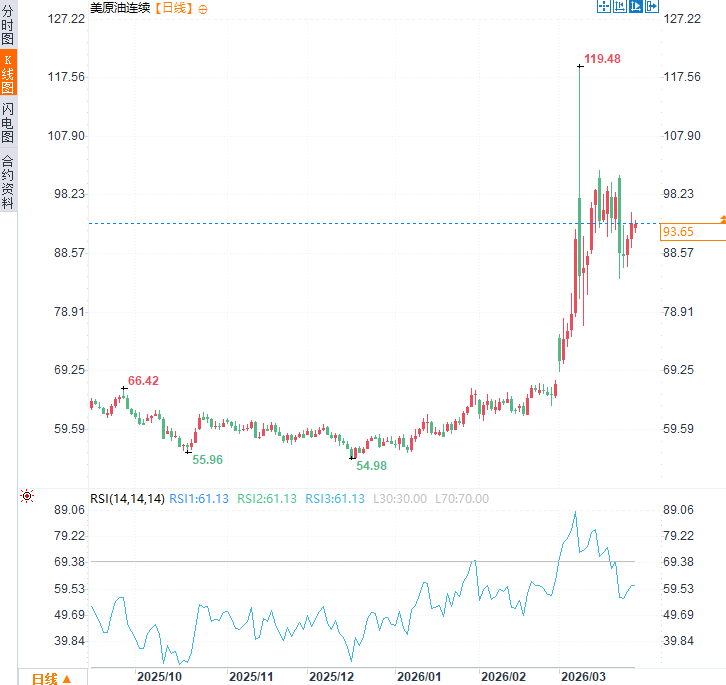
(US crude oil daily chart, source: FX678)
At 11:41 Beijing time, US crude oil futures were trading at $93.50 per barrel.
This phenomenon highlights the resilience of Iran's missile arsenal. In the early stages of the war, Iran attempted a large-scale salvo, but as the combined US-Israeli strikes intensified, it shifted to a strategy of dispersed, small-scale launches, focusing on oil facilities, hotels, and civilian areas to achieve multiple objectives: prolonging the conflict, increasing the economic cost to its adversaries, and preserving its strength.
On Friday (March 27) during the Asian session, US crude oil prices fluctuated downwards and are currently trading around $93.75 per barrel, down about 0.75% from yesterday's settlement price.
US-Israeli strike effectiveness assessment
In a video statement, U.S. Central Command Commander Admiral Brad Cooper stated that the U.S. military has struck more than 10,000 targets inside Iran, while Israel has struck thousands more. Iran's drone and missile launch rates have decreased by more than 90%, and over two-thirds of its missile, drone, and naval vessel production facilities have been destroyed or severely damaged.
Israeli military data further indicates that of the approximately 470 mobile missile launchers Iran possessed pre-war, about 330 have been destroyed or disabled. Half of these were directly destroyed, while the other half were rendered unusable due to blocked tunnel entrances. Pre-war Iranian ballistic missile stockpile was estimated at 2,500 missiles; currently, its large-scale, single-launch capability has been largely lost.
Despite the progress made, the joint US-Israeli operation still faces challenges: Iran has moved its launch sites deeper inland, increasing the difficulty of the strike.
Iran's missile resilience and countermeasures
Iran maintains a limited but continuous launch capability by decentralizing command operations, utilizing the terrain advantages of its vast territory, and rapidly clearing tunnels and mobile launchers. Each independent command only needs to launch one or two missiles per day to maintain the current frequency. Operators often wait until the aircraft are far away before quickly moving out, or salvage resources from bombed underground facilities.
The Khorramshahr missile, a key component of Iran's arsenal with a range exceeding 1,200 miles and capable of carrying heavy warheads, was used in the attacks on Dimona and Arad in Israel over the weekend. Its upgraded version uses a more stable propellant and reduces preparation time, but has also experienced problems such as explosions and fuel leaks during launch.
Military analysts point out that Iran is achieving a "small-scale victory" effect through these low-cost, sporadic strikes, putting its adversaries under continuous economic and psychological pressure .
Analysis of repeated strikes against Yazd Imam Hussein base
The Imam Hussein Strategic Missile Headquarters, located in the mountains south of Yazd, is a key hub for Iran's Khorramshahr missiles. This underground facility has been attacked by US and Israeli warplanes at least three times, including initial damage to surface structures and hillside entrances during the early stages of the war, as well as subsequent targeted airstrikes. Satellite imagery shows partial collapse and thick smoke at the base last week.
Nevertheless, it remains unclear whether Iran can still launch missiles from this location. Yazd, located approximately 500 miles from the coastline in an isolated desert, is a highly challenging target for both the US and Israel. Israel first attempted a daytime long-range strike during last summer's 12-day conflict, but has had to return multiple times in this round of fighting. The base's resilience reflects the underground and decentralized design of Iran's missile systems.
Impact on regional economy and delays in conflict
While the Iranian missile threat has been significantly reduced, the continued sporadic launches have placed an additional economic burden on Gulf oil exports and regional stability. The shift of attacks towards civilian and oil-related areas has further amplified the destructive effects.
Analysts believe that if the conflict ends prematurely, the Iranian regime or its remnants may recover missiles from underground and rebuild production facilities, meaning the threat will remain in the future .
Latest opinions from experts and officials
Former U.S. Central Command commander and retired general Joseph Votel recently stated that Iran is no longer conducting large-scale salvos, but "what they really want to do is get a few stray missiles to successfully penetrate defenses and achieve a huge effect at a very low cost." He emphasized that Iran is trying to escalate and prolong the conflict.
Benham Ben Taleblou, director of the Iran program at the Foundation for the Defense of Democracy, pointed out in a recent discussion that if military operations were to cease prematurely, the current Iranian regime or its remnants would almost certainly attempt to recover the missiles and launchers and gradually rebuild their capabilities. The foundation has long advocated a hardline stance against the Tehran regime.
Carnegie Endowment for International Peace scholar Nicole Graevsky believes that Iran "withstood the bombing campaign" and took steps to continue its operations. Missile defense expert Tal Inbar points out that Iran's vast territory makes comprehensive aerial surveillance difficult.
Impact analysis on the crude oil market
The conflict between the US, Israel, and Iran has shifted from a "quick war" to a "war of attrition." Iran's strategy of maintaining the threat through sporadic strikes has changed the risk premium for Middle Eastern oil supplies from "pulsating" to "persistent." Crude oil prices will be supported by geopolitical factors for a longer period of time, and any direct attack on oil facilities could become the trigger for a sharp rise in oil prices .
(US crude oil daily chart, source: FX678)
At 11:41 Beijing time, US crude oil futures were trading at $93.50 per barrel.
- Risk Warning and Disclaimer
- The market involves risk, and trading may not be suitable for all investors. This article is for reference only and does not constitute personal investment advice, nor does it take into account certain users’ specific investment objectives, financial situation, or other needs. Any investment decisions made based on this information are at your own risk.