The yen's approach to the 160 level triggered expectations of intervention, causing the USD/JPY pair to rise and then fall back, but its strong upward trend remained unchanged.
2026-03-27 13:30:20
The USD/JPY pair saw a slight pullback during Asian trading hours on Friday, ending a three-day winning streak. It is currently trading around 159.50 , slightly lower than its previous high. From a market perspective, this pullback is more of a technical correction, and the overall trend has not yet changed significantly.

One of the main factors driving the exchange rate decline was the yen approaching the key psychological level of 160.00 . This level has long been considered a reference range for potential intervention by Japanese authorities. Historically, whenever the exchange rate approaches or breaks through this level, the market tends to pre-emptively price in potential policy risks, thus exerting short-term downward pressure on the USD/JPY pair. Simultaneously, a slight pullback in the US dollar index in the short term further contributed to the decline in the exchange rate.
However, from a fundamental perspective, the yen's upside potential remains limited. With rising global energy prices, Japan, as a major energy importer, faces significant pressure on its trade structure. Rising oil prices will increase import costs, thereby weakening the current account performance and exerting medium- to long-term downward pressure on the yen. Furthermore, rising energy prices may also push up inflation, but against the backdrop of pressure on economic growth, the Bank of Japan will face greater constraints in normalizing its policy.
This environment exposes the Japanese economy to the risk of stagflation, characterized by rising inflation alongside slowing growth. Under these circumstances, a hasty interest rate hike by the Bank of Japan could further hamper economic recovery, thus limiting its policy adjustment options. This policy constraint means that a sustained appreciation of the yen is unlikely.
Meanwhile, interest rate expectations in the US remain significantly hawkish. Driven by concerns about energy price-push inflation, the market has reassessed the Federal Reserve's policy path, weakening expectations of rate cuts and even beginning to price in potential rate hikes. This shift has kept US Treasury yields high, thus enhancing the attractiveness of the dollar and becoming a key factor supporting the USD/JPY exchange rate.
Furthermore, despite the US delaying potential action against Middle Eastern energy facilities, market concerns about further escalation have not completely subsided. Persistent geopolitical risks support oil prices and further strengthen inflation expectations, leading major central banks to adopt more cautious or even hawkish policies, thus indirectly benefiting the US dollar.
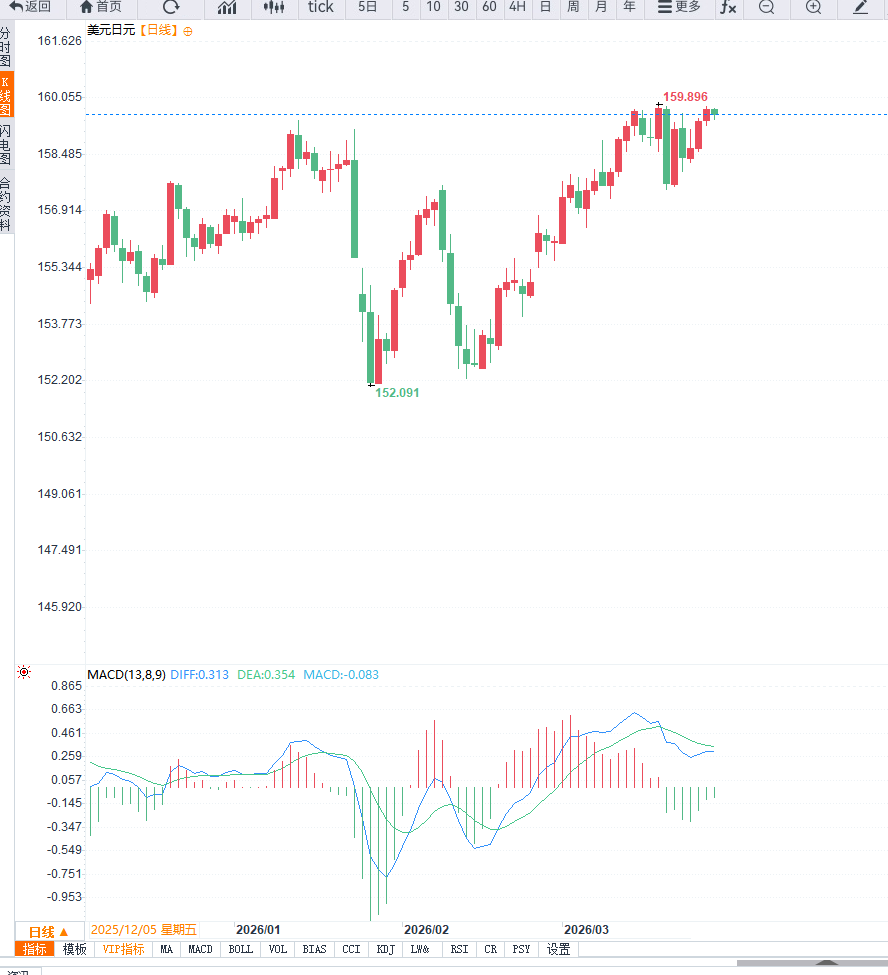
From a technical perspective, the USD/JPY daily chart maintains a clear upward trend. Since the February low near 152.30 , the exchange rate has consistently raised both the lows and highs, forming a typical bullish structure. Currently, the price is trading above major moving averages, which are in a bullish alignment, indicating continued strong upward momentum. The MACD is above the zero line, and although the momentum bars have somewhat converged, they remain positive, suggesting the upward trend has not been broken. The RSI is in high territory but not significantly overbought, implying further upside potential. Key resistance is concentrated at the 160.00 level; a decisive break above this level could open up further upside potential. Support levels are located in the 158.50 and 157.50 area.
From the 4-hour chart, the short-term trend shows a consolidation pattern at high levels. A pullback occurred after touching the 160 level, indicating strong selling pressure at that point. Short-term moving averages are flattening, and the price is oscillating around them, indicating increasing divergence between bulls and bears. The MACD shows a bearish divergence at high levels, indicating weakening short-term momentum; the RSI has fallen to the neutral zone, suggesting insufficient upward momentum in the short term. Current support levels to watch are 159.00 and 158.50 ; a break below these levels could lead to a further pullback to 157.50. Conversely, if the price re-establishes itself above 160, the trend will likely continue.
Editor's Summary:
Overall, the USD/JPY pair is in a structure of "strong trend + short-term pressure." Intervention expectations have limited the exchange rate's rapid rise, but the fundamentals remain clearly bullish for the dollar, limiting the downside potential. In the short term, the exchange rate is likely to fluctuate within the 159-160 range, awaiting new fundamental catalysts. The medium-term trend remains bullish, with the key being a break above the 160 level or the implementation of policy intervention.
One of the main factors driving the exchange rate decline was the yen approaching the key psychological level of 160.00 . This level has long been considered a reference range for potential intervention by Japanese authorities. Historically, whenever the exchange rate approaches or breaks through this level, the market tends to pre-emptively price in potential policy risks, thus exerting short-term downward pressure on the USD/JPY pair. Simultaneously, a slight pullback in the US dollar index in the short term further contributed to the decline in the exchange rate.
However, from a fundamental perspective, the yen's upside potential remains limited. With rising global energy prices, Japan, as a major energy importer, faces significant pressure on its trade structure. Rising oil prices will increase import costs, thereby weakening the current account performance and exerting medium- to long-term downward pressure on the yen. Furthermore, rising energy prices may also push up inflation, but against the backdrop of pressure on economic growth, the Bank of Japan will face greater constraints in normalizing its policy.
This environment exposes the Japanese economy to the risk of stagflation, characterized by rising inflation alongside slowing growth. Under these circumstances, a hasty interest rate hike by the Bank of Japan could further hamper economic recovery, thus limiting its policy adjustment options. This policy constraint means that a sustained appreciation of the yen is unlikely.
Meanwhile, interest rate expectations in the US remain significantly hawkish. Driven by concerns about energy price-push inflation, the market has reassessed the Federal Reserve's policy path, weakening expectations of rate cuts and even beginning to price in potential rate hikes. This shift has kept US Treasury yields high, thus enhancing the attractiveness of the dollar and becoming a key factor supporting the USD/JPY exchange rate.
Furthermore, despite the US delaying potential action against Middle Eastern energy facilities, market concerns about further escalation have not completely subsided. Persistent geopolitical risks support oil prices and further strengthen inflation expectations, leading major central banks to adopt more cautious or even hawkish policies, thus indirectly benefiting the US dollar.
From a technical perspective, the USD/JPY daily chart maintains a clear upward trend. Since the February low near 152.30 , the exchange rate has consistently raised both the lows and highs, forming a typical bullish structure. Currently, the price is trading above major moving averages, which are in a bullish alignment, indicating continued strong upward momentum. The MACD is above the zero line, and although the momentum bars have somewhat converged, they remain positive, suggesting the upward trend has not been broken. The RSI is in high territory but not significantly overbought, implying further upside potential. Key resistance is concentrated at the 160.00 level; a decisive break above this level could open up further upside potential. Support levels are located in the 158.50 and 157.50 area.
From the 4-hour chart, the short-term trend shows a consolidation pattern at high levels. A pullback occurred after touching the 160 level, indicating strong selling pressure at that point. Short-term moving averages are flattening, and the price is oscillating around them, indicating increasing divergence between bulls and bears. The MACD shows a bearish divergence at high levels, indicating weakening short-term momentum; the RSI has fallen to the neutral zone, suggesting insufficient upward momentum in the short term. Current support levels to watch are 159.00 and 158.50 ; a break below these levels could lead to a further pullback to 157.50. Conversely, if the price re-establishes itself above 160, the trend will likely continue.
Editor's Summary:
Overall, the USD/JPY pair is in a structure of "strong trend + short-term pressure." Intervention expectations have limited the exchange rate's rapid rise, but the fundamentals remain clearly bullish for the dollar, limiting the downside potential. In the short term, the exchange rate is likely to fluctuate within the 159-160 range, awaiting new fundamental catalysts. The medium-term trend remains bullish, with the key being a break above the 160 level or the implementation of policy intervention.
- Risk Warning and Disclaimer
- The market involves risk, and trading may not be suitable for all investors. This article is for reference only and does not constitute personal investment advice, nor does it take into account certain users’ specific investment objectives, financial situation, or other needs. Any investment decisions made based on this information are at your own risk.