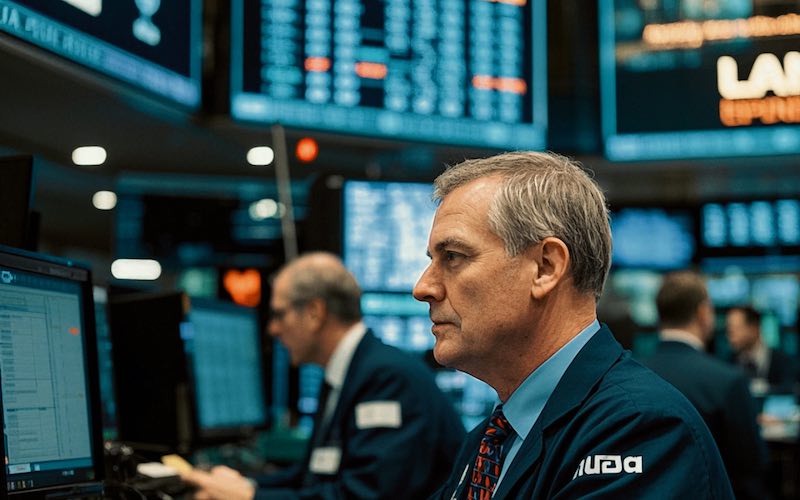
US stocks fell sharply, with the Nasdaq entering correction territory and likely to face significant volatility in the short term.
2026-03-27 13:14:48
On Thursday (March 26), U.S. stocks saw a significant pullback, erasing all gains from earlier in the week. The Nasdaq Composite Index, in particular, fell more than 10% from its all-time high reached on October 29 last year, officially entering correction territory. This marks the first time in a year that the index has closed in correction mode.
According to Dow Jones Market Data, the Nasdaq fell 2.38% on Thursday, closing at 21,408.08. The S&P 500 fell 1.74%, its biggest one-day drop since the start of the Iran-Iraq War, closing at 6,477.13, its lowest level since September 3 last year, and down 7.2% from its all-time high. The Dow Jones Industrial Average was also under pressure, falling 469.38 points to close at 45,960.11, a drop of 1.01%, bringing its monthly decline to over 6%, heading towards its biggest monthly percentage drop since September 2022.
Shortly after the market closed, US President Trump announced on Truth Social that he had decided to suspend strikes against Iran's energy infrastructure for 10 days, ending at 8 p.m. Eastern Time on April 6, 2026. He stated that negotiations with Iran were progressing "very well."
However, this news failed to boost market confidence. Instead, the Wall Street Journal subsequently reported that the Pentagon was considering sending up to 10,000 additional troops to the Middle East to bolster Trump's military options. This news quickly triggered market concerns about a potential ground war, causing stock index futures to fall in after-hours trading and oil prices to recover earlier losses.
Michael O'Rourke, chief market strategist at Jones Trading, said he was not surprised by Trump's delay in postponing the strike plan. He pointed out that Trump has clearly been looking for a way out of the conflict this week, and further escalation would only make that goal more difficult.
He said, "Trump made it clear this week that he wants to end this conflict because he's worried about oil prices and the stock market. To me, it's not surprising that he released this message."
However, he also cautioned that the Iran issue is far from resolved. Despite Trump's insistence that negotiations are ongoing, Iranian officials have rejected related proposals. He stated that, whether or not it's called "TACO" (Trump Always Chickens Out, referring to Trump backing down under market pressure), the matter is not over and is far from resolved.
On Thursday morning, the market was already under multiple pressures. A commentary from Mizuho Securities noted that a report about Iranian hardliners pushing for nuclear weapons acquisition caused the stock market to fall to its intraday low. Furthermore, a series of weak US Treasury auctions this week further exacerbated the pressure on both the bond and stock markets. The auction of $44 billion in 7-year Treasury bonds, in particular, yielded disappointing results.
As a result, the yield on 10-year U.S. Treasury bonds rose by 8.8 basis points to 4.415%, the highest level since 3 p.m. Eastern Time last July.
Sam Stovall, chief investment strategist at CFRA Research, said investors are closely watching rising oil prices and U.S. Treasury yields, while also watching for any news that could signal a solution between the U.S. and Iran. Currently, global oil benchmark Brent crude is consistently trading above $100 a barrel, and closed at around $108 a barrel on Thursday.
He said, "Everyone knows that the longer oil prices remain high, the greater the likelihood that we will fall into an economic slowdown or recession."
Gold and silver prices continued to decline on Thursday. Meanwhile, the Chicago Board Options Exchange Volatility Index (VIX), Wall Street's "fear gauge," surged above 28, marking its highest closing level since March 6.
Shares of tech giant Meta Platforms plunged nearly 8%, becoming a major drag on the Nasdaq index. The company lost two lawsuits in California and New Mexico, and was found liable for failing to protect young people using its platform.
Although the Dow Jones Industrial Average and the Russell 2000 small-cap index managed to post gains this week, the S&P 500 and Nasdaq Composite are both set to close lower for the fifth consecutive week.
"We are in a period of high geopolitical uncertainty," said Phil Neuhart, head of market and economic research at First Citizens Bank.
Trump's announcement of a 10-day pause in strikes against Iranian energy facilities failed to alleviate market concerns. On the contrary, reports of a potential Pentagon troop buildup in the Middle East and the complexity of the Iranian issue continued to put pressure on risk assets. Against the backdrop of high oil prices, rising bond yields, and geopolitical uncertainty, the US stock market will likely face significant volatility in the short term. Investors need to closely monitor the progress of subsequent diplomatic negotiations and policy signals from the Federal Reserve to determine the direction of changes in market risk appetite.
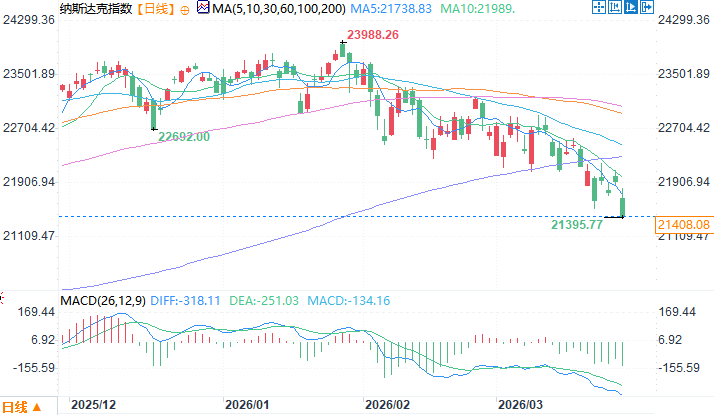
US Nasdaq daily chart source: FX678
The Nasdaq has officially entered a correction phase, while the S&P 500 experienced its largest single-day drop since the war.
According to Dow Jones Market Data, the Nasdaq fell 2.38% on Thursday, closing at 21,408.08. The S&P 500 fell 1.74%, its biggest one-day drop since the start of the Iran-Iraq War, closing at 6,477.13, its lowest level since September 3 last year, and down 7.2% from its all-time high. The Dow Jones Industrial Average was also under pressure, falling 469.38 points to close at 45,960.11, a drop of 1.01%, bringing its monthly decline to over 6%, heading towards its biggest monthly percentage drop since September 2022.
Trump abruptly announced a 10-day pause in the strikes, stating that negotiations were progressing well.
Shortly after the market closed, US President Trump announced on Truth Social that he had decided to suspend strikes against Iran's energy infrastructure for 10 days, ending at 8 p.m. Eastern Time on April 6, 2026. He stated that negotiations with Iran were progressing "very well."
However, this news failed to boost market confidence. Instead, the Wall Street Journal subsequently reported that the Pentagon was considering sending up to 10,000 additional troops to the Middle East to bolster Trump's military options. This news quickly triggered market concerns about a potential ground war, causing stock index futures to fall in after-hours trading and oil prices to recover earlier losses.
Market analysts interpret this as Trump seeking a way out of the conflict.
Michael O'Rourke, chief market strategist at Jones Trading, said he was not surprised by Trump's delay in postponing the strike plan. He pointed out that Trump has clearly been looking for a way out of the conflict this week, and further escalation would only make that goal more difficult.
He said, "Trump made it clear this week that he wants to end this conflict because he's worried about oil prices and the stock market. To me, it's not surprising that he released this message."
However, he also cautioned that the Iran issue is far from resolved. Despite Trump's insistence that negotiations are ongoing, Iranian officials have rejected related proposals. He stated that, whether or not it's called "TACO" (Trump Always Chickens Out, referring to Trump backing down under market pressure), the matter is not over and is far from resolved.
Multiple factors combined to exacerbate market concerns, with weak US Treasury auctions adding to the pressure.
On Thursday morning, the market was already under multiple pressures. A commentary from Mizuho Securities noted that a report about Iranian hardliners pushing for nuclear weapons acquisition caused the stock market to fall to its intraday low. Furthermore, a series of weak US Treasury auctions this week further exacerbated the pressure on both the bond and stock markets. The auction of $44 billion in 7-year Treasury bonds, in particular, yielded disappointing results.
As a result, the yield on 10-year U.S. Treasury bonds rose by 8.8 basis points to 4.415%, the highest level since 3 p.m. Eastern Time last July.
Sam Stovall, chief investment strategist at CFRA Research, said investors are closely watching rising oil prices and U.S. Treasury yields, while also watching for any news that could signal a solution between the U.S. and Iran. Currently, global oil benchmark Brent crude is consistently trading above $100 a barrel, and closed at around $108 a barrel on Thursday.
He said, "Everyone knows that the longer oil prices remain high, the greater the likelihood that we will fall into an economic slowdown or recession."
Gold and silver prices fell, and the fear index surged.
Gold and silver prices continued to decline on Thursday. Meanwhile, the Chicago Board Options Exchange Volatility Index (VIX), Wall Street's "fear gauge," surged above 28, marking its highest closing level since March 6.
Shares of tech giant Meta Platforms plunged nearly 8%, becoming a major drag on the Nasdaq index. The company lost two lawsuits in California and New Mexico, and was found liable for failing to protect young people using its platform.
Although the Dow Jones Industrial Average and the Russell 2000 small-cap index managed to post gains this week, the S&P 500 and Nasdaq Composite are both set to close lower for the fifth consecutive week.
"We are in a period of high geopolitical uncertainty," said Phil Neuhart, head of market and economic research at First Citizens Bank.
Overall Outlook
Trump's announcement of a 10-day pause in strikes against Iranian energy facilities failed to alleviate market concerns. On the contrary, reports of a potential Pentagon troop buildup in the Middle East and the complexity of the Iranian issue continued to put pressure on risk assets. Against the backdrop of high oil prices, rising bond yields, and geopolitical uncertainty, the US stock market will likely face significant volatility in the short term. Investors need to closely monitor the progress of subsequent diplomatic negotiations and policy signals from the Federal Reserve to determine the direction of changes in market risk appetite.
US Nasdaq daily chart source: FX678
- Risk Warning and Disclaimer
- The market involves risk, and trading may not be suitable for all investors. This article is for reference only and does not constitute personal investment advice, nor does it take into account certain users’ specific investment objectives, financial situation, or other needs. Any investment decisions made based on this information are at your own risk.