Gold Trading Alert: Amidst the ongoing conflict in the Middle East, a gold price rebound could not mask a 14% monthly drop, potentially marking a turning point in the market. Investors should be wary of three major risks.
2026-03-31 07:44:50
On Monday (March 30), spot gold rose slightly for the second consecutive trading day, up 0.36%, closing near $4,510 per ounce, after briefly touching $4,580 during the session; US gold futures rose 0.7%, settling at $4,557.50. However, despite a slight recovery in short-term risk aversion, gold has fallen more than 14% so far in March, poised to record its worst monthly performance since the 2008 financial crisis. Behind this unusual trend is a complex interplay of escalating conflict in the Middle East and macroeconomic pressures. The war has pushed up oil prices and exacerbated inflation concerns, while the Federal Reserve's cautious stance has led to a sharp adjustment in market expectations regarding the interest rate path. Investors are generally focused on whether the short-term rebound in gold can be sustained and whether it will resume its upward trend in the long term. The US February JOLTs job openings data will be released today, which investors should pay attention to. On Tuesday (March 31) in early Asian trading, spot gold fluctuated narrowly, currently trading around $4,510 per ounce.

The recent slight rebound in gold prices is mainly due to the ongoing escalation of the conflict in the Middle East. US President Trump issued a strong warning to Iran, stating that if Tehran does not open the Strait of Hormuz (a vital waterway for one-fifth of the world's oil shipments), the US will destroy Iranian power plants, oil wells, and even desalination facilities. Iran, on the other hand, insists that the US peace proposal is "unrealistic" and continues to launch missiles at Israel. The involvement of Houthi rebels and other forces in the conflict in Yemen has further amplified regional uncertainty. The war has entered its fifth week with no clear signs of a resolution, directly stimulating safe-haven buying and pushing gold prices higher in the short term.
Analysts point out that the war continues fiercely, and market focus will be on the progress of the conflict, oil prices, Treasury yields, and the US dollar index. Jim Wyckoff, senior analyst at Kitco Metals, emphasizes that this unresolved conflict continues to provide safe-haven support for gold. However, this support remains fragile. Since early March, US crude oil futures have surged by more than 50%, and the soaring energy prices have not only exacerbated global inflationary pressures but also prompted investors to reassess the Federal Reserve's interest rate path. The market initially expected the Fed to cut rates twice this year, but now interest rate futures have largely ruled out a rate cut in 2026, and even adjusted expectations for rate hikes.
Meanwhile, the dollar index continued its upward trend, rising 0.22% to around 100.50 on Monday, hitting its highest level since May 19th. As a net energy exporter, the United States has a relative advantage in the current energy crisis, further strengthening the dollar's appeal, and a stronger dollar typically puts downward pressure on dollar-denominated gold. Federal Reserve Chairman Powell stated in his speech that policy is well-positioned and that the Fed will closely monitor the impact of the war on the economy and inflation, noting that the Fed can wait and observe the specific evolution of the oil price shock. New York Fed President Williams also believes that current monetary policy is prepared to deal with uncertainty, but rising energy prices may push up inflation in the short term; however, if the war subsides, some of the impact may reverse within the year.
The bond market also reflected a subtle shift in investor sentiment. The yield on the 10-year U.S. Treasury note fell 9.6 basis points to 4.344% on Monday, marking its largest single-day drop in recent times, indicating that concerns about economic growth are beginning to outweigh inflation worries. However, on a monthly basis, yields still climbed sharply, highlighting the market's divergence in expectations for long-term interest rates. In the stock market, most major indices fell as investors weighed conflicting signals from Trump's rhetoric: optimistic hints of progress in negotiations on one hand, and strong warnings of military escalation on the other. All of this has left gold caught in a tug-of-war between safe-haven demand and expectations of macroeconomic tightening.
The impact of the Middle East conflict on gold goes far beyond a simple safe-haven logic. Historically, geopolitical crises have often boosted gold prices, but this time the situation is different. The sharp rise in oil prices and the resulting inflation concerns have led to a significant withdrawal of market bets on interest rate cuts. A high-interest-rate environment is generally unfavorable for gold, a non-interest-bearing asset, as the opportunity cost of holding it increases. At the same time, a stronger dollar and a temporary rise in government bond yields have further squeezed the upside potential for gold.
Fawad Razaqzada, market analyst at City Index and FOREX.com, points out that the $4,700-$4,750 range will be a key test level for a short-term gold rebound. If gold prices fail to break through this level effectively, the rebound is likely to gradually fade, as has happened in previous instances. While statements from Federal Reserve officials such as Powell and Williams emphasized that inflation expectations are generally stable, they also clearly stated that they will closely monitor the transmission of oil price pressures to overall price levels. If the war drags on, supply chain disruptions and rising energy costs could evolve from short-term shocks into more persistent pressures, which will test gold's safe-haven properties.
It's worth noting that gold reached a historical high in early 2026, but experienced significant volatility and even a sharp correction after the outbreak of war. This reflects the increasingly significant influence of speculative forces on gold pricing in financial markets: when oil-driven inflation expectations dominate, gold may temporarily fall out of favor even with high geopolitical risks. However, from a longer-term perspective, central bank demand for gold, global debt levels, and systemic risks still provide solid fundamental support for gold. If the conflict leads to a significant slowdown in economic growth, or even triggers recession fears, gold's appeal as the ultimate safe-haven asset may once again become apparent.
Looking ahead, gold prices are expected to initially test resistance levels through consolidation, followed by a divergence depending on the evolution of the conflict. In the short term, with continued uncertainty surrounding the war and the lack of a quick solution, safe-haven demand will continue to support gold prices. This week's upcoming US job openings, retail sales, ADP employment report, and non-farm payroll data will be the market focus. If the economic data shows resilience, coupled with high oil prices, inflation concerns may persist, limiting the upside potential for gold prices. Conversely, if the data shows signs of slowing growth, declining Treasury yields and increased safe-haven demand could push gold prices to challenge the short-term resistance level of $4700-$4750.
In the medium to long term, the price trend will be highly dependent on the course of the Middle East conflict. If the war shows substantial signs of de-escalation around the April 6th deadline set by Trump (such as the reopening of the Strait of Hormuz or the reaching of a ceasefire agreement), the decline in oil prices will alleviate inflationary pressures, and expectations of a Fed rate cut may reignite. At that time, gold may resume its upward trend, and the probability of it regaining the $5,000 level or even higher will increase significantly. However, if the conflict escalates, shipping lanes are blocked for a long period, the energy crisis deepens, US inflation rises sharply, and expectations of a Fed rate hike intensify, gold prices will face further downside risks, and may even test support below $4,000.
However, historical experience shows that in a prolonged geopolitical crisis, gold often experiences a stronger safe-haven rally after initial volatility, especially when interest rate expectations shift towards easing.
Overall, the fundamentals for a gold bull market in 2026 have not been completely destroyed. Even with the current sharp monthly decline, considering the long-term existence of geopolitical risk premiums and global macroeconomic uncertainties, gold still has a significant chance to resume its upward trend in the second half of the year, potentially targeting or even surpassing historical highs. However, this will not be a linear rise, and volatility will be significantly amplified.
Given the complex situation in the gold market, investors must not be complacent. First, geopolitical risks are highly unpredictable. Trump's tough rhetoric, Iran's firm stance, and potential further actions by forces such as the Houthis could all trigger sharp fluctuations in oil prices and safe-haven demand in a short period. Any news regarding a breakthrough in negotiations or military escalation could cause gold prices to fluctuate by more than 2-3% intraday. It is recommended to closely monitor shipping activity in the Strait of Hormuz and the Bab el-Mandeb Strait, as well as updates on the conflict released by the United Nations or relevant parties.
Secondly, uncertainty surrounding macroeconomic policies is another major concern. While Federal Reserve officials emphasize the traditional approach of "ignoring supply shocks," if oil prices remain high for an extended period, inflation expectations may become unanchored, forcing central banks to adjust their policies. This will put pressure on gold from both sides. Investors should pay close attention to this week's economic data and subsequent speeches by Federal Reserve officials, especially the latest assessments of the impact of the war by key figures such as Powell. Meanwhile, the direction of the US dollar index and US Treasury yields will directly affect the pricing logic of gold.
Third, the risk of a convergence of technical and fundamental factors cannot be ignored. Gold prices are currently in a rebound phase after a sharp monthly decline. If they fail to break through the key $4700-$4750 range, the rebound is likely to falter, and there is a possibility of retesting $4000 or even lower levels. Rapid entry and exit of speculative positions could also amplify short-term volatility. Investors are advised to adopt a phased entry strategy, strictly set stop-loss orders, and diversify their portfolios using different instruments such as gold ETFs, futures, or physical gold to avoid excessive concentration of risk.
Furthermore, the vulnerabilities of other global economies (such as the UK and the EU) warrant attention, as the impact of war on growth in these regions could indirectly spread to commodity markets, further affecting gold's performance. Overall, maintaining position flexibility and combining fundamental and technical analysis is the most prudent approach in the current environment.
The Middle East conflict has cast a shadow of uncertainty over global markets. While gold has suffered a sharp monthly decline in the short term, it has shown resilience in its rebound, supported by safe-haven demand. Future trends will depend on the pace of the conflict, the persistence of inflationary pressures, and the Federal Reserve's policy response. Under the interplay of these three forces, gold's future performance may see significant divergence: a short-term test of key resistance levels, while in the medium to long term, it may regain favor due to systemic risks. Only by remaining vigilant and conducting rational analysis can investors seize opportunities and mitigate risks at this crucial juncture for gold.
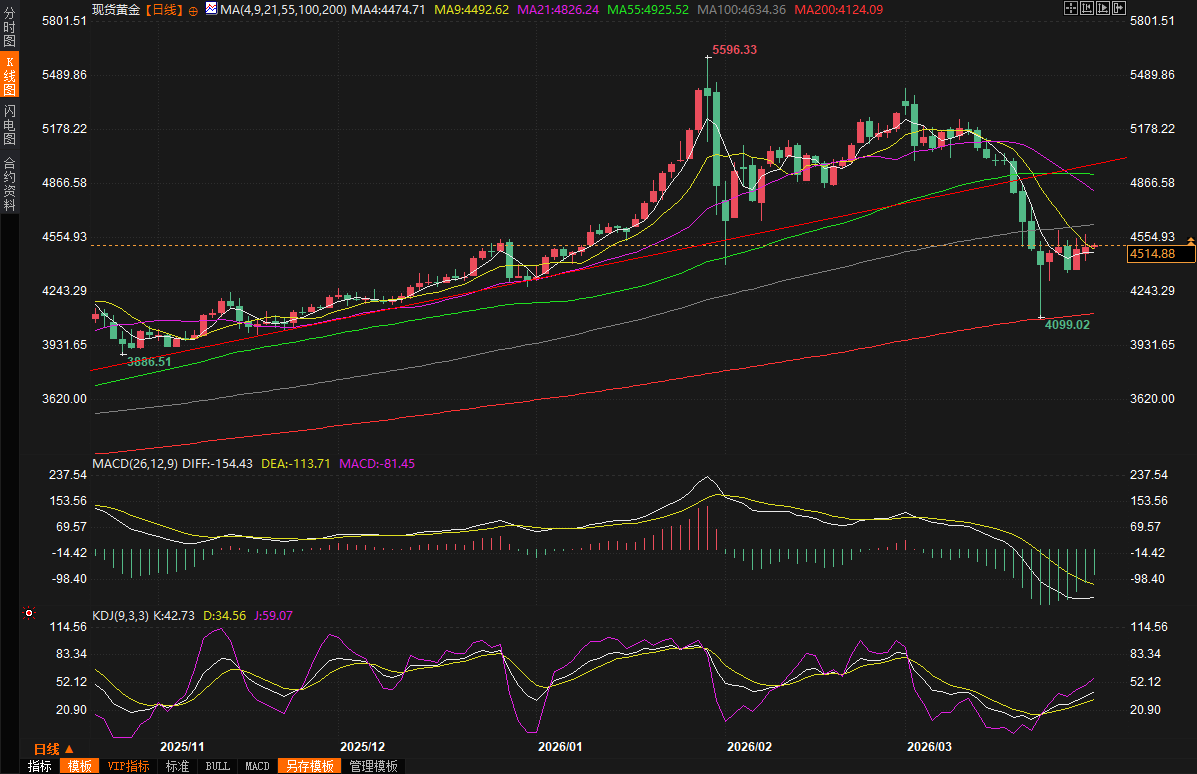
(Spot gold daily chart, source: FX678)
At 07:42 Beijing time, spot gold was trading at $4,513.07 per ounce.
The current delicate balance in the gold market: Safe-haven demand is recovering but struggling to withstand macroeconomic headwinds.
The recent slight rebound in gold prices is mainly due to the ongoing escalation of the conflict in the Middle East. US President Trump issued a strong warning to Iran, stating that if Tehran does not open the Strait of Hormuz (a vital waterway for one-fifth of the world's oil shipments), the US will destroy Iranian power plants, oil wells, and even desalination facilities. Iran, on the other hand, insists that the US peace proposal is "unrealistic" and continues to launch missiles at Israel. The involvement of Houthi rebels and other forces in the conflict in Yemen has further amplified regional uncertainty. The war has entered its fifth week with no clear signs of a resolution, directly stimulating safe-haven buying and pushing gold prices higher in the short term.
Analysts point out that the war continues fiercely, and market focus will be on the progress of the conflict, oil prices, Treasury yields, and the US dollar index. Jim Wyckoff, senior analyst at Kitco Metals, emphasizes that this unresolved conflict continues to provide safe-haven support for gold. However, this support remains fragile. Since early March, US crude oil futures have surged by more than 50%, and the soaring energy prices have not only exacerbated global inflationary pressures but also prompted investors to reassess the Federal Reserve's interest rate path. The market initially expected the Fed to cut rates twice this year, but now interest rate futures have largely ruled out a rate cut in 2026, and even adjusted expectations for rate hikes.
Meanwhile, the dollar index continued its upward trend, rising 0.22% to around 100.50 on Monday, hitting its highest level since May 19th. As a net energy exporter, the United States has a relative advantage in the current energy crisis, further strengthening the dollar's appeal, and a stronger dollar typically puts downward pressure on dollar-denominated gold. Federal Reserve Chairman Powell stated in his speech that policy is well-positioned and that the Fed will closely monitor the impact of the war on the economy and inflation, noting that the Fed can wait and observe the specific evolution of the oil price shock. New York Fed President Williams also believes that current monetary policy is prepared to deal with uncertainty, but rising energy prices may push up inflation in the short term; however, if the war subsides, some of the impact may reverse within the year.
The bond market also reflected a subtle shift in investor sentiment. The yield on the 10-year U.S. Treasury note fell 9.6 basis points to 4.344% on Monday, marking its largest single-day drop in recent times, indicating that concerns about economic growth are beginning to outweigh inflation worries. However, on a monthly basis, yields still climbed sharply, highlighting the market's divergence in expectations for long-term interest rates. In the stock market, most major indices fell as investors weighed conflicting signals from Trump's rhetoric: optimistic hints of progress in negotiations on one hand, and strong warnings of military escalation on the other. All of this has left gold caught in a tug-of-war between safe-haven demand and expectations of macroeconomic tightening.
The underlying forces driving gold prices: the triple interplay of war, inflation, and interest rates.
The impact of the Middle East conflict on gold goes far beyond a simple safe-haven logic. Historically, geopolitical crises have often boosted gold prices, but this time the situation is different. The sharp rise in oil prices and the resulting inflation concerns have led to a significant withdrawal of market bets on interest rate cuts. A high-interest-rate environment is generally unfavorable for gold, a non-interest-bearing asset, as the opportunity cost of holding it increases. At the same time, a stronger dollar and a temporary rise in government bond yields have further squeezed the upside potential for gold.
Fawad Razaqzada, market analyst at City Index and FOREX.com, points out that the $4,700-$4,750 range will be a key test level for a short-term gold rebound. If gold prices fail to break through this level effectively, the rebound is likely to gradually fade, as has happened in previous instances. While statements from Federal Reserve officials such as Powell and Williams emphasized that inflation expectations are generally stable, they also clearly stated that they will closely monitor the transmission of oil price pressures to overall price levels. If the war drags on, supply chain disruptions and rising energy costs could evolve from short-term shocks into more persistent pressures, which will test gold's safe-haven properties.
It's worth noting that gold reached a historical high in early 2026, but experienced significant volatility and even a sharp correction after the outbreak of war. This reflects the increasingly significant influence of speculative forces on gold pricing in financial markets: when oil-driven inflation expectations dominate, gold may temporarily fall out of favor even with high geopolitical risks. However, from a longer-term perspective, central bank demand for gold, global debt levels, and systemic risks still provide solid fundamental support for gold. If the conflict leads to a significant slowdown in economic growth, or even triggers recession fears, gold's appeal as the ultimate safe-haven asset may once again become apparent.
Market Outlook: Short-term fluctuations and rebounds are expected, with a potential return to an upward trend in the medium to long term.
Looking ahead, gold prices are expected to initially test resistance levels through consolidation, followed by a divergence depending on the evolution of the conflict. In the short term, with continued uncertainty surrounding the war and the lack of a quick solution, safe-haven demand will continue to support gold prices. This week's upcoming US job openings, retail sales, ADP employment report, and non-farm payroll data will be the market focus. If the economic data shows resilience, coupled with high oil prices, inflation concerns may persist, limiting the upside potential for gold prices. Conversely, if the data shows signs of slowing growth, declining Treasury yields and increased safe-haven demand could push gold prices to challenge the short-term resistance level of $4700-$4750.
In the medium to long term, the price trend will be highly dependent on the course of the Middle East conflict. If the war shows substantial signs of de-escalation around the April 6th deadline set by Trump (such as the reopening of the Strait of Hormuz or the reaching of a ceasefire agreement), the decline in oil prices will alleviate inflationary pressures, and expectations of a Fed rate cut may reignite. At that time, gold may resume its upward trend, and the probability of it regaining the $5,000 level or even higher will increase significantly. However, if the conflict escalates, shipping lanes are blocked for a long period, the energy crisis deepens, US inflation rises sharply, and expectations of a Fed rate hike intensify, gold prices will face further downside risks, and may even test support below $4,000.
However, historical experience shows that in a prolonged geopolitical crisis, gold often experiences a stronger safe-haven rally after initial volatility, especially when interest rate expectations shift towards easing.
Overall, the fundamentals for a gold bull market in 2026 have not been completely destroyed. Even with the current sharp monthly decline, considering the long-term existence of geopolitical risk premiums and global macroeconomic uncertainties, gold still has a significant chance to resume its upward trend in the second half of the year, potentially targeting or even surpassing historical highs. However, this will not be a linear rise, and volatility will be significantly amplified.
Three major risks that investors should pay close attention to and corresponding strategies
Given the complex situation in the gold market, investors must not be complacent. First, geopolitical risks are highly unpredictable. Trump's tough rhetoric, Iran's firm stance, and potential further actions by forces such as the Houthis could all trigger sharp fluctuations in oil prices and safe-haven demand in a short period. Any news regarding a breakthrough in negotiations or military escalation could cause gold prices to fluctuate by more than 2-3% intraday. It is recommended to closely monitor shipping activity in the Strait of Hormuz and the Bab el-Mandeb Strait, as well as updates on the conflict released by the United Nations or relevant parties.
Secondly, uncertainty surrounding macroeconomic policies is another major concern. While Federal Reserve officials emphasize the traditional approach of "ignoring supply shocks," if oil prices remain high for an extended period, inflation expectations may become unanchored, forcing central banks to adjust their policies. This will put pressure on gold from both sides. Investors should pay close attention to this week's economic data and subsequent speeches by Federal Reserve officials, especially the latest assessments of the impact of the war by key figures such as Powell. Meanwhile, the direction of the US dollar index and US Treasury yields will directly affect the pricing logic of gold.
Third, the risk of a convergence of technical and fundamental factors cannot be ignored. Gold prices are currently in a rebound phase after a sharp monthly decline. If they fail to break through the key $4700-$4750 range, the rebound is likely to falter, and there is a possibility of retesting $4000 or even lower levels. Rapid entry and exit of speculative positions could also amplify short-term volatility. Investors are advised to adopt a phased entry strategy, strictly set stop-loss orders, and diversify their portfolios using different instruments such as gold ETFs, futures, or physical gold to avoid excessive concentration of risk.
Furthermore, the vulnerabilities of other global economies (such as the UK and the EU) warrant attention, as the impact of war on growth in these regions could indirectly spread to commodity markets, further affecting gold's performance. Overall, maintaining position flexibility and combining fundamental and technical analysis is the most prudent approach in the current environment.
Conclusion: Gold's resilience presents both challenges and opportunities.
The Middle East conflict has cast a shadow of uncertainty over global markets. While gold has suffered a sharp monthly decline in the short term, it has shown resilience in its rebound, supported by safe-haven demand. Future trends will depend on the pace of the conflict, the persistence of inflationary pressures, and the Federal Reserve's policy response. Under the interplay of these three forces, gold's future performance may see significant divergence: a short-term test of key resistance levels, while in the medium to long term, it may regain favor due to systemic risks. Only by remaining vigilant and conducting rational analysis can investors seize opportunities and mitigate risks at this crucial juncture for gold.
(Spot gold daily chart, source: FX678)
At 07:42 Beijing time, spot gold was trading at $4,513.07 per ounce.
- Risk Warning and Disclaimer
- The market involves risk, and trading may not be suitable for all investors. This article is for reference only and does not constitute personal investment advice, nor does it take into account certain users’ specific investment objectives, financial situation, or other needs. Any investment decisions made based on this information are at your own risk.