The Middle East conflict is fueling inflation expectations, and coupled with policy uncertainty, the Reserve Bank of Australia faces the dual pressures of interest rate hikes and stagflation.
2026-03-31 16:09:53
The Reserve Bank of Australia's (RBA) meeting minutes revealed a significantly more cautious stance from policymakers regarding the future path of interest rates. The minutes stated that, given the ongoing conflict in the Middle East and the high degree of uncertainty surrounding the situation, the central bank "cannot confidently predict the future path of the cash rate." This statement reflects the greater challenges facing monetary policy decisions in a complex external environment.
From an inflation perspective, energy prices have become a key variable. The Reserve Bank of Australia estimates that if oil prices remain around US$100 , it will alone push overall inflation to approximately 5% in the second quarter, 0.75 percentage points higher than previously expected. This means that rising energy prices not only have a short-term impact but may also gradually spread to a wider range of economic sectors through cost transmission mechanisms.
Against this backdrop, most policymakers believe that further tightening of monetary policy remains necessary in the short term to address upward inflationary pressures. High oil prices coupled with rising wages may strengthen inflation stickiness, making it difficult for central banks to quickly achieve their price stability targets.
ANZ analysts said, "The combination of energy shocks and wage growth is driving structural inflation upwards, and pressure for policy tightening remains."
It is worth noting that the risk of stagflation has begun to enter the scope of policy discussions. Some officials are concerned that with persistently high inflation, economic growth may be suppressed. In particular, in an environment of continuously rising interest rates, consumption and investment activities may slow down, thereby dragging down the overall economy.
At the same time, new changes are emerging in the labor market. Recent adjustments to Australia's minimum wage have increased the salaries of approximately 500,000 young workers by up to 42% . While this measure will boost household income in the short term, it may also further increase business costs and intensify inflationary pressures. This interaction between wages and inflation adds complexity to policymaking.
From a market perspective, the current trading logic is gradually shifting from "single inflation driver" to "the game between inflation and growth." On the one hand, high oil prices are pushing inflation upward and strengthening expectations of interest rate hikes; on the other hand, the risk of stagflation limits the room for policy tightening, leading to significant disagreements in the market regarding the future path.
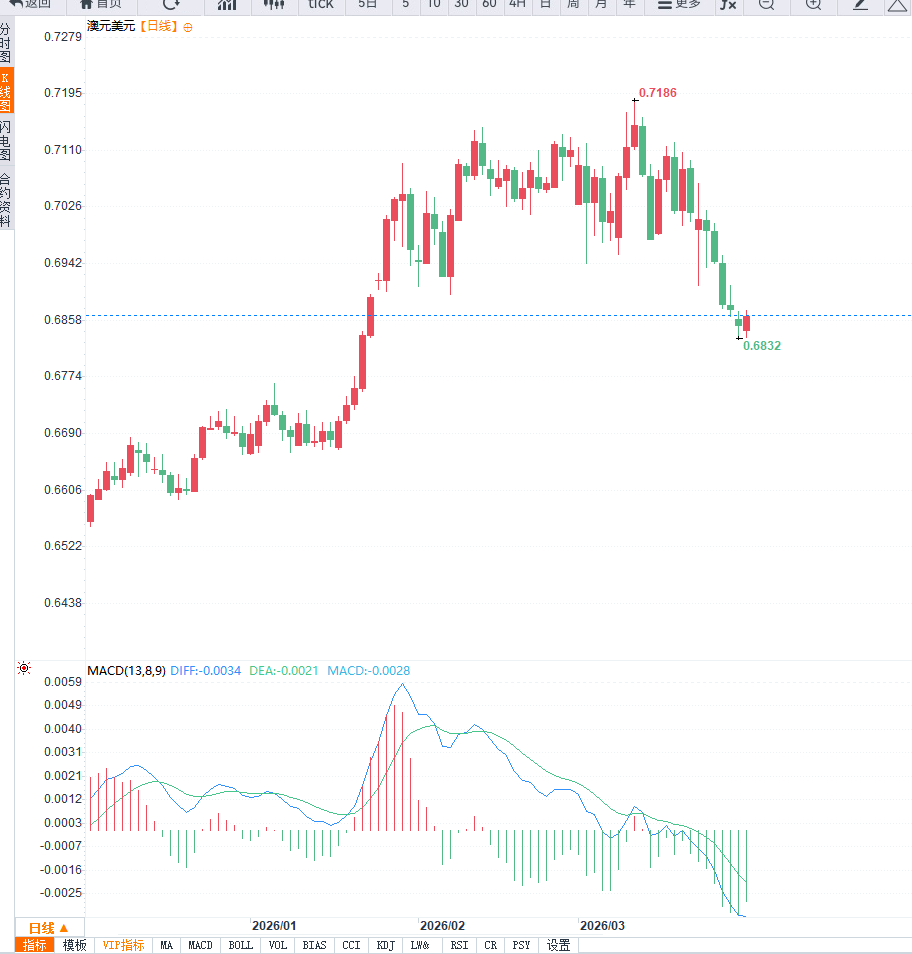
From a technical perspective, Australian dollar-related assets are generally exhibiting a volatile pattern. On the daily chart, the market has entered a consolidation phase after previous fluctuations, with the trend direction still unclear. The upside is constrained by the risk premium arising from policy uncertainty, while the downside is supported by resource prices. Looking at the 4-hour chart, price fluctuations are frequent, and momentum indicators are constantly shifting, indicating a lack of a clear short-term trend. The market is more inclined to wait for new macroeconomic drivers.
Editor's Summary : Overall, the Reserve Bank of Australia (RBA) is caught in a policy dilemma between "inflationary pressures" and "growth risks." The situation in the Middle East is pushing up energy prices, further complicating the inflation outlook, while rising wages are further strengthening price stickiness. Although most officials favor continuing to raise interest rates, the risk of stagflation is rising, which may limit policy space. Future trends will depend on changes in energy prices and economic data performance; market volatility is expected to remain high, and investors need to pay close attention to policy signals and changes in the external environment.
From an inflation perspective, energy prices have become a key variable. The Reserve Bank of Australia estimates that if oil prices remain around US$100 , it will alone push overall inflation to approximately 5% in the second quarter, 0.75 percentage points higher than previously expected. This means that rising energy prices not only have a short-term impact but may also gradually spread to a wider range of economic sectors through cost transmission mechanisms.
Against this backdrop, most policymakers believe that further tightening of monetary policy remains necessary in the short term to address upward inflationary pressures. High oil prices coupled with rising wages may strengthen inflation stickiness, making it difficult for central banks to quickly achieve their price stability targets.
ANZ analysts said, "The combination of energy shocks and wage growth is driving structural inflation upwards, and pressure for policy tightening remains."
It is worth noting that the risk of stagflation has begun to enter the scope of policy discussions. Some officials are concerned that with persistently high inflation, economic growth may be suppressed. In particular, in an environment of continuously rising interest rates, consumption and investment activities may slow down, thereby dragging down the overall economy.
At the same time, new changes are emerging in the labor market. Recent adjustments to Australia's minimum wage have increased the salaries of approximately 500,000 young workers by up to 42% . While this measure will boost household income in the short term, it may also further increase business costs and intensify inflationary pressures. This interaction between wages and inflation adds complexity to policymaking.
From a market perspective, the current trading logic is gradually shifting from "single inflation driver" to "the game between inflation and growth." On the one hand, high oil prices are pushing inflation upward and strengthening expectations of interest rate hikes; on the other hand, the risk of stagflation limits the room for policy tightening, leading to significant disagreements in the market regarding the future path.
From a technical perspective, Australian dollar-related assets are generally exhibiting a volatile pattern. On the daily chart, the market has entered a consolidation phase after previous fluctuations, with the trend direction still unclear. The upside is constrained by the risk premium arising from policy uncertainty, while the downside is supported by resource prices. Looking at the 4-hour chart, price fluctuations are frequent, and momentum indicators are constantly shifting, indicating a lack of a clear short-term trend. The market is more inclined to wait for new macroeconomic drivers.
Editor's Summary : Overall, the Reserve Bank of Australia (RBA) is caught in a policy dilemma between "inflationary pressures" and "growth risks." The situation in the Middle East is pushing up energy prices, further complicating the inflation outlook, while rising wages are further strengthening price stickiness. Although most officials favor continuing to raise interest rates, the risk of stagflation is rising, which may limit policy space. Future trends will depend on changes in energy prices and economic data performance; market volatility is expected to remain high, and investors need to pay close attention to policy signals and changes in the external environment.
- Risk Warning and Disclaimer
- The market involves risk, and trading may not be suitable for all investors. This article is for reference only and does not constitute personal investment advice, nor does it take into account certain users’ specific investment objectives, financial situation, or other needs. Any investment decisions made based on this information are at your own risk.