Risks in the Strait of Hormuz combined with a widening supply gap could push Brent crude oil prices to $150.
2026-03-31 16:15:12
The global crude oil market continues to fluctuate, driven by geopolitical conflicts and expectations of supply contraction. A recent report from Societe Generale has significantly raised its oil price outlook, noting that in an extreme scenario, Brent crude prices could rise to $150 per barrel . This forecast is based on the assumption that a two-month disruption to the Strait of Hormuz would have a significant impact on global energy supplies.
From a supply and demand perspective, the market is currently facing a significant supply gap. The agency predicts that OPEC production losses due to the conflict will reach 15 million barrels per day in March, creating a supply gap of approximately 8 million barrels per day in April. Meanwhile, Gulf countries' production is expected to decline by up to 3 million barrels per day for the whole year, while Iran's export capacity may decrease by 2 million barrels per day , further exacerbating the supply shortage.
Societe Generale's commodities team noted: "Against the backdrop of limited supply and tight inventory, oil prices may experience a sharp surge in the short term and remain at high levels."
On the demand side, although high oil prices have begun to suppress some consumption, overall demand remains resilient. Global crude oil demand is expected to gradually rise to approximately 106 million barrels per day , remaining at a high level. However, due to the limited decline in demand, it is difficult to fully offset the impact of supply contraction, and the market as a whole remains in a state of tight balance or even shortage.
Inventory levels are also a crucial factor supporting oil prices. The report shows that current inventory coverage days remain below the five-year average, meaning the market has limited buffering capacity. Further supply disruptions could lead to more volatile prices.
However, from a time perspective, this extreme surge is not a long-term trend. The agency predicts that as some OPEC production gradually recovers from May onwards, coupled with the release of strategic reserves by G7 countries and a rebound in demand from Asian countries, the market supply and demand relationship will gradually improve. Against this backdrop, oil prices may fluctuate at an average high of around $125 in April, with a risk of hitting $150 , but will subsequently gradually fall back to around $80 by the end of the year.
From a market sentiment perspective, the current trading logic has shifted from "short-term shocks" to "structural shortages." Investors are focusing on the upside risks to prices brought about by extreme events, while also assessing the dampening effect of high oil prices on demand and the possibility of policy intervention.
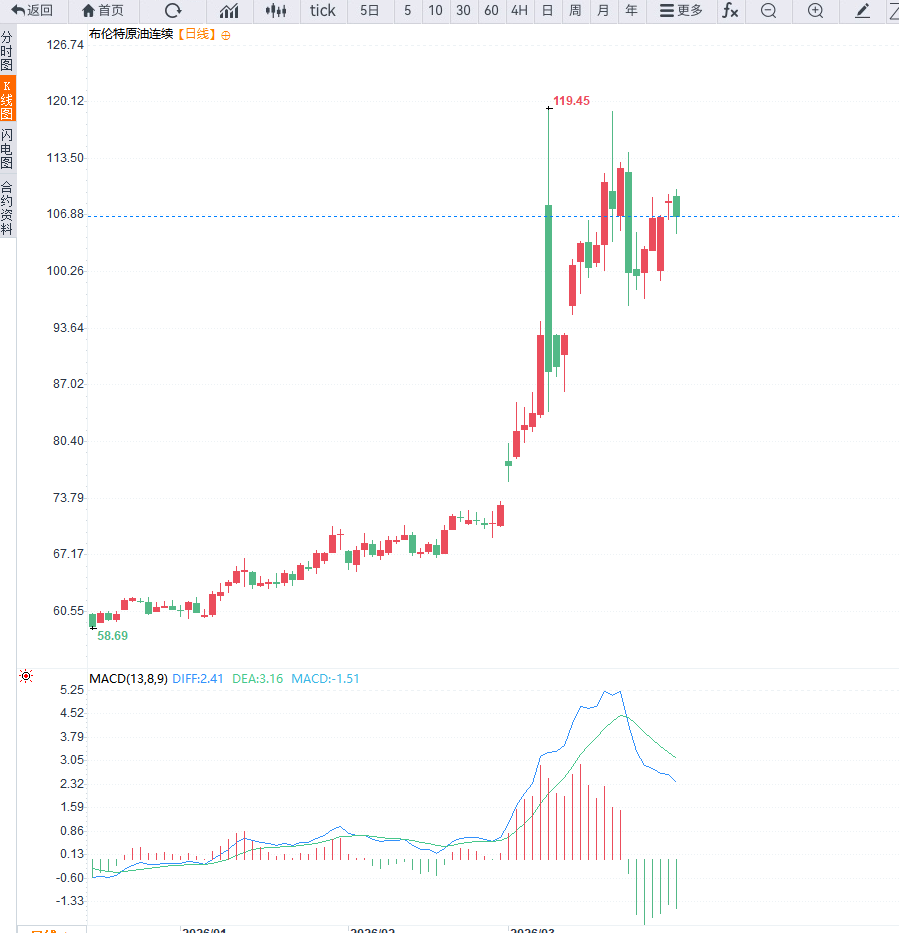
From a technical perspective, on the daily chart, Brent crude oil is generally in a strong upward trend, but after a rapid rise, momentum has begun to diverge, leading to increased price volatility. Key resistance levels to watch are $112 and $125 , while support levels are at $100 and $95 . On the 4-hour chart, prices are showing a high-level consolidation structure, with short-term momentum indicators showing signs of overbought conditions and a potential pullback, indicating a need for technical correction. If prices fall back to the key support area and stabilize, further upward movement is possible.
Editor's Summary : Overall, the crude oil market is at a critical juncture, fraught with both supply-demand mismatch and geopolitical risks. In the short term, the Strait of Hormuz risk and anticipated supply disruptions may drive oil prices significantly higher. However, in the medium to long term, as supply gradually recovers and demand adjusts, prices are likely to decline. Current market volatility is significantly increased; investors need to pay close attention to supply-demand changes and policy intervention signals in this high-risk environment, seizing opportunities while managing risks.
From a supply and demand perspective, the market is currently facing a significant supply gap. The agency predicts that OPEC production losses due to the conflict will reach 15 million barrels per day in March, creating a supply gap of approximately 8 million barrels per day in April. Meanwhile, Gulf countries' production is expected to decline by up to 3 million barrels per day for the whole year, while Iran's export capacity may decrease by 2 million barrels per day , further exacerbating the supply shortage.
Societe Generale's commodities team noted: "Against the backdrop of limited supply and tight inventory, oil prices may experience a sharp surge in the short term and remain at high levels."
On the demand side, although high oil prices have begun to suppress some consumption, overall demand remains resilient. Global crude oil demand is expected to gradually rise to approximately 106 million barrels per day , remaining at a high level. However, due to the limited decline in demand, it is difficult to fully offset the impact of supply contraction, and the market as a whole remains in a state of tight balance or even shortage.
Inventory levels are also a crucial factor supporting oil prices. The report shows that current inventory coverage days remain below the five-year average, meaning the market has limited buffering capacity. Further supply disruptions could lead to more volatile prices.
However, from a time perspective, this extreme surge is not a long-term trend. The agency predicts that as some OPEC production gradually recovers from May onwards, coupled with the release of strategic reserves by G7 countries and a rebound in demand from Asian countries, the market supply and demand relationship will gradually improve. Against this backdrop, oil prices may fluctuate at an average high of around $125 in April, with a risk of hitting $150 , but will subsequently gradually fall back to around $80 by the end of the year.
From a market sentiment perspective, the current trading logic has shifted from "short-term shocks" to "structural shortages." Investors are focusing on the upside risks to prices brought about by extreme events, while also assessing the dampening effect of high oil prices on demand and the possibility of policy intervention.
From a technical perspective, on the daily chart, Brent crude oil is generally in a strong upward trend, but after a rapid rise, momentum has begun to diverge, leading to increased price volatility. Key resistance levels to watch are $112 and $125 , while support levels are at $100 and $95 . On the 4-hour chart, prices are showing a high-level consolidation structure, with short-term momentum indicators showing signs of overbought conditions and a potential pullback, indicating a need for technical correction. If prices fall back to the key support area and stabilize, further upward movement is possible.
Editor's Summary : Overall, the crude oil market is at a critical juncture, fraught with both supply-demand mismatch and geopolitical risks. In the short term, the Strait of Hormuz risk and anticipated supply disruptions may drive oil prices significantly higher. However, in the medium to long term, as supply gradually recovers and demand adjusts, prices are likely to decline. Current market volatility is significantly increased; investors need to pay close attention to supply-demand changes and policy intervention signals in this high-risk environment, seizing opportunities while managing risks.
- Risk Warning and Disclaimer
- The market involves risk, and trading may not be suitable for all investors. This article is for reference only and does not constitute personal investment advice, nor does it take into account certain users’ specific investment objectives, financial situation, or other needs. Any investment decisions made based on this information are at your own risk.