A narrow escape from the border! Why are non-US currencies and gold collectively silent? The US dollar suffers a self-inflicted wound.
2026-03-31 21:47:02
On Tuesday (March 31), during the European and American trading sessions, the US dollar index plunged rapidly from the key level of 100.50, with a daily decline of 0.37%, and was last trading at 100.13, barely holding the psychological level of 100.
The core reason for the recent weakening of the US dollar is the rapid easing of concerns about geopolitical risks in the Middle East, leading to a significant withdrawal of safe-haven funds from dollar assets.
Meanwhile, gold did not strengthen in tandem with the dollar's plunge, suggesting that the logic of easing geopolitical concerns holds true.
According to the Wall Street Journal, citing U.S. government officials, Trump has told his staff that he is willing to end the current military action against Iran even if the Strait of Hormuz remains largely closed.
After assessment, the US concluded that forcibly opening up the shipping route would extend the conflict beyond the pre-set four to six-week timeframe. Therefore, it plans to gradually cease fire after achieving the core objective of weakening the Iranian navy and missile stockpile.
The United States will subsequently use diplomatic means to pressure Iran to restore free trade in the Straits. If diplomatic efforts are hampered, it will push for Europe and its Gulf allies to lead the reopening of the Straits. Military options are not currently a priority.
Israeli Prime Minister Benjamin Netanyahu stated that the US-Israeli military operation against Iran is more than halfway complete, with the focus shifting to Iran's enriched uranium stockpile. Trump has demanded that the relevant nuclear materials be transferred to international organizations for oversight.
However, Trump later made it clear that almost no one could actually remove Iran's uranium, implying that military means could not achieve the ultimate goal of denuclearizing Iran, and that the resolution of the dispute would depend on diplomatic negotiations.
U.S. Defense Secretary Hergace stated that the U.S. does not rule out the possibility of deploying ground troops, and that there is no fixed timeframe for the conflict; Trump went further, saying that countries can negotiate with Iran to obtain oil on their own and independently safeguard their rights in the Strait of Hormuz.
The first preliminary inflation reading for the Eurozone in March since the escalation of tensions in the Middle East showed that energy prices pushed overall inflation up to 2.5% year-on-year, exceeding the ECB's 2% target, but core inflation fell to 2.2% year-on-year, below expectations and the previous value, reflecting weak domestic demand and contracting growth momentum in the Eurozone economy.
Meanwhile, high energy costs exacerbated concerns about an economic slowdown, and the market significantly lowered its expectations for a short-term interest rate hike by the ECB, making it difficult for the euro to boost the dollar.
The UK economy also performed poorly, with GDP growing by only 0.1% quarter-on-quarter in the fourth quarter, showing signs of stagflation. The Bank of England's monetary policy is caught in a dilemma, and the pound has no basis for strengthening.
Overall, the geopolitical conflict in the Middle East has shifted from military confrontation to diplomatic negotiations, leading to a significant decline in market risk aversion and a continued waning of safe-haven buying of the US dollar.
At the same time, the weak fundamentals of major non-US currencies such as the euro and the pound sterling also ruled out the possibility of suppressing the dollar, indicating that the rapid decline in the dollar index in stages was due to its own reasons.
Meanwhile, the fact that gold has strengthened instead of weakening in tandem with the dollar further confirms that geopolitical risks are receding.
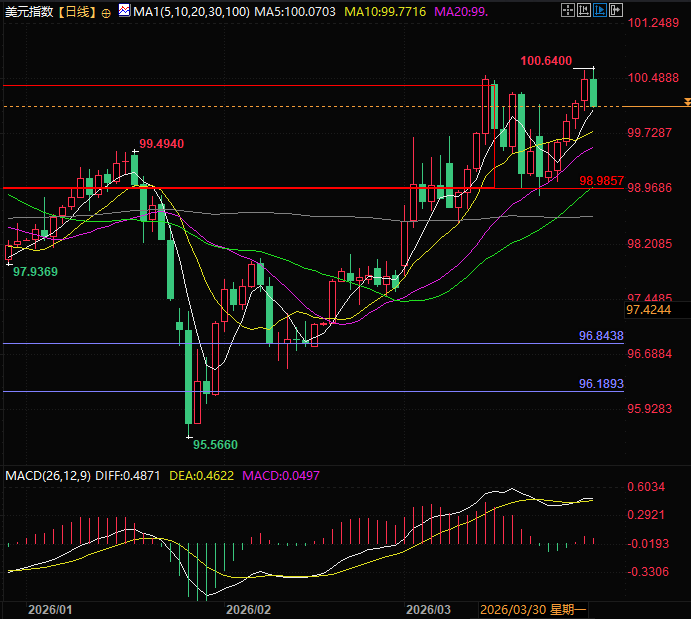
(US Dollar Index Daily Chart, Source: EasyForex)
At 21:45 Beijing time, the US dollar index is currently at 100.09.
The core reason for the recent weakening of the US dollar is the rapid easing of concerns about geopolitical risks in the Middle East, leading to a significant withdrawal of safe-haven funds from dollar assets.
Meanwhile, gold did not strengthen in tandem with the dollar's plunge, suggesting that the logic of easing geopolitical concerns holds true.
The United States plans to end its military operations in Iraq, significantly slowing the pace of the conflict.
According to the Wall Street Journal, citing U.S. government officials, Trump has told his staff that he is willing to end the current military action against Iran even if the Strait of Hormuz remains largely closed.
After assessment, the US concluded that forcibly opening up the shipping route would extend the conflict beyond the pre-set four to six-week timeframe. Therefore, it plans to gradually cease fire after achieving the core objective of weakening the Iranian navy and missile stockpile.
The United States will subsequently use diplomatic means to pressure Iran to restore free trade in the Straits. If diplomatic efforts are hampered, it will push for Europe and its Gulf allies to lead the reopening of the Straits. Military options are not currently a priority.
Trump hints that military force is insufficient to achieve Iran's denuclearization, shifting towards diplomatic negotiations.
Israeli Prime Minister Benjamin Netanyahu stated that the US-Israeli military operation against Iran is more than halfway complete, with the focus shifting to Iran's enriched uranium stockpile. Trump has demanded that the relevant nuclear materials be transferred to international organizations for oversight.
However, Trump later made it clear that almost no one could actually remove Iran's uranium, implying that military means could not achieve the ultimate goal of denuclearizing Iran, and that the resolution of the dispute would depend on diplomatic negotiations.
U.S. Defense Secretary Hergace stated that the U.S. does not rule out the possibility of deploying ground troops, and that there is no fixed timeframe for the conflict; Trump went further, saying that countries can negotiate with Iran to obtain oil on their own and independently safeguard their rights in the Strait of Hormuz.
Divergent inflation data in the Eurozone and a lack of support for the Euro and British currencies suggest that the dollar's decline is due to its own internal factors.
The first preliminary inflation reading for the Eurozone in March since the escalation of tensions in the Middle East showed that energy prices pushed overall inflation up to 2.5% year-on-year, exceeding the ECB's 2% target, but core inflation fell to 2.2% year-on-year, below expectations and the previous value, reflecting weak domestic demand and contracting growth momentum in the Eurozone economy.
Meanwhile, high energy costs exacerbated concerns about an economic slowdown, and the market significantly lowered its expectations for a short-term interest rate hike by the ECB, making it difficult for the euro to boost the dollar.
The UK economy also performed poorly, with GDP growing by only 0.1% quarter-on-quarter in the fourth quarter, showing signs of stagflation. The Bank of England's monetary policy is caught in a dilemma, and the pound has no basis for strengthening.
The retreat of safe-haven demand has become the core logic, putting short-term downward pressure on the US dollar.
Overall, the geopolitical conflict in the Middle East has shifted from military confrontation to diplomatic negotiations, leading to a significant decline in market risk aversion and a continued waning of safe-haven buying of the US dollar.
At the same time, the weak fundamentals of major non-US currencies such as the euro and the pound sterling also ruled out the possibility of suppressing the dollar, indicating that the rapid decline in the dollar index in stages was due to its own reasons.
Meanwhile, the fact that gold has strengthened instead of weakening in tandem with the dollar further confirms that geopolitical risks are receding.
(US Dollar Index Daily Chart, Source: EasyForex)
At 21:45 Beijing time, the US dollar index is currently at 100.09.
- Risk Warning and Disclaimer
- The market involves risk, and trading may not be suitable for all investors. This article is for reference only and does not constitute personal investment advice, nor does it take into account certain users’ specific investment objectives, financial situation, or other needs. Any investment decisions made based on this information are at your own risk.