Gold prices suffered their worst monthly drop in 17 years! But why is there still a chance for a turnaround?
2026-03-31 21:10:18
On Tuesday (March 31), spot gold continued to rebound during the Asian and European sessions, currently trading around 4577, up 1.5%.
Gold is experiencing its worst monthly performance since 2008. Amid the complex geopolitical situation as the US-Iran war enters its fifth week, despite a slight rebound, it is still unable to reverse the downward trend of its largest monthly drop in nearly 17 years.
The current monthly decline of 14.6% has reached its highest level since October 2008 (when the decline was 16.8%).
The recent weak rebound in gold prices is due to the continued escalation of the situation in the Middle East and a fundamental shift in market trading logic.
Recent geopolitical conflicts have erupted in multiple locations: Iran attacked a Kuwaiti oil tanker carrying crude oil in waters near Dubai and launched three volleys of missiles at Israel on Tuesday morning;
The US has been making frequent moves, with 2,500 Marines from the elite 82nd Airborne Division deployed to the Middle East. On the one hand, the US is signaling that it will terminate military strikes without reopening the Strait of Hormuz. On the other hand, Trump stated that it would be difficult for anyone to remove Iran's uranium, implying that military action can no longer achieve the goal of denuclearizing Iran and that negotiations are now necessary.
In a post on the TruthSocial platform, he stated that the US and Iran were engaged in "serious consultations," but warned that if the negotiations failed, he would attack Iranian power plants, oil wells, and Kharg Island. In other words, the deployment of troops was mainly for deterrence and intimidation, and the ultimate hope was to reach an agreement through negotiations.
Meanwhile, Spain closed its airspace to US flights involved in the military operation against Iran. US Secretary of State Rubio revealed that due to the lukewarm attitude of NATO allies towards the war with Iran, the US may reassess the value of NATO's existence. This also lays the groundwork for the US to declare victory if it can bypass the Strait of Hormuz. Multiple variables make the course of the war unpredictable.
It is worth noting that the traditional geopolitical safe-haven attribute has not provided support for gold. On the contrary, the oil and gas prices driven up by the conflict have fueled global inflation expectations, and market concerns about central banks around the world starting a new round of interest rate hikes have continued to intensify.
Wayne Natland, an investment manager at Shackleton Advisors, points out that the logic behind gold trading has undergone a fundamental shift over the past four years: before the Ukraine war, gold prices were stably negatively correlated with real government bond yields and the US dollar index;
This pattern was broken between 2025 and early 2026, with gold prices rising far beyond the historical correlation range;
After the outbreak of the Iran war, gold returned to the traditional trading framework. "Government bond yields strengthened in tandem with the US dollar, and gold exhibited classic inverse sensitivity. Coupled with the profit-taking that had accumulated at the high gold price in early 2026, the decline was further amplified."
The recent pullback in US Treasury yields has given gold a chance to breathe.
Netwealth Chief Investment Officer Ian Barnes added that gold volatility has reached twice the historical average in recent months, primarily driven by the divergence in market behavior resulting from increased participation of financial investors.
"The global central banks' efforts to diversify their reserves and move away from the dollar have initiated this round of gold bull market, but as new financial buying dries up, coupled with a rebounding dollar and increased market uncertainty, investors are taking profits, putting downward pressure on gold prices."
He also pointed out that the current market is similar to that of 2008: after the fundamentals and sentiment of the US dollar changed, "investors with excessive commodity holdings" significantly amplified price volatility. Just like during the 2008 global financial crisis, gold was sold off along with assets such as oil and copper. This year, the market has once again exposed the vulnerability of holding positions that excessively regard gold as the "last safe-haven asset".
Regarding the future market trend, Goldman Sachs maintained a constructive view in its latest report. Although it acknowledges that the risks are skewed to the downside in the short term—the continued disruption in the Strait of Hormuz could trigger further gold sell-offs—it still predicts that gold prices will reach $5,400 per ounce by the end of 2026.
Its core logic includes: the continued diversification of global central bank reserves, the gradual return of currently low speculative holdings to normalcy, and the expectation that the Federal Reserve will deliver on its 50 basis point rate cut.
In the medium to long term, if the situation in Iran resonates with other geopolitical hotspots such as Greenland and Venezuela, driving global gold purchases to accelerate and weakening confidence in the sustainability of Western fiscal policies, the upside potential for gold prices will be further unlocked.
When will expectations for interest rate cuts resurface and the narrative of a weak dollar return? When will gold continue to rise? At the same time, if the market shifts from trading stagflation to trading a global recession, gold may also have a chance to start rising subsequently. This is because economic recessions are usually accompanied by lower inflation, and central banks have to resort to measures such as interest rate cuts and easing to stimulate the economy. Recently, US Treasury yields have adjusted significantly and may rebound in the near future, putting downward pressure on gold prices.
Technically, spot gold rebounded after holding above 4426. Currently, support is at the middle channel line, while resistance is at the upper channel line and the 0.618 Fibonacci retracement level around 4700.
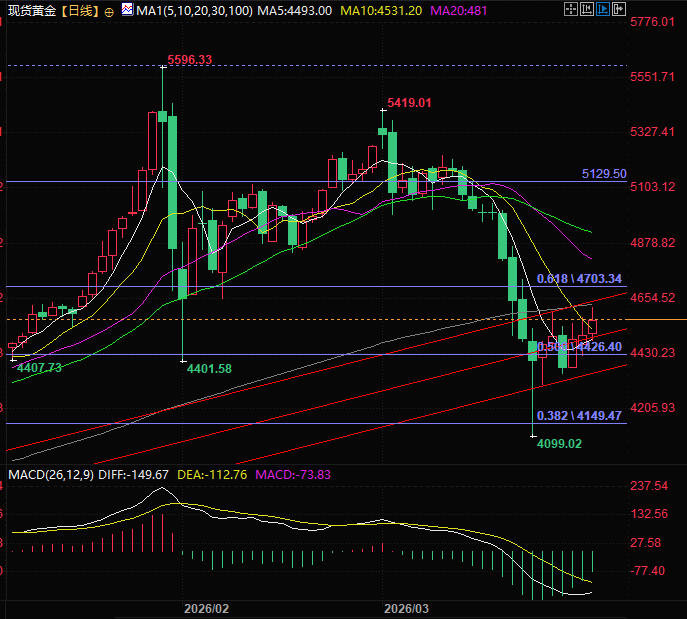
(Spot gold daily chart, source: EasyForex subsidiary)
At 21:07 Beijing time, spot gold was trading at $4571.71 per ounce.
Gold is experiencing its worst monthly performance since 2008. Amid the complex geopolitical situation as the US-Iran war enters its fifth week, despite a slight rebound, it is still unable to reverse the downward trend of its largest monthly drop in nearly 17 years.
The current monthly decline of 14.6% has reached its highest level since October 2008 (when the decline was 16.8%).
Geopolitical conflicts are escalating on multiple fronts, adding uncertainty to the US-Iran rivalry.
The recent weak rebound in gold prices is due to the continued escalation of the situation in the Middle East and a fundamental shift in market trading logic.
Recent geopolitical conflicts have erupted in multiple locations: Iran attacked a Kuwaiti oil tanker carrying crude oil in waters near Dubai and launched three volleys of missiles at Israel on Tuesday morning;
The US has been making frequent moves, with 2,500 Marines from the elite 82nd Airborne Division deployed to the Middle East. On the one hand, the US is signaling that it will terminate military strikes without reopening the Strait of Hormuz. On the other hand, Trump stated that it would be difficult for anyone to remove Iran's uranium, implying that military action can no longer achieve the goal of denuclearizing Iran and that negotiations are now necessary.
In a post on the TruthSocial platform, he stated that the US and Iran were engaged in "serious consultations," but warned that if the negotiations failed, he would attack Iranian power plants, oil wells, and Kharg Island. In other words, the deployment of troops was mainly for deterrence and intimidation, and the ultimate hope was to reach an agreement through negotiations.
Meanwhile, Spain closed its airspace to US flights involved in the military operation against Iran. US Secretary of State Rubio revealed that due to the lukewarm attitude of NATO allies towards the war with Iran, the US may reassess the value of NATO's existence. This also lays the groundwork for the US to declare victory if it can bypass the Strait of Hormuz. Multiple variables make the course of the war unpredictable.
Traditional safe-haven attributes have failed, and trading logic is reverting to a classic framework.
It is worth noting that the traditional geopolitical safe-haven attribute has not provided support for gold. On the contrary, the oil and gas prices driven up by the conflict have fueled global inflation expectations, and market concerns about central banks around the world starting a new round of interest rate hikes have continued to intensify.
Wayne Natland, an investment manager at Shackleton Advisors, points out that the logic behind gold trading has undergone a fundamental shift over the past four years: before the Ukraine war, gold prices were stably negatively correlated with real government bond yields and the US dollar index;
This pattern was broken between 2025 and early 2026, with gold prices rising far beyond the historical correlation range;
After the outbreak of the Iran war, gold returned to the traditional trading framework. "Government bond yields strengthened in tandem with the US dollar, and gold exhibited classic inverse sensitivity. Coupled with the profit-taking that had accumulated at the high gold price in early 2026, the decline was further amplified."
The recent pullback in US Treasury yields has given gold a chance to breathe.
Volatility doubles, exposing vulnerabilities in positions
Netwealth Chief Investment Officer Ian Barnes added that gold volatility has reached twice the historical average in recent months, primarily driven by the divergence in market behavior resulting from increased participation of financial investors.
"The global central banks' efforts to diversify their reserves and move away from the dollar have initiated this round of gold bull market, but as new financial buying dries up, coupled with a rebounding dollar and increased market uncertainty, investors are taking profits, putting downward pressure on gold prices."
He also pointed out that the current market is similar to that of 2008: after the fundamentals and sentiment of the US dollar changed, "investors with excessive commodity holdings" significantly amplified price volatility. Just like during the 2008 global financial crisis, gold was sold off along with assets such as oil and copper. This year, the market has once again exposed the vulnerability of holding positions that excessively regard gold as the "last safe-haven asset".
Goldman Sachs maintains a bullish outlook, with significant upside potential in the medium to long term.
Regarding the future market trend, Goldman Sachs maintained a constructive view in its latest report. Although it acknowledges that the risks are skewed to the downside in the short term—the continued disruption in the Strait of Hormuz could trigger further gold sell-offs—it still predicts that gold prices will reach $5,400 per ounce by the end of 2026.
Its core logic includes: the continued diversification of global central bank reserves, the gradual return of currently low speculative holdings to normalcy, and the expectation that the Federal Reserve will deliver on its 50 basis point rate cut.
In the medium to long term, if the situation in Iran resonates with other geopolitical hotspots such as Greenland and Venezuela, driving global gold purchases to accelerate and weakening confidence in the sustainability of Western fiscal policies, the upside potential for gold prices will be further unlocked.
Summary and Technical Analysis:
When will expectations for interest rate cuts resurface and the narrative of a weak dollar return? When will gold continue to rise? At the same time, if the market shifts from trading stagflation to trading a global recession, gold may also have a chance to start rising subsequently. This is because economic recessions are usually accompanied by lower inflation, and central banks have to resort to measures such as interest rate cuts and easing to stimulate the economy. Recently, US Treasury yields have adjusted significantly and may rebound in the near future, putting downward pressure on gold prices.
Technically, spot gold rebounded after holding above 4426. Currently, support is at the middle channel line, while resistance is at the upper channel line and the 0.618 Fibonacci retracement level around 4700.
(Spot gold daily chart, source: EasyForex subsidiary)
At 21:07 Beijing time, spot gold was trading at $4571.71 per ounce.
- Risk Warning and Disclaimer
- The market involves risk, and trading may not be suitable for all investors. This article is for reference only and does not constitute personal investment advice, nor does it take into account certain users’ specific investment objectives, financial situation, or other needs. Any investment decisions made based on this information are at your own risk.