April 2nd Financial Breakfast: Easing tensions in the Middle East boosted optimism, pushing gold prices near the $4800 mark, while oil prices fell back below $100.
2026-04-02 07:23:42
On Thursday (April 2, Beijing time) in early Asian trading, spot gold was trading around $4,800 per ounce, marking its fifth consecutive day of gains. Gold prices were primarily boosted by a weaker dollar, and cautious optimism regarding a potential easing of tensions in the Middle East also contributed to the rise. Oil prices fell by more than 1%, trading around $98.85 per barrel, after US President Trump stated that the US would soon end its war with Iran.

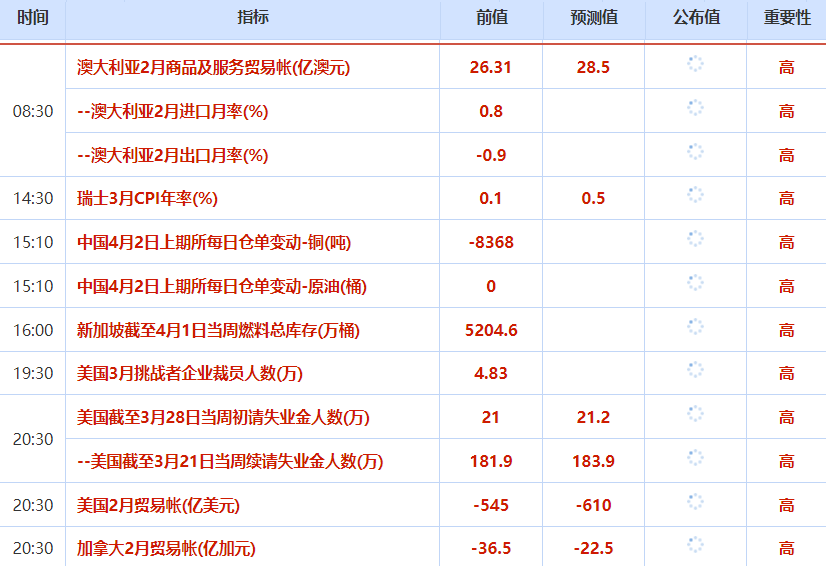
U.S. stocks closed higher on Wednesday, with all three major indexes rising. The S&P 500 rose 0.72% to 6,575.32, the Nasdaq Composite jumped 116% to 21,840.95, and the Dow Jones Industrial Average gained 0.48% to 46,565.74. This followed President Trump's suggestion that the Middle East conflict might be nearing its end, stating that the U.S. would "quickly withdraw from Iran" and could resume "targeted strikes" if necessary. The market interpreted this as a positive signal.
Trump's speech boosted Alphabet by 3.4%, and Meta and Amazon both rose by more than 1%, with other tech giants generally rising; Intel surged 8.8% after announcing it would repurchase Apollo's stake in its Irish factory for $14.2 billion; news that SpaceX had secretly filed for an IPO also boosted aerospace stocks.
A sharp drop in oil prices dragged down the energy sector by 3.9%, while airline stocks jumped 2.3%. In individual stocks, Nike plunged 15.5% to a ten-year low after unexpectedly predicting a decline in fourth-quarter sales.
Economic data showed steady growth in U.S. private sector employment in March, while retail sales in February saw their biggest increase in seven months, and manufacturing activity also picked up. Market focus now shifts to Friday's March non-farm payroll data, but U.S. markets will be closed for Good Friday. With inflation concerns mounting, traders currently believe the Federal Reserve is more likely to raise interest rates than cut them before the end of the year.
Gold prices rose for the fourth straight session on Wednesday, with spot gold closing up 2.5% at $4,784.22 an ounce and U.S. gold futures closing up 2.9% at $4,813.10, mainly driven by a second consecutive day of dollar weakness, making dollar-denominated gold more attractive to investors holding other currencies.
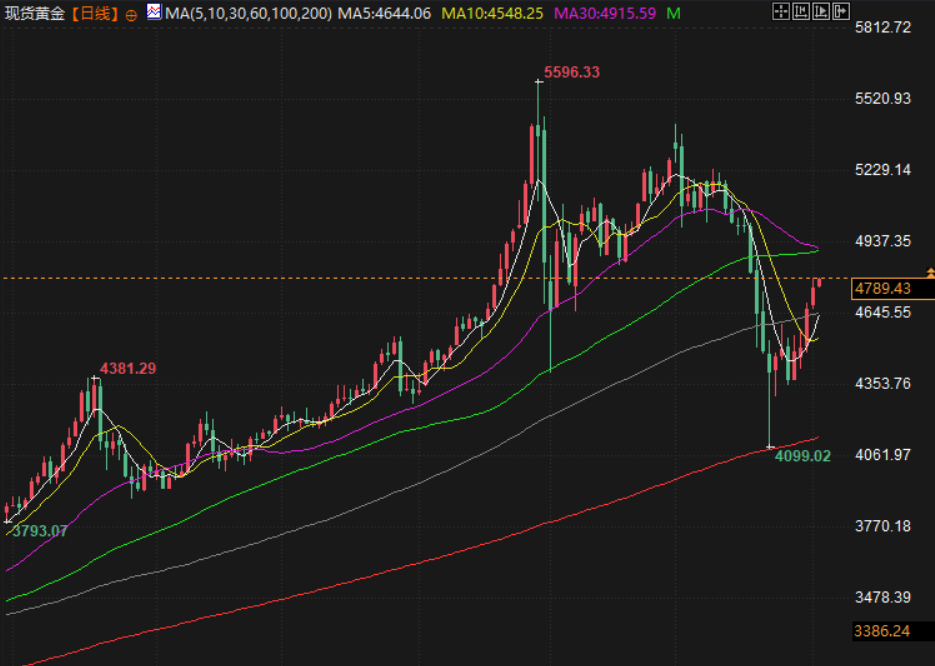
Cautious optimism in the market regarding a potential de-escalation of the Middle East situation also boosted gold prices. A senior market strategist at RJO Futures stated that if the situation de-escalates, gold prices could return above $5,000 and expectations for interest rate cuts could re-emerge. US President Trump claimed that Iran had requested a ceasefire, but the Iranian Foreign Ministry denied this claim. He plans to deliver a national address on Thursday.
On the economic data front, the ADP report showed steady growth in U.S. private sector employment in March, while strong retail sales in February were offset by high gasoline prices that may dampen future consumption. Spot silver rose 1.2% to $76.03, while platinum and palladium also gained.
Oil prices closed lower on Wednesday as President Trump said the U.S. would soon end its war with Iran. Brent crude futures fell 2.7% to $101.16 a barrel, hitting a low of $98.35 during the session, while U.S. crude futures fell about 1.2% to $100.12 a barrel, hitting a low of $96.50 during the session.
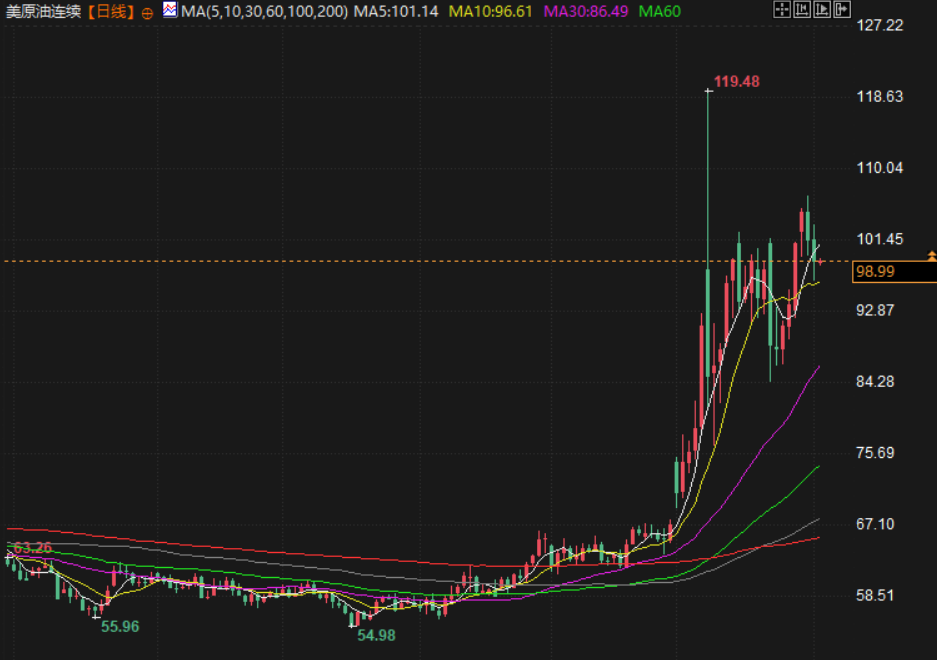
Trump stated that the US has ensured Iran will not possess nuclear weapons and is prepared to end the war "soon," and his comments on Tuesday suggesting an end to the war within two to three weeks caused oil prices to fall by more than $3 per barrel. SEB analysts pointed out that the market is betting that Trump will not allow supply disruptions to continue into the peak gasoline demand season in mid-May, as the protracted conflict poses political risks to US gasoline prices, consumer confidence, and the midterm elections.
Despite the continued contradictory signals from the US and Iran—Trump claimed Iran had requested a ceasefire, which Iran denied, and the Strait of Hormuz remains blocked—analysts predict that even with a ceasefire, energy transport volumes will struggle to recover quickly. Meanwhile, OPEC crude oil production fell by 7.5 million barrels per day in March due to the Strait closure, US crude oil inventories rose more than expected last week, and Saudi Arabia may raise its official selling price for Asian crude oil in May to a record level.
The dollar fell for a second straight session on Wednesday against major currencies such as the Swiss franc and the euro, as increasing signs of a potential ceasefire in the Middle East eased demand for safe-haven assets. President Trump's statement that the U.S. would soon end its war with Iran, scheduled for a national address on Thursday, reversed some of the previously popular safe-haven trading.
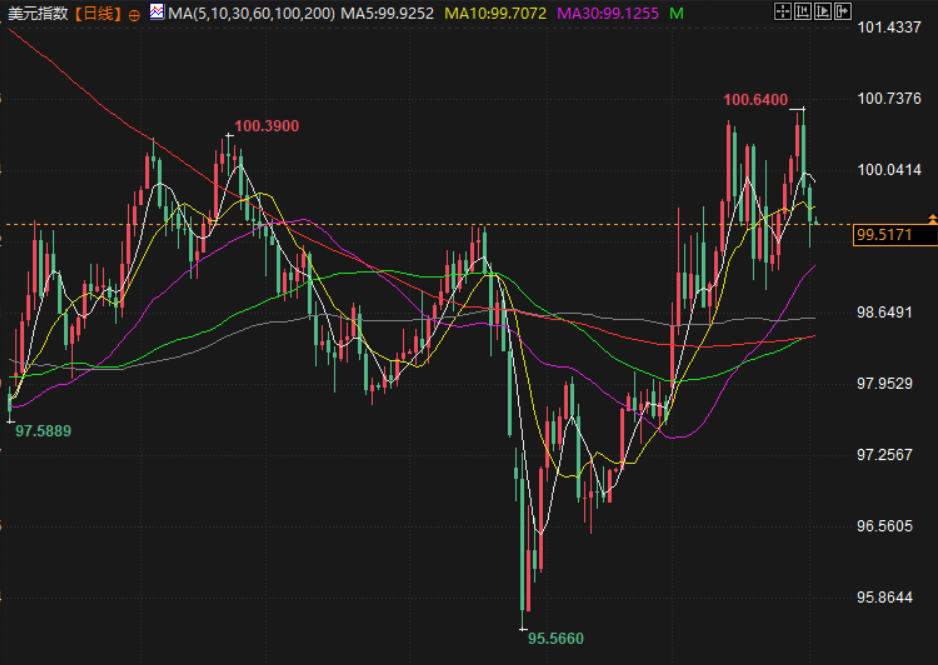
The euro rose 0.27% against the dollar to $1.1584, marking its second consecutive day of gains; the dollar fell 0.58% against the Swiss franc to 0.7947 francs; and the dollar retreated from its year-to-date high against the yen, but still rose slightly by 0.09% to 158.85 yen.
Despite ongoing attacks in various parts of the Middle East, oil prices have fallen significantly in line with expectations of a ceasefire. Market focus has shifted to Friday's US March jobs report; a sharp deterioration in the labor market could reignite expectations of a Federal Reserve rate cut this year.
Trump demands the military submit a plan to seize Iranian nuclear materials.
On April 1, local time, according to The Washington Post, two sources familiar with the matter revealed that the U.S. military has submitted a plan to President Trump aimed at seizing more than 460 kilograms of highly enriched uranium from Iran. The report stated that the plan involves airlifting excavation equipment to the site and constructing a runway to allow cargo planes to transport the nuclear material out. According to the sources, Trump had previously requested the military to submit the relevant plan, and the military briefed him on the complex plan over the past week, explaining the significant operational risks involved. The report stated that Trump's request indicates he is considering an extremely sensitive and high-risk special operations mission. (CCTV International News)
The Pentagon will double the number of A-10 attack aircraft in the Middle East.
Despite President Trump's stated desire to end the war with Iran within two to three weeks, the Pentagon is doubling the number of Air Force A-10 attack aircraft deployed in the Middle East. These aircraft provide support for ground troop advances. Two Pentagon officials said Wednesday that the Air Force will send 18 more A-10 attack aircraft, joining the approximately 12 already deployed in the region. Previously, U.S. military commanders had used these A-10s to strike Iranian ships and Iranian-backed militias in Iraq. The slow-moving A-10 Warthog is a so-called close air support aircraft, equipped with a powerful cannon in its nose capable of firing 70 rounds of 30mm ammunition per second.
Trump claims Iran is currently "incapable" of developing nuclear weapons.
On April 1, local time, US President Trump stated that he was not concerned about Iran's enriched uranium stockpile, saying that the facilities were "buried very deep." Trump said the US would continue to monitor the situation via satellite, and stated that Iran currently "lacks the capability" to develop nuclear weapons, while reiterating that the goal of preventing Iran from acquiring nuclear weapons had been achieved. (CCTV News)
Vance told the mediator that Trump had little patience left to reach a deal with Iran.
U.S. Vice President Vance, speaking through Pakistani intermediaries on Tuesday regarding the Iran conflict, told them that Trump was impatient to reach an agreement. Vance conveyed to Pakistan that Trump was open to a ceasefire if U.S. conditions, such as reopening the Strait of Hormuz, were met. Vance stated that pressure on Iran's infrastructure would increase further unless Iran agreed to a deal.
The Middle East's largest aluminum producer shuts down smelter due to Iranian attack.
Emirates Global Aluminium (EGA), the Middle East's largest aluminum producer, has suspended operations following Iranian missile and drone attacks on its Al Taweelah smelter on the outskirts of Abu Dhabi, according to sources familiar with the matter. The attacks caused a power outage, forcing the smelting facilities to shut down uncontrollably, and the metal solidified in the smelting circuit, causing significant damage to operations. Bahrain Aluminium, another major producer in the region, also confirmed that it was attacked by Iran over the weekend. These two plants are among the world's largest aluminum producers, each with a production capacity of 1.6 million tons by 2025. The Middle East accounts for approximately 9% of global supply, with EGA and other manufacturers playing a key role in supplying manufacturers in Europe, Asia, and the United States.
Iranian Foreign Ministry: Iran's Supreme Leader is in good health but his public appearance has been postponed due to the war.
According to a report by the Islamic Republic News Agency (IRNA) on April 1, Iranian Foreign Ministry spokesman Bagaei said in a media interview that Iran's Supreme Leader Mojtaba Khamenei is in good health, but his public appearances have been postponed due to the war. Bagaei told Al-Egypt Today, "He (Mojtaba) is in good health. I think it's not surprising that he may need some time before making a public appearance given the current wartime situation. But I assure you, the country, the government administration, and defense are all functioning efficiently." (Xinhua)
Trump becomes the first sitting president in U.S. history to appear before the Supreme Court.
On April 1, local time, the U.S. Supreme Court began hearings on the legality of President Trump's directive to restrict birthright citizenship. This controversial plan, linked to the Trump administration's efforts to curb immigration, would, if implemented, overturn long-held understandings of a key clause in the U.S. Constitution. Trump's attendance at the Supreme Court's oral arguments on the birthright citizenship restriction policy made him the first sitting president in U.S. history to personally appear before the Supreme Court. Demonstrators gathered outside the courthouse, some holding anti-Trump signs. According to Claire Cushman, a resident historian at the Supreme Court Historical Society, Trump is the first sitting president to appear in oral arguments before the Supreme Court. While there are precedents of 19th-century presidents appearing before the Supreme Court, they were all no longer in office at the time, including John Quincy Adams, Grover Cleveland, and Benjamin Harrison. (CCTV News)
International Energy Agency Executive Director: April oil supply deficit will be twice that of March.
International Energy Agency (IEA) Executive Director Fatih Birol said in a podcast on Wednesday that the agency is considering another emergency release of oil reserves and recommended that governments take other energy-saving measures, such as promoting working from home and lowering speed limits. "The situation in April will be much more severe than in March," Birol said on the show, hosted by Nicolai Tangen, CEO of Norgesbank Investment Management. He noted that March's oil supply was relatively eased due to shipments already en route before the Iran-Iraq War. He added, "The oil supply gap in April will be twice that of March." Last month, 32 IEA member countries, including the United States, released 400 million barrels of oil from their emergency reserves to lower crude prices, the largest reserve release in the agency's history. "We are assessing the market situation daily, even hourly," Birol said, "to decide whether to take further intervention measures."
Domestic flight fuel surcharges to be increased starting April 5
Today (April 1st), several airlines, including Air China, Xiamen Airlines, and China United Airlines, issued announcements adjusting their domestic passenger fuel surcharge standards. Xiamen Airlines' announcement stated that starting from 00:00 on April 5th, 2026, the domestic passenger fuel surcharge will be adjusted. Specifically, the surcharge for routes of 800 kilometers (inclusive) or less will increase from RMB 10 to RMB 60, and for routes over 800 kilometers, it will increase from RMB 20 to RMB 120. China United Airlines' notice indicated that the domestic passenger fuel surcharge standards are: RMB 60 per passenger for routes of 800 kilometers (inclusive) or less; and RMB 120 per passenger for routes over 800 kilometers. It is understood that fuel costs are the largest single cost expenditure in the aviation industry, accounting for 30% to 40% of an airline's total operating costs. Sources indicate that this fee increase is closely related to the recent sharp fluctuations in international oil prices. According to statistics from commodity research firm General Index, aviation kerosene, used in jet engines, has risen from nearly $800 per ton at the end of February to $1,600 per ton, a much larger increase than other petrochemical products such as gasoline, marine fuel, and naphtha. (CCTV Finance)
Key Focus Today
stock market
U.S. stocks closed higher on Wednesday, with all three major indexes rising. The S&P 500 rose 0.72% to 6,575.32, the Nasdaq Composite jumped 116% to 21,840.95, and the Dow Jones Industrial Average gained 0.48% to 46,565.74. This followed President Trump's suggestion that the Middle East conflict might be nearing its end, stating that the U.S. would "quickly withdraw from Iran" and could resume "targeted strikes" if necessary. The market interpreted this as a positive signal.
Trump's speech boosted Alphabet by 3.4%, and Meta and Amazon both rose by more than 1%, with other tech giants generally rising; Intel surged 8.8% after announcing it would repurchase Apollo's stake in its Irish factory for $14.2 billion; news that SpaceX had secretly filed for an IPO also boosted aerospace stocks.
A sharp drop in oil prices dragged down the energy sector by 3.9%, while airline stocks jumped 2.3%. In individual stocks, Nike plunged 15.5% to a ten-year low after unexpectedly predicting a decline in fourth-quarter sales.
Economic data showed steady growth in U.S. private sector employment in March, while retail sales in February saw their biggest increase in seven months, and manufacturing activity also picked up. Market focus now shifts to Friday's March non-farm payroll data, but U.S. markets will be closed for Good Friday. With inflation concerns mounting, traders currently believe the Federal Reserve is more likely to raise interest rates than cut them before the end of the year.
Gold Market
Gold prices rose for the fourth straight session on Wednesday, with spot gold closing up 2.5% at $4,784.22 an ounce and U.S. gold futures closing up 2.9% at $4,813.10, mainly driven by a second consecutive day of dollar weakness, making dollar-denominated gold more attractive to investors holding other currencies.
Cautious optimism in the market regarding a potential de-escalation of the Middle East situation also boosted gold prices. A senior market strategist at RJO Futures stated that if the situation de-escalates, gold prices could return above $5,000 and expectations for interest rate cuts could re-emerge. US President Trump claimed that Iran had requested a ceasefire, but the Iranian Foreign Ministry denied this claim. He plans to deliver a national address on Thursday.
On the economic data front, the ADP report showed steady growth in U.S. private sector employment in March, while strong retail sales in February were offset by high gasoline prices that may dampen future consumption. Spot silver rose 1.2% to $76.03, while platinum and palladium also gained.
oil market
Oil prices closed lower on Wednesday as President Trump said the U.S. would soon end its war with Iran. Brent crude futures fell 2.7% to $101.16 a barrel, hitting a low of $98.35 during the session, while U.S. crude futures fell about 1.2% to $100.12 a barrel, hitting a low of $96.50 during the session.
Trump stated that the US has ensured Iran will not possess nuclear weapons and is prepared to end the war "soon," and his comments on Tuesday suggesting an end to the war within two to three weeks caused oil prices to fall by more than $3 per barrel. SEB analysts pointed out that the market is betting that Trump will not allow supply disruptions to continue into the peak gasoline demand season in mid-May, as the protracted conflict poses political risks to US gasoline prices, consumer confidence, and the midterm elections.
Despite the continued contradictory signals from the US and Iran—Trump claimed Iran had requested a ceasefire, which Iran denied, and the Strait of Hormuz remains blocked—analysts predict that even with a ceasefire, energy transport volumes will struggle to recover quickly. Meanwhile, OPEC crude oil production fell by 7.5 million barrels per day in March due to the Strait closure, US crude oil inventories rose more than expected last week, and Saudi Arabia may raise its official selling price for Asian crude oil in May to a record level.
Foreign exchange market
The dollar fell for a second straight session on Wednesday against major currencies such as the Swiss franc and the euro, as increasing signs of a potential ceasefire in the Middle East eased demand for safe-haven assets. President Trump's statement that the U.S. would soon end its war with Iran, scheduled for a national address on Thursday, reversed some of the previously popular safe-haven trading.
The euro rose 0.27% against the dollar to $1.1584, marking its second consecutive day of gains; the dollar fell 0.58% against the Swiss franc to 0.7947 francs; and the dollar retreated from its year-to-date high against the yen, but still rose slightly by 0.09% to 158.85 yen.
Despite ongoing attacks in various parts of the Middle East, oil prices have fallen significantly in line with expectations of a ceasefire. Market focus has shifted to Friday's US March jobs report; a sharp deterioration in the labor market could reignite expectations of a Federal Reserve rate cut this year.
International News
Trump demands the military submit a plan to seize Iranian nuclear materials.
On April 1, local time, according to The Washington Post, two sources familiar with the matter revealed that the U.S. military has submitted a plan to President Trump aimed at seizing more than 460 kilograms of highly enriched uranium from Iran. The report stated that the plan involves airlifting excavation equipment to the site and constructing a runway to allow cargo planes to transport the nuclear material out. According to the sources, Trump had previously requested the military to submit the relevant plan, and the military briefed him on the complex plan over the past week, explaining the significant operational risks involved. The report stated that Trump's request indicates he is considering an extremely sensitive and high-risk special operations mission. (CCTV International News)
The Pentagon will double the number of A-10 attack aircraft in the Middle East.
Despite President Trump's stated desire to end the war with Iran within two to three weeks, the Pentagon is doubling the number of Air Force A-10 attack aircraft deployed in the Middle East. These aircraft provide support for ground troop advances. Two Pentagon officials said Wednesday that the Air Force will send 18 more A-10 attack aircraft, joining the approximately 12 already deployed in the region. Previously, U.S. military commanders had used these A-10s to strike Iranian ships and Iranian-backed militias in Iraq. The slow-moving A-10 Warthog is a so-called close air support aircraft, equipped with a powerful cannon in its nose capable of firing 70 rounds of 30mm ammunition per second.
Trump claims Iran is currently "incapable" of developing nuclear weapons.
On April 1, local time, US President Trump stated that he was not concerned about Iran's enriched uranium stockpile, saying that the facilities were "buried very deep." Trump said the US would continue to monitor the situation via satellite, and stated that Iran currently "lacks the capability" to develop nuclear weapons, while reiterating that the goal of preventing Iran from acquiring nuclear weapons had been achieved. (CCTV News)
Vance told the mediator that Trump had little patience left to reach a deal with Iran.
U.S. Vice President Vance, speaking through Pakistani intermediaries on Tuesday regarding the Iran conflict, told them that Trump was impatient to reach an agreement. Vance conveyed to Pakistan that Trump was open to a ceasefire if U.S. conditions, such as reopening the Strait of Hormuz, were met. Vance stated that pressure on Iran's infrastructure would increase further unless Iran agreed to a deal.
The Middle East's largest aluminum producer shuts down smelter due to Iranian attack.
Emirates Global Aluminium (EGA), the Middle East's largest aluminum producer, has suspended operations following Iranian missile and drone attacks on its Al Taweelah smelter on the outskirts of Abu Dhabi, according to sources familiar with the matter. The attacks caused a power outage, forcing the smelting facilities to shut down uncontrollably, and the metal solidified in the smelting circuit, causing significant damage to operations. Bahrain Aluminium, another major producer in the region, also confirmed that it was attacked by Iran over the weekend. These two plants are among the world's largest aluminum producers, each with a production capacity of 1.6 million tons by 2025. The Middle East accounts for approximately 9% of global supply, with EGA and other manufacturers playing a key role in supplying manufacturers in Europe, Asia, and the United States.
Iranian Foreign Ministry: Iran's Supreme Leader is in good health but his public appearance has been postponed due to the war.
According to a report by the Islamic Republic News Agency (IRNA) on April 1, Iranian Foreign Ministry spokesman Bagaei said in a media interview that Iran's Supreme Leader Mojtaba Khamenei is in good health, but his public appearances have been postponed due to the war. Bagaei told Al-Egypt Today, "He (Mojtaba) is in good health. I think it's not surprising that he may need some time before making a public appearance given the current wartime situation. But I assure you, the country, the government administration, and defense are all functioning efficiently." (Xinhua)
Trump becomes the first sitting president in U.S. history to appear before the Supreme Court.
On April 1, local time, the U.S. Supreme Court began hearings on the legality of President Trump's directive to restrict birthright citizenship. This controversial plan, linked to the Trump administration's efforts to curb immigration, would, if implemented, overturn long-held understandings of a key clause in the U.S. Constitution. Trump's attendance at the Supreme Court's oral arguments on the birthright citizenship restriction policy made him the first sitting president in U.S. history to personally appear before the Supreme Court. Demonstrators gathered outside the courthouse, some holding anti-Trump signs. According to Claire Cushman, a resident historian at the Supreme Court Historical Society, Trump is the first sitting president to appear in oral arguments before the Supreme Court. While there are precedents of 19th-century presidents appearing before the Supreme Court, they were all no longer in office at the time, including John Quincy Adams, Grover Cleveland, and Benjamin Harrison. (CCTV News)
International Energy Agency Executive Director: April oil supply deficit will be twice that of March.
International Energy Agency (IEA) Executive Director Fatih Birol said in a podcast on Wednesday that the agency is considering another emergency release of oil reserves and recommended that governments take other energy-saving measures, such as promoting working from home and lowering speed limits. "The situation in April will be much more severe than in March," Birol said on the show, hosted by Nicolai Tangen, CEO of Norgesbank Investment Management. He noted that March's oil supply was relatively eased due to shipments already en route before the Iran-Iraq War. He added, "The oil supply gap in April will be twice that of March." Last month, 32 IEA member countries, including the United States, released 400 million barrels of oil from their emergency reserves to lower crude prices, the largest reserve release in the agency's history. "We are assessing the market situation daily, even hourly," Birol said, "to decide whether to take further intervention measures."
Domestic News
Domestic flight fuel surcharges to be increased starting April 5
Today (April 1st), several airlines, including Air China, Xiamen Airlines, and China United Airlines, issued announcements adjusting their domestic passenger fuel surcharge standards. Xiamen Airlines' announcement stated that starting from 00:00 on April 5th, 2026, the domestic passenger fuel surcharge will be adjusted. Specifically, the surcharge for routes of 800 kilometers (inclusive) or less will increase from RMB 10 to RMB 60, and for routes over 800 kilometers, it will increase from RMB 20 to RMB 120. China United Airlines' notice indicated that the domestic passenger fuel surcharge standards are: RMB 60 per passenger for routes of 800 kilometers (inclusive) or less; and RMB 120 per passenger for routes over 800 kilometers. It is understood that fuel costs are the largest single cost expenditure in the aviation industry, accounting for 30% to 40% of an airline's total operating costs. Sources indicate that this fee increase is closely related to the recent sharp fluctuations in international oil prices. According to statistics from commodity research firm General Index, aviation kerosene, used in jet engines, has risen from nearly $800 per ton at the end of February to $1,600 per ton, a much larger increase than other petrochemical products such as gasoline, marine fuel, and naphtha. (CCTV Finance)
- Risk Warning and Disclaimer
- The market involves risk, and trading may not be suitable for all investors. This article is for reference only and does not constitute personal investment advice, nor does it take into account certain users’ specific investment objectives, financial situation, or other needs. Any investment decisions made based on this information are at your own risk.