Trump's speech disrupted geopolitical expectations, and coupled with a rebound in the US dollar, gold prices rose and then fell back.
2026-04-02 09:47:45
International gold prices have continued their recent rebound, briefly reaching around $4,775 during Asian trading hours, a new high for the period, before quickly falling back below $4,700. The main drivers of this rise were a weaker US dollar and signs of easing tensions in the Middle East, which temporarily boosted market risk appetite and reinforced a reassessment of the inflationary environment.

US President Donald Trump's latest remarks have once again unsettled market sentiment. Trump stated that Iran had requested a ceasefire, but this claim was subsequently denied, causing market divergence on the direction of the situation. Meanwhile, the Strait of Hormuz remains tense, and global energy transport faces uncertainty. These conflicting signals have caused market sentiment to repeatedly shift between "expectations of easing tensions" and "risk concerns."
At the macro level, rising energy prices have further intensified expectations of inflationary pressures. The market generally believes that higher oil prices may push up global price levels through cost transmission, thereby influencing the policy paths of major central banks. The Federal Reserve is expected to maintain interest rates at 3.50%–3.75% at its March 2026 meeting, while its dot plot indicates only one 25-basis -point rate cut is anticipated this year, with some officials even favoring no rate cuts throughout the year. This policy expectation is putting some downward pressure on gold, as its attractiveness as a non-interest-bearing asset decreases in an environment of persistently high interest rates.
Nevertheless, gold still possesses the attributes of a hedge against inflation and uncertainty. In the current environment, the market has not completely escaped risk factors, especially the uncertainties surrounding energy supply and geopolitical situations. Therefore, gold prices can still find support from bargain hunters during pullbacks, and the overall structure remains intact.
In addition, the upcoming US initial jobless claims and non-farm payroll data this week are the focus of market attention. If the employment data falls short of expectations, it could further suppress the dollar's performance, thus providing support for dollar-denominated gold. Conversely, strong data could reinforce expectations of high interest rates, putting temporary pressure on gold prices.
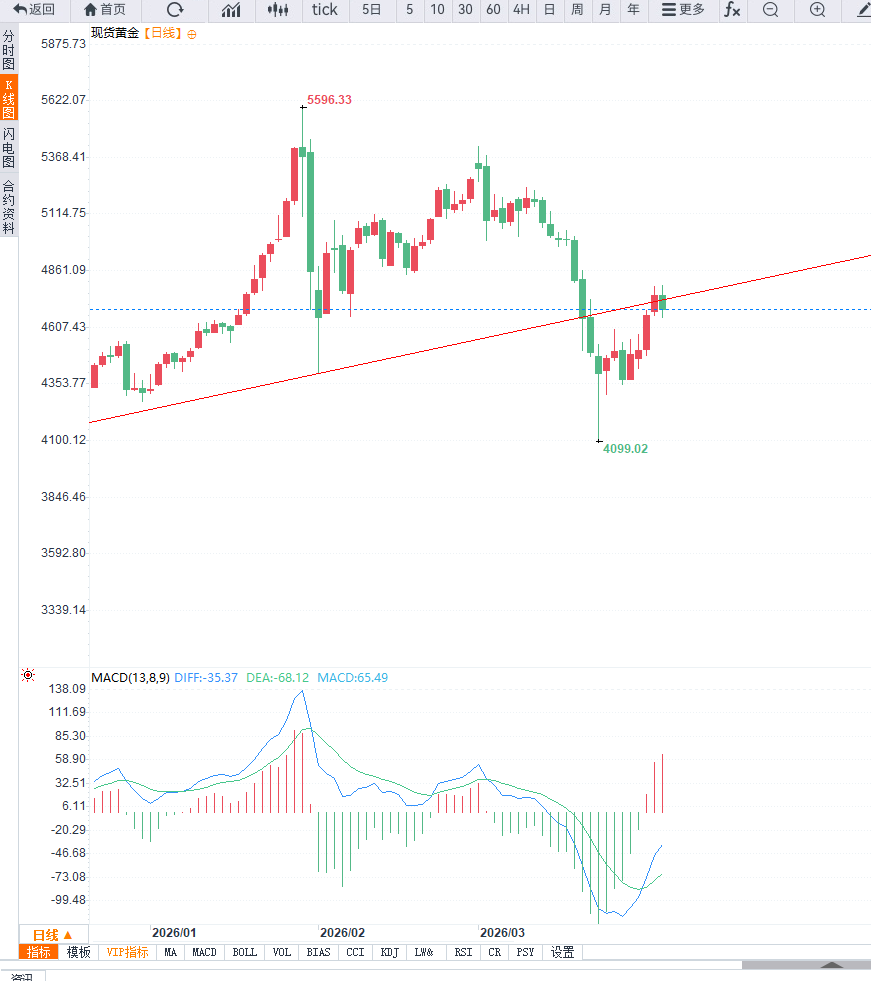
From a technical perspective, gold maintains its rebound structure on the daily chart, but it is gradually approaching a key resistance area. The current price is nearing the extension of the previous downtrend line, and technical selling pressure is beginning to emerge. The $4800 level has become a watershed between bulls and bears; a successful break above this level could open up further upside potential, while repeated failures to break through could form a temporary top. Support levels are concentrated around $4560 , an area of previous pullback lows and high trading volume; a break below this level could trigger a deeper correction. From a momentum perspective, while the daily uptrend remains intact, the slope has slowed.
On the 4-hour chart, gold prices surged briefly before experiencing a significant pullback, indicating increased selling pressure. Technical indicators are gradually returning to neutral territory, short-term momentum is weakening, and prices are more likely to fluctuate within a range. If prices fail to hold above $4800, the risk of another pullback to test support levels should be closely monitored.
Editor's Summary : The current gold market is in a phase of intertwined factors: on the one hand, a weakening dollar and inflation expectations are supporting gold prices; on the other hand, the high-interest-rate environment and geopolitical uncertainties are limiting its upside potential. Trump's remarks further amplified market sentiment volatility, making short-term trends more complex. Overall, gold has not yet formed a clear trend breakout and is expected to maintain a high-level consolidation pattern. Future trends will depend heavily on US economic data and the actual evolution of the geopolitical situation. Investors should pay close attention to breakouts at key price levels and be wary of short-term volatility risks driven by sentiment.
US President Donald Trump's latest remarks have once again unsettled market sentiment. Trump stated that Iran had requested a ceasefire, but this claim was subsequently denied, causing market divergence on the direction of the situation. Meanwhile, the Strait of Hormuz remains tense, and global energy transport faces uncertainty. These conflicting signals have caused market sentiment to repeatedly shift between "expectations of easing tensions" and "risk concerns."
At the macro level, rising energy prices have further intensified expectations of inflationary pressures. The market generally believes that higher oil prices may push up global price levels through cost transmission, thereby influencing the policy paths of major central banks. The Federal Reserve is expected to maintain interest rates at 3.50%–3.75% at its March 2026 meeting, while its dot plot indicates only one 25-basis -point rate cut is anticipated this year, with some officials even favoring no rate cuts throughout the year. This policy expectation is putting some downward pressure on gold, as its attractiveness as a non-interest-bearing asset decreases in an environment of persistently high interest rates.
Nevertheless, gold still possesses the attributes of a hedge against inflation and uncertainty. In the current environment, the market has not completely escaped risk factors, especially the uncertainties surrounding energy supply and geopolitical situations. Therefore, gold prices can still find support from bargain hunters during pullbacks, and the overall structure remains intact.
In addition, the upcoming US initial jobless claims and non-farm payroll data this week are the focus of market attention. If the employment data falls short of expectations, it could further suppress the dollar's performance, thus providing support for dollar-denominated gold. Conversely, strong data could reinforce expectations of high interest rates, putting temporary pressure on gold prices.
From a technical perspective, gold maintains its rebound structure on the daily chart, but it is gradually approaching a key resistance area. The current price is nearing the extension of the previous downtrend line, and technical selling pressure is beginning to emerge. The $4800 level has become a watershed between bulls and bears; a successful break above this level could open up further upside potential, while repeated failures to break through could form a temporary top. Support levels are concentrated around $4560 , an area of previous pullback lows and high trading volume; a break below this level could trigger a deeper correction. From a momentum perspective, while the daily uptrend remains intact, the slope has slowed.
On the 4-hour chart, gold prices surged briefly before experiencing a significant pullback, indicating increased selling pressure. Technical indicators are gradually returning to neutral territory, short-term momentum is weakening, and prices are more likely to fluctuate within a range. If prices fail to hold above $4800, the risk of another pullback to test support levels should be closely monitored.
Editor's Summary : The current gold market is in a phase of intertwined factors: on the one hand, a weakening dollar and inflation expectations are supporting gold prices; on the other hand, the high-interest-rate environment and geopolitical uncertainties are limiting its upside potential. Trump's remarks further amplified market sentiment volatility, making short-term trends more complex. Overall, gold has not yet formed a clear trend breakout and is expected to maintain a high-level consolidation pattern. Future trends will depend heavily on US economic data and the actual evolution of the geopolitical situation. Investors should pay close attention to breakouts at key price levels and be wary of short-term volatility risks driven by sentiment.
- Risk Warning and Disclaimer
- The market involves risk, and trading may not be suitable for all investors. This article is for reference only and does not constitute personal investment advice, nor does it take into account certain users’ specific investment objectives, financial situation, or other needs. Any investment decisions made based on this information are at your own risk.