Trump's threat to send Iran back to the Stone Age has brought the Strait of Hormuz agreement to global attention, causing oil prices to surge.
2026-04-03 10:44:28
US President Trump has recently made several strong statements, vowing to launch a more forceful military strike against Iran, a stance that has rapidly escalated tensions in the Middle East. Meanwhile, dozens of countries are urgently discussing how to restore key energy transport through the Strait of Hormuz, while Iran has proposed a new passage agreement and warned of broader retaliatory actions.
The escalation of the conflict not only caused a sharp rise in Brent crude oil prices, but also triggered a significant correction in global stock markets, further increasing the burden on consumers.
In a speech on Wednesday evening (April 1), Trump made it clear that he would launch an extremely fierce attack on Iran within the next two to three weeks.
In his speech, he stated, "We will send them back to the Stone Age." This statement, which did not provide a specific timetable for ending hostilities, instead provoked strong threats of retaliation from Tehran.
Trump continued to post on social media on Thursday, saying "It's time for Iran to make a deal before it's too late," and released footage that appeared to show an attack on an Iranian bridge, further exacerbating market concerns about a protracted conflict.
On Thursday, about 40 countries participated in a UK-hosted online meeting focusing on how to restore freedom of navigation in the Strait of Hormuz. Participants agreed that all countries should have free access to this crucial waterway, but ultimately failed to reach any concrete agreement.
This effort reflects the international community’s serious concern about disruptions to global energy transport, as the Strait of Hormuz carries about 20% of the world’s maritime oil shipments, and a continued blockade would have a huge impact on the world’s energy market.
In response to the current situation, Iran stated that it is discussing an agreement with Oman regarding the Strait of Hormuz.
According to Iran's state news agency, Iranian Deputy Foreign Minister Kazem Gharibabadi stated, "These requirements are not intended to restrict, but rather to facilitate and ensure safe passage, and to provide better service to ships traveling through this route." The agreement envisions ships requiring permits to pass.
An Iranian military spokesman warned on Thursday that the strait would remain closed to the United States and Israel for a “long time.”
Iranian Armed Forces Central Command spokesman Ebrahim Zolfaqari stated that the war will continue until the enemy experiences "permanent remorse and surrender." Iran also listed several bridges in Saudi Arabia, Kuwait, Abu Dhabi, and Jordan as potential military targets, following an airstrike on a bridge within Iranian territory. The Islamic Revolutionary Guard Corps stated that it has already struck steel and aluminum facilities in Gulf states with US ties, as well as an Oracle data center in Dubai, and indicated it will escalate such strikes should Iranian industrial facilities be attacked again.
EU High Representative for Foreign Affairs and Security Policy Kaja Kallas responded by writing on social media platform X: "International law does not recognize the concept of paid passage." This statement clearly opposes the idea of Iran charging countries "tolls" to allow ships to pass.
Iranian state media reported that an airstrike on a bridge connecting Tehran and the western city of Karaj killed eight people and injured 95. Several major steel producers and the Iranian Pasteur Institute of Medical Research in Tehran also suffered severe damage.
These events further highlight the destructive nature of conflict and exacerbate regional tensions.
Trump's tough stance and Iran's threats of retaliation directly drove a sharp rise in oil prices. Brent crude surged 8.68% on Thursday, settling at $109.02 a barrel, a significant increase from previous levels. This move was primarily driven by market concerns about the continued blockade of the Strait of Hormuz. A disruption to the strait would reduce global oil supply by millions of barrels per day, a situation that would be difficult to fully compensate for in the short term through other pipelines or reserves.
In the longer term, if the conflict cannot be de-escalated quickly and the agreement between Iran and Oman fails to effectively restore shipping, Brent crude oil prices could further break through $110, and even approach $120 in the event of continued disruption. This would not only directly push up global gasoline, diesel, and jet fuel prices, but would also affect multiple sectors such as food, manufacturing, and transportation through cost transmission, exacerbating global inflationary pressures. Meanwhile, the stock market's sensitive reaction to geopolitical risks has already led to a correction in major stock indices, indicating that investors are preparing for rising energy costs and economic uncertainty.
Overall, the sustainability of this round of oil price increases is highly dependent on the progress of the opening of the Strait of Hormuz and the outcome of negotiations among the parties. If the strait remains closed for an extended period, the situation of "higher and longer" energy prices will significantly drag down global economic growth; conversely, if substantial progress is made in negotiations among multiple countries, oil prices may see some correction. However, the current situation indicates that the energy market will remain highly volatile in the short term.
In conclusion , the escalating threats between Trump and Iran have brought shipping security in the Strait of Hormuz to the forefront of global attention. While dozens of countries are actively seeking solutions, Iran's proposed new agreement and continued military threats present significant obstacles to restoring normal energy transport. This conflict is not only testing regional stability but is also profoundly impacting global energy markets and economic prospects.
Whether the parties can resolve the crisis through diplomatic efforts remains to be seen.
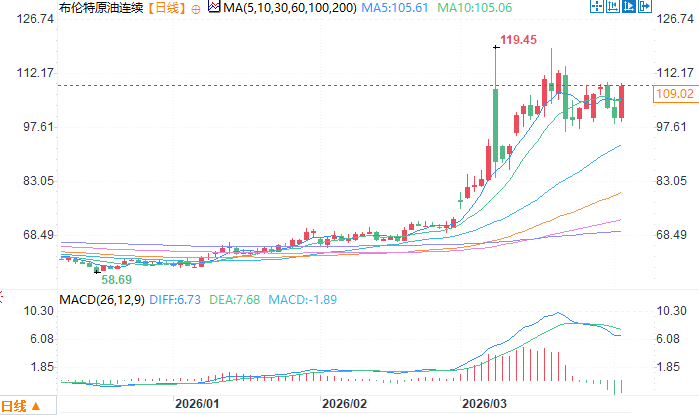
Brent crude oil daily chart source: EasyForex
Brent crude oil closed at $109.02 per barrel on April 2nd.
The escalation of the conflict not only caused a sharp rise in Brent crude oil prices, but also triggered a significant correction in global stock markets, further increasing the burden on consumers.
Trump escalates threats with no timetable set for military action.
In a speech on Wednesday evening (April 1), Trump made it clear that he would launch an extremely fierce attack on Iran within the next two to three weeks.
In his speech, he stated, "We will send them back to the Stone Age." This statement, which did not provide a specific timetable for ending hostilities, instead provoked strong threats of retaliation from Tehran.
Trump continued to post on social media on Thursday, saying "It's time for Iran to make a deal before it's too late," and released footage that appeared to show an attack on an Iranian bridge, further exacerbating market concerns about a protracted conflict.
Several countries held emergency consultations to resume shipping across the strait, but no concrete agreement was reached.
On Thursday, about 40 countries participated in a UK-hosted online meeting focusing on how to restore freedom of navigation in the Strait of Hormuz. Participants agreed that all countries should have free access to this crucial waterway, but ultimately failed to reach any concrete agreement.
This effort reflects the international community’s serious concern about disruptions to global energy transport, as the Strait of Hormuz carries about 20% of the world’s maritime oil shipments, and a continued blockade would have a huge impact on the world’s energy market.
Iran proposes new transit agreement and issues strong warnings of retaliation.
In response to the current situation, Iran stated that it is discussing an agreement with Oman regarding the Strait of Hormuz.
According to Iran's state news agency, Iranian Deputy Foreign Minister Kazem Gharibabadi stated, "These requirements are not intended to restrict, but rather to facilitate and ensure safe passage, and to provide better service to ships traveling through this route." The agreement envisions ships requiring permits to pass.
An Iranian military spokesman warned on Thursday that the strait would remain closed to the United States and Israel for a “long time.”
Iranian Armed Forces Central Command spokesman Ebrahim Zolfaqari stated that the war will continue until the enemy experiences "permanent remorse and surrender." Iran also listed several bridges in Saudi Arabia, Kuwait, Abu Dhabi, and Jordan as potential military targets, following an airstrike on a bridge within Iranian territory. The Islamic Revolutionary Guard Corps stated that it has already struck steel and aluminum facilities in Gulf states with US ties, as well as an Oracle data center in Dubai, and indicated it will escalate such strikes should Iranian industrial facilities be attacked again.
EU High Representative for Foreign Affairs and Security Policy Kaja Kallas responded by writing on social media platform X: "International law does not recognize the concept of paid passage." This statement clearly opposes the idea of Iran charging countries "tolls" to allow ships to pass.
The conflict has resulted in casualties and severe damage to facilities.
Iranian state media reported that an airstrike on a bridge connecting Tehran and the western city of Karaj killed eight people and injured 95. Several major steel producers and the Iranian Pasteur Institute of Medical Research in Tehran also suffered severe damage.
These events further highlight the destructive nature of conflict and exacerbate regional tensions.
Analysis of the impact on oil prices
Trump's tough stance and Iran's threats of retaliation directly drove a sharp rise in oil prices. Brent crude surged 8.68% on Thursday, settling at $109.02 a barrel, a significant increase from previous levels. This move was primarily driven by market concerns about the continued blockade of the Strait of Hormuz. A disruption to the strait would reduce global oil supply by millions of barrels per day, a situation that would be difficult to fully compensate for in the short term through other pipelines or reserves.
In the longer term, if the conflict cannot be de-escalated quickly and the agreement between Iran and Oman fails to effectively restore shipping, Brent crude oil prices could further break through $110, and even approach $120 in the event of continued disruption. This would not only directly push up global gasoline, diesel, and jet fuel prices, but would also affect multiple sectors such as food, manufacturing, and transportation through cost transmission, exacerbating global inflationary pressures. Meanwhile, the stock market's sensitive reaction to geopolitical risks has already led to a correction in major stock indices, indicating that investors are preparing for rising energy costs and economic uncertainty.
Overall, the sustainability of this round of oil price increases is highly dependent on the progress of the opening of the Strait of Hormuz and the outcome of negotiations among the parties. If the strait remains closed for an extended period, the situation of "higher and longer" energy prices will significantly drag down global economic growth; conversely, if substantial progress is made in negotiations among multiple countries, oil prices may see some correction. However, the current situation indicates that the energy market will remain highly volatile in the short term.
In conclusion , the escalating threats between Trump and Iran have brought shipping security in the Strait of Hormuz to the forefront of global attention. While dozens of countries are actively seeking solutions, Iran's proposed new agreement and continued military threats present significant obstacles to restoring normal energy transport. This conflict is not only testing regional stability but is also profoundly impacting global energy markets and economic prospects.
Whether the parties can resolve the crisis through diplomatic efforts remains to be seen.
Brent crude oil daily chart source: EasyForex
Brent crude oil closed at $109.02 per barrel on April 2nd.
- Risk Warning and Disclaimer
- The market involves risk, and trading may not be suitable for all investors. This article is for reference only and does not constitute personal investment advice, nor does it take into account certain users’ specific investment objectives, financial situation, or other needs. Any investment decisions made based on this information are at your own risk.